Today in History: September 18

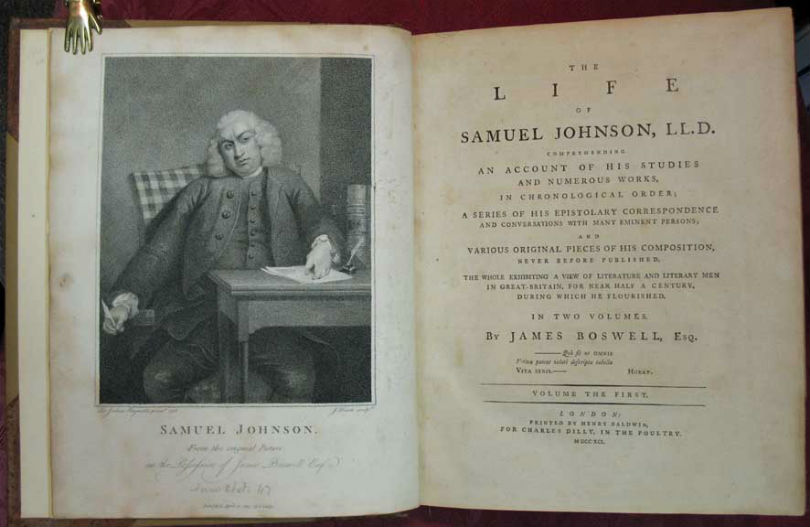
“He that hopes to look back hereafter with satisfaction upon past years must learn to know the present value of single minutes, and endeavor to let no particle of time fall useless to the ground.”—Samuel Johnson, Rambler 108, March 30, 1751

Samuel Johnson was born on this date in 1709 in Lichfield, England.

Dr. Johnson was 41 in March 1751, when he wrote the above quote, and he was several years into his work on his most lasting project, his Dictionary. Unlike most of the dictionaries developed for any language, and all dictionaries in English, Johnson’s A Dictionary of the English Language was written by one man. An entire dictionary, with more than 40,000 word entries and over 100,000 literary quotations to back up and explain Johnson’s definitions and create an etymology (the study of the origin of words). It took Johnson nine years to complete it; 75 years later, Noah Webster published his own dictionary, which had 70,000 entries, took 25 years to complete, and cites Johnson’s work throughout. The first completed edition of the Oxford English Dictionary took 75 years and dozens of scholars to compile its first edition, published in 1928. Johnson worked alone.
Read More
Today in History: September 17

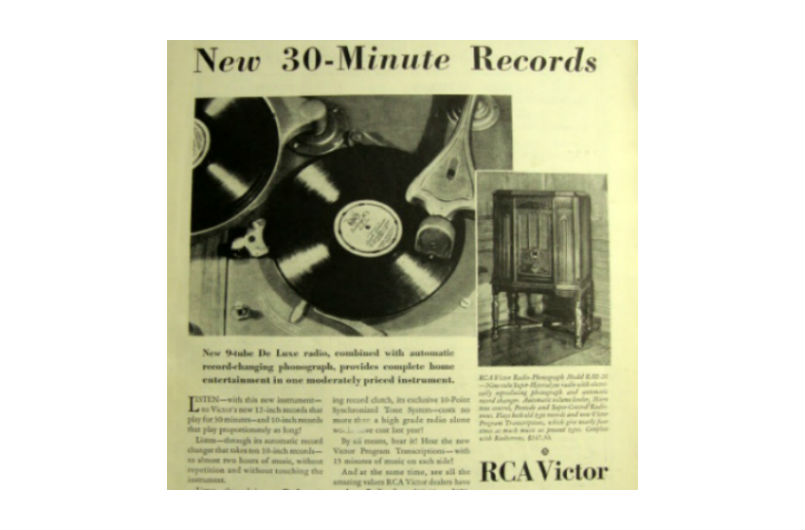
RCA Victor introduced the long-playing record, the 33 1⁄3 rpm, 12-inch, record on this date in 1931. It was the first record that could play up to fifteen minutes on a side.

Because classical music seemed to be the only appropriate music for the new format, the first recording that the company offered (under the catalog number of Victor L-7001) was a brand-new recording of Beethoven’s Fifth Symphony performed by the Philadelphia Orchestra conducted by Leopold Stowkowski. The orchestra was recorded with new equipment designed especially for recordings to be played on the new LP phonographs, which were to be outfitted with the company’s own chrome-plated steel needle, the “Chromium Orange,” when playing the new LPs.

The orchestra was recorded in August; 85 years ago today, these recordings were released (click to play):

1931 Beethoven Symphony no 5 movement 1
 
1931 Beethoven Symphony no 5 movement 2
 
1931 Beethoven Symphony no 5 movements 3 & 4

Read More

Today in History: September 16

Asked if he had any plans as he turned 100, the old man joked, “I may go on forever. Statistics say that very few men die after the age of 100.” The old man was Amos Alonzo Stagg, and when he died in 1965 at 102, he was a somewhat forgotten figure in sports history in part because he created so many things that do not seem to us as things a person would have had to dream up. Weren’t these things always so? … He did not invent the game of football, but “all football comes from Stagg,” Knute Rockne once said.

Amos Alonzo Stagg retired as kicking coach for a junior college in Stockton, California, on this date in 1960. He was 98 years old and had been a football coach continuously since 1890. (He is seen on the cover of Time from 1958.) Almost every play formation and tactic that one may associate with football—including the huddle, the end-around play, the forward pass, the lateral pass, and even shoulder pads and pads on the goalpost legs—was an innovation Stagg developed himself or had a hand in developing in his seven decades, most of them as a head coach, and most of them as the head coach at the University of Chicago. He was the first coach to put numbers on uniforms.
Read More