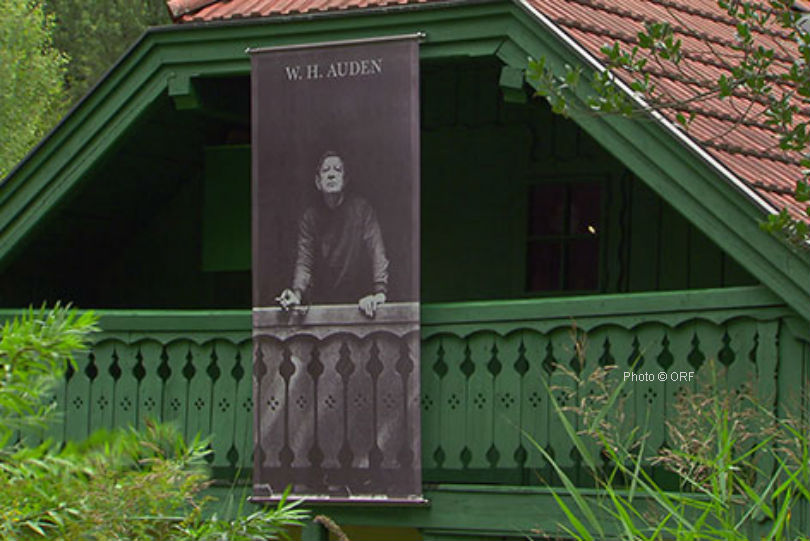
Auden at Home

In About the House, published in 1965, W. H. Auden gives readers a tour of his home in Kirchstetten, Austria. Each of the twelve poems in the section titled “Thanksgiving for a Habitat,” bears a dedication to an individual, one of Auden’s friends.

(“Down There,” about the cellar, is dedicated to Irving Weiss, and “Up There,” about the attic, is dedicated to Anne Weiss. Irving Weiss taught in the English Department of SUNY New Paltz and retired in 1985, before I was a student in that department, but he was still around when I was there. Anne was his wife. For me, “Auden dedicated a poem to him” may as well have been the caption under his face each time I saw Professor Weiss. He is still alive, 94 years old, and a profile of him in a recent Long Island newspaper does not mention any of the above.)

Back to Auden’s home (pictured in a recent photo at top with a poster bringing the master back to the porch outside his upstairs study):
Read More

Memories of the Future

In his Confessions, St. Augustine writes, “What then is time? If no one asks me, I know; if I wish to explain it to one that asks, I know not.” He decides that time is an idea, unique to humans, and also unique in that we can simultaneously grasp the past in memory, the present by attention, and the future by expectation. In our minds, but only there, we are not locked to one perception of one reality.

Earlier, I deleted everything that I had written up to that point by dragging my unbuttoned shirtsleeve across my laptop’s touchpad while reaching for my coffee. (No, I can not replicate the results in an experiment; yes, like an idiot, I have attempted to replicate these results in an experiment.) In a feat of memory, I retyped all that I had written to that point: simultaneously, I remembered what I had written, was super-present and typed it attentively in the moment, and I lived in expectation of a future in which I regularly saved my work, a lesson I first learned, oh, 20 years ago.

I was in three specific time-experiences at once, and each one sucked.
Read More

Harassment & Free Speech

The essayist who wrote this in 2012:

We are all by now accustomed to the periodic whinging of public figures after another round of drive-by shootings on Twitter. But the problem isn’t restricted to those who put themselves on a public platform. Just take a look at how people are talking to each other as well. Frankly, it’s terrifying, and it occurs to me that one of the great challenges of the next decade will be how we, as a society, manage those people unable to manage themselves.

… was banned “permanently” from posting on Twitter this week. A spokesman for Twitter told an interviewer for Buzzfeed, “People should be able to express diverse opinions and beliefs on Twitter, but no one deserves to be subjected to targeted abuse online, and our rules prohibit inciting or engaging in the targeted abuse or harassment of others.”

The author of the essay quoted above, titled, “The Internet Is Turning Us All Into Sociopaths,” is one Milo Yiannopoulos, who seems to have decided that his article was more useful to him as a point-by-point, how-to-become-a-sociopath expository essay instead of a complaint against sociopathy. In the subsequent four years, he became famous as an Internet sociopath, celebrated as an “alt-Right wing” hero of some sort, a keyboard bully who never had the balls to say what he wrote to anyone’s face and yet wore a bulletproof vest for show as if he had even one time spoken truth to power.
Read More