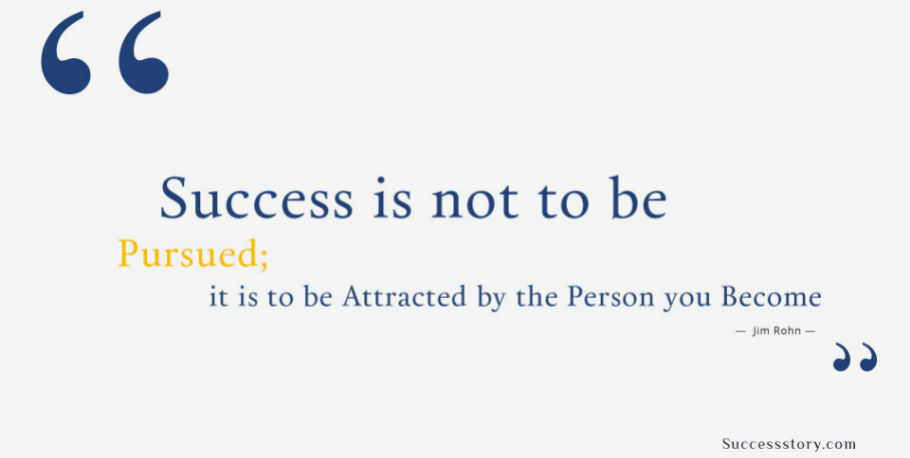
How to Be a Successful Success

A Bronze level “Jim Rohn 1-Year Success Plan” is $179, a Silver is $299, and a Gold is $499. A subscription to Success Magazine, a Jim Rohn publication, is about $35 for a year. Who was Jim Rohn?

Rohn was one of a long line of American entrepreneurs who sold plans and strategies for success and achievement and leadership in one’s field, whatever that may be. If you are a fan of Tony Robbins, you are a fan of Jim Rohn by extension. According to Robbins, Rohn was one of his mentors, and he got his start selling plans like the ones cited above. (I am agnostic on the topic of self-betterment entrepreneurs, but I am a believer in the grace and beauty of getting to know oneself, which is something that all successfulness sellers sell.)

Rohn died in 2009 at age 79 and left behind a self-improvement business empire. He also left us with many quotes, such as, “You are the average of the five people you spend the most time with.” And, “Don’t wish it were easier; wish you were better. Don’t wish for less problems; wish for more skills. Don’t wish for less challenges; wish for more wisdom.” And, “Don’t join an easy crowd. You won’t grow. Go where the expectations and the demands to perform and achieve are high.” And, “Success is what you attract by the person you become.” And last, “The ultimate expression of life is not a paycheck. The ultimate expression of life is not a Mercedes. The ultimate expression of life is not a million dollars or a bank account or a home. The ultimate expression of life is living a good life.” (Apparently Rohn was a big believer in the rule of three.)
Read More

What’s Your Problem?

No one who asks the question, “What’s your problem?” is expressing an invitation to join them in the quest for a solution. It is a statement costumed as a question. In linguistics, this sort of accusation-posing-as-question/concern is known by a linguistic term that I have not researched. “Accusation-posing-as-question,” or APAQ works for me, though.

It is aggressively passive-aggressive almost approximately one-hundred percent of the time that it is uttered. The person speaking the non-rhetorical non-question is profoundly certain of one thing, is philosophically sure of this: That they are not now doing, nor have they just been doing, nor were they about to do, something that falls in the range between perplexing to annoying to criminal.
Read More

‘Day by day’: Rare Disease Day 2015

“Day-by-day, hand-in-hand.” Today, February 28, is International Rare Disease Day, and “Day by day, hand in hand” is this year’s slogan. As slogans go, “#TheDress” might have received more attention today, but tomorrow the world will not remember this week’s Twitter trends and millions of people will still be living day by day with rare diseases.

Rare Disease Day was first established in 2008 by EURODIS, the European Rare Disease Organization. In 2009, the National Organization for Rare Disorders (NORD) in the United States joined the effort to educate the public. This year’s theme is “Living with a Rare Disease.” Some rare diseases are life-shortening, and even kill in infancy. All of them are life-altering.

Once upon a time, rare diseases were called “orphan diseases,” and, really, neither term alone quite conveys the concept. One rare disease may affect only a few individuals, making it something that is rarely seen; diseases and conditions that affect just a few people are sometimes viewed as research dead ends, “orphans” in drug and treatment research. The medical industry wants to aid the greatest number of people, and research money is hard to win for research into a condition that affects only a few thousand individuals.

Rare is not so rare, however. There are about 6000 rare diseases that are officially recognized as such; since each one affects (by definition) fewer than but up to 200,000 people per condition, some researchers estimate that 300 million people around the globe have a rare disease. That is about one in 25 people on the planet.

If you visit a restaurant tonight or go see a movie, a couple of us with a rare disease are hanging out with you. Hello.
Read More