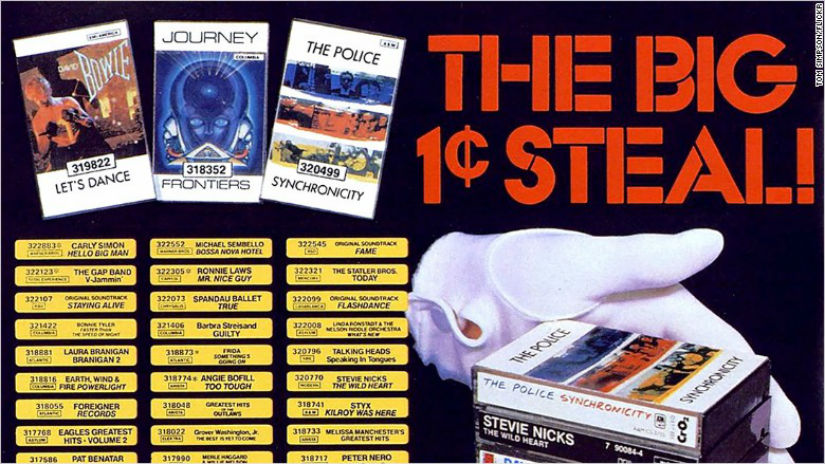
If I Send in a Penny, Can That Save Columbia House?

If I still had access to the storage unit—which I do not not, because rental companies enjoy it when one pays rent regularly, and I did not, so they auctioned the contents many years ago—if I still had access to that unit, I might be able to help out Columbia House.

The company that owns Columbia House, something called Pride Tree Holdings, Inc., announced today that it would be selling off what remains of the former music retailer at bankruptcy auction because it owns assets worth $2 million while it owes more than $63 million. (Pride Tree’s website is cheerfully ominous: it features a photo of an enormous, top-heavy, tree, a paragraph about the company, and a “Contact Us” button. And that is it.)

In that storage unit of memory there sit probably 100 CDs purchased from Columbia House for, oh, not a dime. Not even a thought of sending money, at least not a penny more than the penny I affixed to the cardboard order form I sent in every so often when I wanted to plump up my music collection.
Read More
Windows Wishes: Some Windows 10 Solutions

Last week, I installed the Windows 10 upgrade/update and wrote about it here and here. That second column, “Windows 10: Really Good, Horrible, or Both,” received more comments and suggestions than almost any other.

If it is not the most commented-on piece on this entire website, it is certainly the most commented-on piece from that day about Windows 10 and written by me.

I think I am ready to deliver a verdict.
Read More

No Mystery

We are speaking of the summer of 1976, when I was a seven-year-old hidden from myself, a summer I remember for being the Bicentennial, for being sunny every single day, and for the work of Leslie McFarlane, who around that time had published a book revealing he was the author of my favorite books. That book landed with a thud that did not reverberate into my world: as far as I was concerned, “Franklin W. Dixon” and not Leslie McFarlane was my favorite writer, and The Hardy Boys were the older brothers I did not have.

Books 1 through 22 of The Hardy Boys series were written between 1927 and 1947 by a Canadian writer who was desperate for income, Leslie McFarlane, and even though Grosset & Dunlap only paid him $85 per book with no royalties, he discovered that this was $85 per book that he could count on as long as he kept typing. He wrote the first eight in just over two years, just as the Great Depression was consuming all it could.
Read More