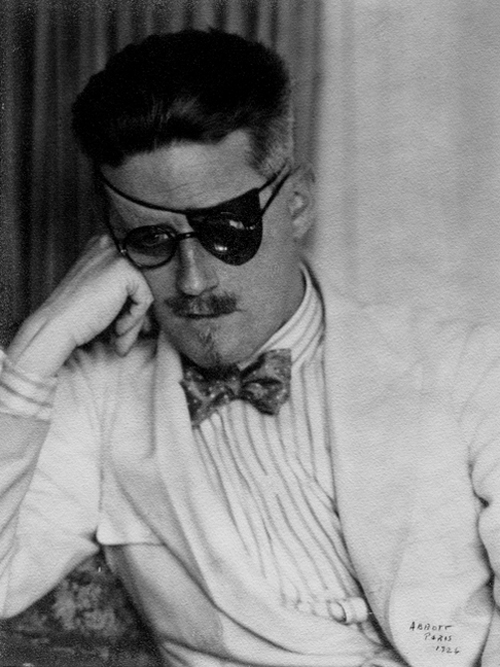
James Joyce, A Portrait of the Artist, Sitting

For most of 1928, James Joyce’s attention was unequally divided among many projects and complications: He was keeping a wary watch over German and French translations of “Ulysses,” his 1922 novel; readying sections of his next novel, which was still officially titled “Work in Progress” (published as “Finnegan’s Wake” years later, in 1939); defending “Work in Progress” from negative reviews and letters from friends who were urging him to quit his experimental writing; explaining to his patrons when new sections of “Work in Progress” could be expected so that he could have an income; and losing his eyesight.

He was 46 years old, living in Paris with his partner, Nora, and their two children, and life was complicated. He was engaged in writing the novel that became “Finnegan’s Wake,” and his artistic ambition for it and its effect on him were both unsparing. “Ulysses” tells a story of a single day, June 16, 1904, in a particular place, Dublin, using as many types of storytelling and modes of rhetoric as he could use. Joyce intended “Work in Progress” to do the same thing but for the idea of nighttime; it is entirely inside the sleeping and dreaming mind of some unknown person, and it is written in a sort of pidgin English animated by puns.

His letters to his patrons tended to obscure matters even further and made it more challenging to continue funding his project. In one 1927 letter to his most important supporter, Harriet Shaw Weaver, he wrote something with “the intention of enlightenment,” as his biographer Richard Ellmann cheerfully puts it, but what he sent read:

I am making an engine with only one wheel. No spokes, of course. The wheel is a perfect square. You see what I’m driving at, don’t you? I am awfully solemn about it, mind you, so you must not think it is a silly story about the mooks and the grapes. No, it’s a wheel, I tell the world. And it’s all square. (Ellmann, 597)

Weaver tried to get in the spirit of his constant riddling and urged him to square the wheel, a suggestion for which he thanked her but further explained that he was doing something different than that. By 1928, financially and artistically discouraged, he declared to one friend

Critics who were most appreciative of “Ulysses” are complaining about my new work. They cannot understand it. Therefore they say it is meaningless. Now if it were meaningless it could be written quickly, without thought, without pains, without erudition; but I assure you that these twenty pages now before us cost me twelve hundred hours and an enormous expense of spirit.” (Ellmann, 598)

Thus, Weaver traveled from London to Paris in 1928 to see for herself how things were going, on the occasion of Joyce’s 46th birthday. The visit reassured both parties and later that year he received word of an advance payment from two American publishers.

This is the James Joyce captured in Berenice Abbott’s famous portrait of the artist: At rest and a bit more confident in his world. The left lens in his eyeglasses is shaded, evidence of the ongoing battle to save his sight. It is one of the two or three most famous photos of the author, the one fondly parodied on the album cover for “If I Should Fall From Grace with God”:
Pogues

james-joyceAbbott was an American who became more famous in later years for her portraits of New York City during the Great Depression. She spent the decade of the 1920s learning her craft, working with the photographer Man Ray, and opened her own studio in 1927. She had photographed Joyce before, in 1926, and that photo session saw the author wearing an eye patch after surgery (and a soul patch under his lower lip):


joyce sans hatJoyce apparently liked sitting for Abbott, as there are several other photos from the 1928 session, without the stylish fedora and cane, but obviously from the same session, as he is wearing the same striped necktie. I think the one at left captures Joyce with more feeling; perhaps without the protection the hat and cane afforded him he let his guard down. The iconic photo of an iconic literary figure is followed by a photo of a weary, but not wary, momentarily confident, 46-year-old artist.

* * * *
James Joyce died 74 years ago today, January 13, 1941.

____________________________________________
The WordPress Daily Prompt for January 13 asks, “Pick a random word and do Google image search on it. Check out the eleventh picture it brings up. Write about whatever that image brings to mind.” When one searches Google Images for images of the great author, the famous Berenice Abbott photo, the one at the top of this column, is number 11.

* * * *
Please subscribe to The Gad About Town on Facebook: http://www.facebook.com/thegadabouttown
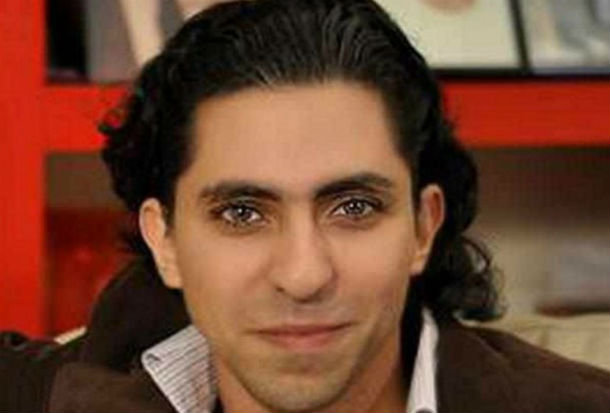
For Raif Badawi

A young journalist and activist has been in jail since 2012 for the crime of insulting his country’s official religion. Sadly, that sentence can be written about dozens, perhaps hundreds, of writers worldwide, but only one writer—one writer that we know about—was publicly flogged this weekend.

This was the very same weekend that government leaders from around the world joined a million-person anti-terrorism march in Paris. The march was the emotional punctuation mark that concluded a sad stretch of days in that city. Days earlier, a group of mass murderers who were deluded into thinking that murder is a religious act massacred the staff of an irreverent humor magazine and killed two police officers, one of whom nominally shared the religion of the killers. The killers and the police officer only shared a religion in name, as the killers believed in murder as an act of faith and the police officer did not.

Raif Badawi is the name of the journalist, and he has been living in a Kafka-esque dreamscape of religion-as-part-of-state-bureaucracy since 2008. In May of last year, he was sentenced to ten years in prison and 1000 lashes, which are to be meted out in sets of 50 lashes each Friday for 20 weeks. For over a year, his sentence has been publicly changed multiple times between six years and 600 lashes and ten years/1000 lashes while his case bounced between a higher court and a lower court in his country’s legal system.

His country is Saudi Arabia, and as a citizen of the United States, I am aware that I have no say in the legal system or traditions of another country’s bureaucracy; I can only write this column to implore my government to at least say something to one of its allies in the name of a fellow writer and the freedom of ideas. I have written in the past about things I do not like about my country, its use of capital punishment, for instance, and I vote my conscience on these issues, In another country, I might have been arrested for expressing my views, but it has not happened here.

Amnesty International, Reporters without Borders, the Committee to Protect Journalists, Human Rights Watch, PEN International, and many other organizations have taken up Badawi’s cause, possibly in part because of its clear-cut blatancy: A man is being publicly flogged because he is a writer and has expressed ideas his government would rather he not.

A brief sketch of his journey so far: In 2008, he set up a website, a blog named “Saudi Arabian Liberals,” and he was arrested, questioned, and released. He was then charged with insulting Islam, left the country, was told the charges were being dropped, returned home, and then was blocked from leaving the country again, which is never an indication of good things to come. The web site continued, and he was arrested again in 2012 when a religious leader said that his website “infringes on religious values” and proved that he is an apostate, or one who renounces his religion. Apostasy carries with it a sentence of death, and that legal question—is Raif Badawi an apostate or not?—is what has kept his case bouncing between courts in Jeddah, Saudi Arabia. A lower court declared that it did not have the authority to decide and referred the case to a higher court which decided that the lower court could indeed decide if Badawi is an apostate.

He was cleared of the apostasy charge, which freed the courts to sentence him for the charges he was found guilty of from pretty much the moment he was arrested in 2012: insulting the faith and “going beyond the realm of obedience.” Ten years in prison, 1000 lashes, and a one million riyal fine. And his lawyer, Waleed Abu al-Khair , was arrested and found guilty of setting up a human rights monitor organization, which landed him a 15-year jail sentence.

On Friday, Amnesty International published an in-person account of that day’s flogging:

When the worshipers saw the police van outside the mosque, they knew someone would be flogged today.

They gathered in a circle. Passers-by joined them and the crowd grew. But no one knew why the man brought forward was about to be punished. Is he a killer, they asked? A criminal? Does he not pray?

Raif Badawi had been brought to the square in front of al-Jafali mosque in Jeddah just after midday. There was a huge security presence–not just accompanying Raif but also in the streets and around the mosque. Some roads had also been closed.

Raif was escorted from a bus and placed in the middle of the crowd, guarded by eight or nine officers. He was handcuffed and shackled but his face was not covered – everyone could see his face.

Still shackled, Raif stood up in the middle of the crowd. He was dressed in a pair of trousers and a shirt.

A security officer approached him from behind with a huge cane and started beating him.

Raif raised his head towards the sky, closing his eyes and arching his back. He was silent, but you could tell from his face and his body that he was in real pain.

The officer beat Raif on his back and legs, counting the lashes until they reached 50.

The punishment took about 5 minutes. It was very quick, with no break in between lashes.

When it was over, the crowd shouted, “Allah-hu Akbar! Allah-hu Akbar!”–as if Raif had been purified.

Raif was taken away in the bus, back to prison. The whole scene had lasted less than half an hour.

A brief cellphone video was made public, and it shows that the punishment is almost as much “a ritualized public humiliation as a specifically physical punishment (though it is certainly that),” as Nick Gillespie of Reason put it. The video is brief, and I hesitated to include it because it is disturbing and because if you go to YouTube to view it, people who comment on YouTube videos can be astonishingly disgusting.

 
The juxtaposition of a nation publicly flogging a prisoner of conscience and that country sending an envoy to Sunday’s anti-terror march was not lost on one journalist, who Tweeted almost two dozen similar examples of irony:

The Washington Post’s editorial page on Saturday pointed out that those who are outraged have limits on what we can do, since:

The Obama administration briefly on Thursday called on Saudi Arabia to cancel the flogging of Mr. Badawi. On Friday the kingdom ignored the plea and carried out the first of the 50 whippings. So much for strong language from the State Department. It had no impact because it came with no consequences.

The editorial suggested an international investigation into Saudi Arabia’s human rights record, which sounds as toothless as anything that will never happen would sound.

But that is the reality: The U.S. government raised its voice to slightly above a whisper on behalf of one man (not a U.S. citizen) in a different country’s bureaucracy and … crickets. Which is the same non-response our government would give (and gives) if that country formally and diplomatically complained about anything in our system of jurisprudence here.

All I can do as one person, one writer is this: Share the story and some web sites with readers in the hope that someone else will also use their writing voice, their platform. The Committee to Protect Journalists reports that last year some 200 reporters were jailed around the world. Many of these reporters are electronic media writers, also known as bloggers, like you and me.

Amnesty International’s Raif Badawi page.

PEN International’s Press Release about Raif Badawi.

My only hope is that someday Raif Badawi will be able to read the many columns out there like this one and, true to his calling, point out that there are a lot of other reporters around the world who need columns like this one written, marches organized, and petitions circulated about their stories.

____________________________________________
The WordPress Daily Prompt for January 12 asks, “Picture the one person in the world you really wish were reading your blog. Write her or him a letter.”

* * * *
Please subscribe to The Gad About Town on Facebook: http://www.facebook.com/thegadabouttown

Anger, Nothing But Ed Anger

The greatest newspaper—ever!—is and was the Weekly World News. Its presence next to every grocery store checkout lane is thoroughly missed by every non-Bat Boy walking among us.

Most American boys who grew up in the 1970s and ’80s, and by most, I mean me, made this progression in our reading: from Cracked magazine, which quickly revealed itself to be a weak imitation of Mad magazine, to Mad magazine, which was brilliant but I (we) stopped looking at it around age 14, through a wasteland of our teen years and the New York Times and homework—heck, the Times and all newspapers everywhere just feel like permanent homework, don’t they? AmIRight?—to the discovery that the Weekly World News existed.

It is a three-word title and only one of those three words is correct: Weekly. Is this terrible? No. That is a .333 average and a career batting average like that would result in the hitter being elected to the Hall of Fame. So, weekly, yes. World? A printing press in central Florida certainly is on the globe. But “world” is an exaggeration. News? Well, upon finishing every article I would say out loud, “It’s news to me.”

An alien named P’lod regularly visited the White House and advised presidents Clinton and Bush? News to me. Where is CNN? Someone call somebody. There’s a boy abused by his own shadow? That’s a heartbreaking slice of life story. (An admission: When I was young, my own shadow was faster than me, too. It was only when lights were behind me, but still.) Bat Boy? You can’t make this stuff up … because why would anyone? That is why everything the WWN reported had to be true … ish … or, okay, not at all.

WWNtwinkieTwinkies are a superfood? In my life, on occasion, ‘deed they were. (I have now been sober for almost five years.) I love this article, TWINKIES: THE NEW SUPERFOOD!, by the way; look at that photo. How small a staff works there now? How small is the budget? Once upon a time, the reported paid circulation was a quarter-million readers, and of course, all of the Men in Black. The staff could not afford the minutes to leave the office and spend two dollars on some real fruit and berries and real Twinkies, so they had to copy-and-paste a clip-art photo of a broken Twinkie over a photo of some fruit? Even in the name of truth or comedy? You can see the white border around the middle Twinkie.

I would like to think that someone spent extra time to make this photomontage look this sloppy, in the same way that I like to think, for approximately six seconds, that every word in the newspaper is true.

The newspaper—and yes, only half of that term is correct, in that the publication was in fact printed on paper—the paper ran into hard times and only exists online now. It is there that you will find a few, a precious few, examples of the paper’s opinion writer, Ed Anger, who appeared in its pages from 1979 till around a few years ago. The title of his book, “Let’s Pave the Stupid Rainforests & Give School Teachers Stun Guns: And Other Ways to Save America,” gives a taste of his typical opinion.

Ed Anger was a creation of a staff writer named Rafe Klinger and then was the pet project of the editor, a man named Eddie Clontz. After Clontz died, several writers have revealed that they took turns editorializing as Ed Anger in the years since. Klinger sued the WWN, arguing that the paper could not continue to run the angry Anger editorials, but he lost. Thus, there was some real anger animating Ed Anger’s anger.

Ed Anger hates everything and everyone, especially Democrats, foreigners, religions other than his, wild animals that somehow need protection even though they have claws, complicated foods, and most television programming. Each editorial begins with, “I’m madder than a” and then promptly becomes less funny over the subsequent four hundred words or so.

Ed Anger amused me because I remembered a real Ed Anger in my hometown when I was growing up. I do not remember the gentleman’s name, but people in Dutchess County, New York, may remember in the 1970s a self-published newspaper—a blog, but on paper—by a writer who devoted pages to convincing his readers that all people of color were bad, that all Democrats were Communists, that the local Democrats were Satanists, that his new tin-foil hat was protecting him. Now, anyone can think anything they like and hate anything they want to, can write inspiringly dull sentences outlining their many hatreds, can self-publish those sentences in a newspaper or blog, can spend money getting copies printed and distributed, but this man, the real-life Ed Anger of my youth, he had advertising in his local production! His racist and anti-semitic, single-note, single-theme weekly newspaper, which was basically an eight-page run-on sentence interrupted by headlines, had ads in it. There were local businesses whose owners maybe did not want to rile people up by publicizing their political leanings, but they paid for ads in this one man’s hate-filled quirk.

As Ed Anger might have written: “You know what I think of that?” It is not printable in a family blog.

____________________________________________
The WordPress Daily Prompt for January 11 asks, “Pick a contentious issue about which you care deeply—it could be the same-sex marriage debate, or just a disagreement you’re having with a friend. Write a post defending the opposite position, and then reflect on what it was like to do that.”

* * * *
Please subscribe to The Gad About Town on Facebook: http://www.facebook.com/thegadabouttown