If You’re Not a Part of the Solution …

The bitter angels of our nature are sometimes easier to hear. Sometimes, the words chosen and spoken by the “better angels of our nature,” the peace-lovers among us, are heard by the bitter angels as bitter. That is insidious.

When President Lincoln delivered his first inaugural address, from which we get the phrase, “better angels of our nature,” there was little he could have said or done that would have averted the Civil War; there was no guarantee the war was going to happen, but enough people were looking for the fight rather than looking for areas of agreement that the war was minutes instead of hours or months away. (Some states wanted to leave—and had already formed a new country—and the remaining states did not want them to leave but did not want them to stay in the Union with slavery as a part of their economy, so there were few areas of agreement.) Once an anti-slavery, pro-Union Republican (a new political party) was elected president, secession began, and war looked ever closer.

Lincoln dedicated his speech to explaining that secession was logically impossible, since a Union is a union, and promising that the federal government would not fire unless fired upon (which happened a couple weeks later, at Fort Sumter).

He concluded his address with an emotionally stirring paragraph, beginning with this plaintive sentence: “I am loath to close.” He did not want to end the speech. It was almost like he believed that, the longer he talked, the longer the Union would remain. But he went ahead and finished with these famous words:

We are not enemies, but friends. We must not be enemies. Though passion may have strained it must not break our bonds of affection. The mystic chords of memory, stretching from every battlefield and patriot grave to every living heart and hearthstone all over this broad land, will yet swell the chorus of the Union, when again touched, as surely they will be, by the better angels of our nature.

There was no response from the states that had seceded, official or otherwise, until the attack on Fort Sumter. That was their reply, and then the war was on. Those southern newspapers that deigned to report on the new president’s first speech focused on his “threats” (their word) to preserve the Union and ignored or insulted the concluding sentences. Northern newspapers apparently highlighted the “better angels” passage.

(I have an acquaintance who believes himself to be a Southerner more than an American and refuses to allow pennies in his house, because “that man” is depicted on them. It would be comical, except for it not being funny at all.)

In her book, “Abraham Lincoln the Orator,” a Binghamton University scholar named Lois Einhorn writes about the first inaugural address and the marked difference in reactions to it from North and South:

Selective listening, in effect, means that people hear what they expect and perhaps want to hear. All people listen selectively, hearing only part of any message. In the case of Lincoln’s Inaugural, one could expect a great deal of selective listening because the situation was marked by a high degree of prejudice and because Lincoln had said little to counter these prejudiced views. Many of the editorials evaluating the Inaugural Address support the view that selective listening and selective perception help account for the divergent reactions to the speech. Northern and Southern editorials tended to quote different portions of the speech: Northern editorials usually quoted the speech’s conciliatory peroration, while Southern editorials usually quoted Lincoln’s forceful statements about how he would treat the South.

“Selective listening” is an enormous phrase. I saw it in all its power recently. A friend who was important to me started to express opinions that I found offensive; I struggled to find the words to express my discomfort—this friend was not attacking me personally, after all, so why complain? There must be some reason behind what I felt was ugliness coming from my friend, I thought. I wrote to him, explained that I was not going to attempt to change his opinion, that I did not need an explanation in return nor did I want a debate, but that I simply needed to express my discomfort and for that to be accepted so we could move on to happier conversations. Even if my friend simply expressed discomfort with my discomfort, I would have been fine. (“Agree to disagree,” as they say.)

I hoped my better angels were present. The issue happened to be about social unfairness and race and recent events in the news, an issue I have written about before—in “Guilty of White” —and will again, and my friend responded with a photo of himself with people of color, as if such a thing could even be a response. (I restrained myself and did not write this: “Okay, fine. You have African-American friends. Have you shared with them what I have been reading from you? How well has that been going?”) A joke that I will not reprint followed from my friend; it was at about the same level of emotional maturity as not allowing pennies in one’s house. I have walked away from that friendship, grateful that I learned a lesson, but I am still not certain what that lesson was or is, because this is a friend who tended (tends) to find better angels in almost every circumstance. I was and am confused.

My friend read my expression of discomfort as an attack that needed to be rebuffed; it is sad. Was I selectively hearing his anger as hate? Was he selectively hearing me attacking him? Both at the same time?

There is a line I can not cross just so I can say that I am friends with all sorts of individuals, even intolerant people who insist on being tolerated.

____________________________________________
The WordPress Daily Prompt for January 16 asks, “Do you have a good friend or close relative with whom you disagree on a major issue (political, personal, cultural)? What’s the issue, and how do you make the relationship work?”

* * * *
Please subscribe to The Gad About Town on Facebook: http://www.facebook.com/thegadabouttown
How to Win Friends and Influence Everybody

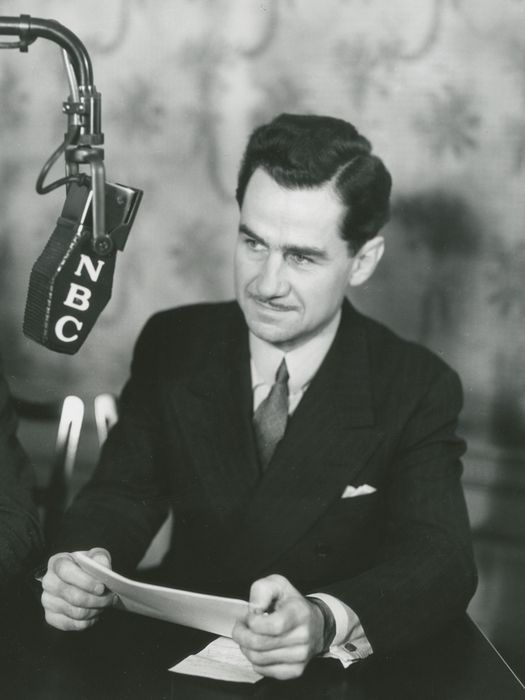
Blame Lowell Thomas. He’s as good a person to blame as anyone.

lowell thomas

Lowell Thomas

Because if you are going to make a claim—about anything at all—in the forward of a book that goes on to sell tens of millions of copies and remain continuously in print for nearly 80 years, you are going to be responsible for authoring a claim that will stick in the communal mind, that will become a part of how we as a culture think we understand ourselves. And as Lowell Thomas might have put it himself in his folksy manner of speaking, it was a doozy.*

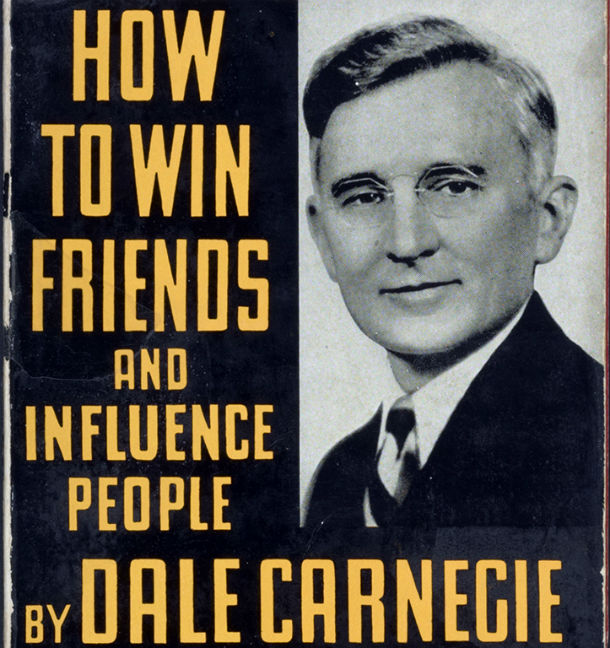
The claim in question comes at the end of his introduction to Dale Carnegie’s “How to Win Friends and Influence People,” the first modern self-help book. His introduction is cinematic in its approach, which makes sense, as Thomas was the newsman to the movie-going public in the 1930s. Thus, the piece reads like a script to a newsreel. Thomas tells the stories of three people who had benefited from Carnegie’s famous public speaking and self-confidence course and then tells the mildly heroic tale of Carnegie himself, the entire tale, from the age of zygote till the present day, in a breezy few pages.

In his college days, we learn, Carnegie was embarrassed by his family’s farm poverty and wanted to come up with something to stand out among his classmates. (Carnegie was born in Missouri in 1888, so this would be 1906 or so at State Teacher’s College, which is now Central Missouri State University. Go Mules!) Because he was neither an athlete nor an actor, he thought he would attract attention as an orator and join the debate society.

Realizing that he had no flair for athletics, he decided to win one of the speaking contests. He spent months preparing his talks. He practiced as he sat in the saddle galloping to college and back; he practiced his speeches as he milked the cows; and then he mounted a bale of hay in the barn and with great gusto and gestures harangued the frightened pigeons about the issues of the day.

But in spite of all his earnestness and preparation, he met with defeat after defeat. He was eighteen at the time—sensitive and proud. He became so discouraged, so depressed, that he even thought of suicide. And then suddenly he began to win, not one contest, but every speaking contest in college. Other students pleaded with him to train them; and they won also.

Thomas leaves out one vital detail: What changed? Suddenly, he began to win. What changed? I want to read on. Picture pages flying off a calendar and then a train and a map of the lower 48 states with a line taking us from city to city. Maybe the picture shifts from black and white to color. Thomas was a movie maker and radio personality and he knew how to make even a quiet intellectual effort—a life spent helping others to gain self-confidence—read like a hero’s journey.

Dale Carnegie claimed that all people can talk when they get mad. He said that if you hit the most ignorant man in town on the jaw and knock him down, he would get on his feet and talk with an eloquence, heat and emphasis that would have rivaled that world-famous orator William Jennings Bryan at the height of his career. He claimed that almost any person can speak acceptably in public if he or she has self-confidence and an idea that is boiling and stewing within.

The way to develop self-confidence, he said, is to do the thing you fear to do and get a record of successful experiences behind you.

At the end, Thomas sums up Carnegie’s gift to the world: “Professor William James of Harvard used to say that the average person develops only 10 percent of his latent mental ability. Dale Carnegie, by helping business men and women to develop their latent possibilities, created one of the most significant movements in adult education.” That is the claim. The word “latent” is the only element connecting those two thoughts. James is one of those figures in American history whose quotes have proved to be very useful for popular writers even when they are taken out of context. Or, especially when they are taken out of context.

To the best of anyone’s intellectual reconstruction, James never said anything of the sort. It is known that he carefully watched a colleague educate his child in an enhanced way with the goal of achieving a superior intellect. (The child had a difficult life.) In nonacademic lectures, that is, lectures delivered to entertain and educate more than to explore ideas, James apparently used to say that human beings use only a portion of their available intellectual energy, that we do not meet our full potential. Which is probably true or perhaps is not.

Decades later, by the time Thomas wrote his sentence—please note that he reports it as something James “used to say”—the thought must have been common. So common that it acquired a specific percentage, ten percent, and shifted from human intellectual “potential” to our brains, our mental ability. We only use ten percent of our thought-thinkers. Everybody knows that. Thomas wrote this to read like an after-dinner speech, which of course is no accident: it is an introduction to Dale Carnegie’s public speaking (and more) book, and everything Lowell Thomas ever said out loud sounded like it was an after-dinner speech, anyway. In Carnegie’s world, and Thomas’, “potential” is everything. It is as American a conceit as anything we Americans ever tell ourselves about ourselves: Live up to your potential. Progress, progress, progress.

Neuroscience is not proving the thought to be correct; the closest one can come to the idea in reality is that our brains are complex and use one-hundred percent of available neurons at all times, that general maps of the brain are generally correct but each person’s brain appears to be unique and possesses fluid boundaries among those general areas, and that we at most pay attention to about ten percent of what our brain is doing at any moment anyway. (I just typed that sentence without paying attention to the location of the keys and while listening to a bird that ought not be outside my window on a cold January afternoon. My brain is humming along quite well without me. I’m not even at ten percent today.)

Earlier in Thomas’ introduction, he mentions that Carnegie has personally overseen and critiqued 150,000 speeches given by people taking his course. The source he gives is “Ripley’s “Believe-It-or-Not.” which is not a source one cites for, well, anything. And Ripley’s source for the statistic was: Dale Carnegie. Thomas continues with even more math: “If that grand total doesn’t impress you, remember that it meant one talk for almost every day that has passed since Columbus discovered America. Or, to put it in other words, if all the people who had spoken before him had used only three minutes and had appeared before him in succession, it would have taken ten months, listening day and night, to hear them all.” Well, okay. That circle of citations citing citations created for the sake of citing them is not a bad thing in and of itself; it’s after-dinner talk logic. It’s logic like that that probably landed us the “ten percent of our brains” idea in the first place. (When giving a speech, use numbers because they sound like facts.)

That “ten percent” idea was presented by one of the great communicators (Lowell Thomas) inside a sales pitch written to persuade readers to buy and read a copy of one of the great instruction manuals about honest, persuasive salesmanship. Eighty years later, we have a movie like “Lucy” depicting a hero using her remaining ninety percent. It has earned almost half a billion dollars since it was released six months ago. The estates of William James, Dale Carnegie, and Lowell Thomas should sue for a cut.

* * * *
*I did not link to the Wikipedia biography of Lowell Thomas partly because it reads like it was written by someone who did not like the late broadcaster, and also because I am a Marist College graduate who spent many hours studying and working in the broadcast studios that were available to me in the Lowell Thomas Building on the Marist campus. Go Red Foxes!

____________________________________________
The WordPress Daily Prompt for January 15 asks, “Let’s assume we do, in fact, use only 10% of our brain. If you could unlock the remaining 90%, what would you do with it?”

* * * *
Please subscribe to The Gad About Town on Facebook: http://www.facebook.com/thegadabouttown

Tapping into ‘Echo Spring’

Every alcoholic has a collection of anecdotes that can be simultaneously heartbreaking, outrageous, and hilarious. Perhaps they are hilarious only to fellow alcoholics; perhaps they can not even be listened to by outsiders. For an outsider, most alcoholic anecdotes may as well conclude with the same punchline, an interchangeable rubber-stamped ending: “And then I got away with it again.” Or, “I didn’t die that time, either.” And then comes the next hair-raising—or eyebrow-raising—tale.

There are two standard anecdotes, one usually about outrageous behavior, and another about the pit at the end of the road. Almost everyone who drinks has a few of the first sort of story.

“I thought things were going great and I was happy to be sober and proud to be in recovery, but I kept having these urges. I was in a good mood and I talked about the urges and people helped me understand. And now it’s two weeks later and I don’t remember these two weeks.” That is the second kind of story; I heard it from someone today. The speaker had “picked up,” which is recovery-speak for “drank.” He “went out” is another phrase.

In her 2013 book, The Trip to Echo Spring, Olivia Laing quotes Andrew Turnbull’s biography of F. Scott Fitzgerald (pictured above):

He describes Fitzgerald in his room at the Grove Park Inn making endless lists “of cavalry officers, athletes, cities, popular tunes. Later, he realized that he had been witnessing the disintegration of his own personality and likened the sensation to that of a man standing at twilight on a deserted range with an empty rifle in his hands and the targets down.” The images are drawn from Fitzgerald’s own account in “The Crack-up,” but somehow have more impact here. (Laing, 84)

That is the second kind of story, too.

Towards the end of my drinking, but really, nowhere near the end, I remember extemporizing for several hours straight about NASCAR to a friend. Now, I am a racing fan so I have a fan’s knowledge base, but I remember feeling like I had turned into an obsessed young boy who has discovered the backside of his baseball cards and wants to read off every single statistic out loud to everyone. And the moment came from nowhere. It was possibly a symptom of delirium tremens, but I recall feeling safe in settled facts and unsafe in the open field of conversation. The subject matter of the facts was chosen at random, by me, and could have been any other topic area, but I cleverly picked one that none of my friends shared enthusiasm for. There could be no conversation. For my friend, it must have felt like what Turnbull described about watching Fitzgerald as I rattled off lists of winners and possible routes to the championship for certain race teams. For hours. (“Cavalry officers, athletes, cities.”) I also remember that I detected an intervention in my future and I figured that if I spoke continuously, no intervention could happen. Instead, I probably hastened one.

That is the second kind of story. My brain was firing blanks, a lot of them in rapid succession, as confidently as my brain had ever fired off substantive thoughts in graduate school classes or in front of classrooms, but blanks anyway. A line from a Robert Lowell poem, “Eye and Tooth,” haunted me: “I am tired. Everyone’s tired of my turmoil.”

Laing’s book mixes travel narrative, expository journalism, and literary biography in pursuit of a personal answer to a large question: “I wanted to know what made a person drink and what it did to them. More specifically, I wanted to know why writers drink, and what effect this stew of spirits has had upon the body of literature itself.” She picks six male, American, Twentieth-century, writers—Ernest Hemingway, F. Scott Fitzgerald, Tennessee Williams, John Berryman, John Cheever, and Raymond Carver—as her biographical subjects, even though she is young, British, female. These figures give her sufficient distance to look more closely at the subject; she alludes to being raised in a house “under the rule of alcohol.” She adds, “There are some things that one can’t address at home,” and decides to travel to America.

What I wanted was to discover how each of these men—and along the way, some of the many others who have suffered from the disease—experienced and thought about their addiction. If anything, it was an expression of my faith in literature, and its power to map the more difficult regions of human experience and knowledge. (Laing, 12)

(The ‘Echo Spring’ of her title comes from Williams’ “Cat on a Hot Tin Roof,” in which Brick, to get away from Big Daddy, excuses himself. Big Daddy asks, “Where you goin’?” and Brick replies, memorably, “I’m takin’ a little short trip to Echo Spring.” Echo Spring is his brand of bourbon and the nickname for the liquor cabinet holding it.)

It is the first kind of story, the outrageous anecdote, the prurient tale, that Laing says that she wants avoid, and she successfully does; the hair-raising bits are kept to a minimum, and, when seen, sketched very deftly, as on page 82: “Once, in the 1920s, he stripped to his underclothes in the audience of a play.” That was Fitzgerald at his hijinks-loving “best.” Fitzgerald’s fellow famous Baltimoran appears in the next sentence, at his most pruriently judgmental. “According to Mencken, [Fitzgerald] shocked a Baltimore dinner party ‘by arising at the dinner table and taking down his pantaloons, exposing his gospel pipe.'”

Laing finds and expresses the empathy that can be found in Fitzgerald’s apparent fondness for drunkenly dropping trou, though, and writes about the mask that baldly revealing oneself can prove to be: “Undressing is an act of concealment sometimes. You can yank down your pants and show off your gospel pipe and still be a man in mortal terror of revealing who you are.” An alcoholic will shock to prevent a embarrassing conversation about his drinking.

It is that mortal terror that animates much addiction and certainly contributed to the art these six writers created; to her credit, Laing’s empathy is clear-eyed and clear-hearted and she does not look for redemption where there is none. That second kind of story is too heart-breaking, after all, and each of her six writers lived it. Fitzgerald, Hemingway, and Berryman did not survive theirs.

____________________________________________
The WordPress Daily Prompt for January 14 asks, “Open your nearest book to page 82. Take the third full sentence on the page, and work it into a post somehow.” This was it: “Once, in the 1920s, he stripped to his underclothes in the audience of a play.”

* * * *
Please subscribe to The Gad About Town on Facebook: http://www.facebook.com/thegadabouttown