Borrowed Time

Samuel Johnson wrote, “He that hopes to look back hereafter with satisfaction upon past years must learn to know the present value of single minutes, and endeavor to let no particle of time fall useless to the ground.”—Rambler 108, March 30, 1751

Dr. Johnson was 41 in March of 1751 and several years into his work on his most lasting project, his Dictionary. Unlike most of the dictionaries developed for any language, and all dictionaries in English, Johnson’s “A Dictionary of the English Language” was written by one man. An entire dictionary, with more than 40,000 word entries and over 100,000 literary quotations to back up and explain Johnson’s definitions and create an etymology (the study of the origin of words). It took Johnson nine years to complete it; 75 years later, Noah Webster published his own dictionary, which had 70,000 entries, took 25 years to complete, and cites Johnson throughout. The first completed edition of the Oxford English Dictionary took 75 years and dozens of scholars to compile its first edition, published in 1928.
Read More

Today in History: April 24

We declare the right of the people of Ireland to the ownership of Ireland and to the unfettered control of Irish destinies, to be sovereign and indefeasible. The long usurpation of that right by a foreign people and government has not extinguished the right, nor can it ever be extinguished except by the destruction of the Irish people. In every generation the Irish people have asserted their right to national freedom and sovereignty; six times during the past three hundred years they have asserted it in arms. Standing on that fundamental right and again asserting it in arms in the face of the world, we hereby proclaim the Irish Republic as a Sovereign Independent State, and we pledge our lives and the lives of our comrades in arms to the cause of its freedom, of its welfare, and of its exaltation among the nations.—”Poblacht na hÉireann”

The Easter Rising began 100 years ago today and lasted five days.

Seven men—Thomas J. Clarke, Seán Mac Diarmada, Thomas MacDonagh, P. H. Pearse, Éamonn Ceannt, James Connolly, and Joseph Plunkett—printed and signed a document headed “Poblacht na hÉireann” (Republic of Ireland), which declared Ireland’s independence from the United Kingdom. Although the independence movement possessed a force of more than 1000 insurgents, the far larger British Army suppressed the uprising after a week. After the uprising was put down, the seven signatories were court-martialed and executed, but the movement toward a free and independent Republic of Ireland was born. It took years to achieve.
Read More

984 Days in Prison: #FreeShawkan

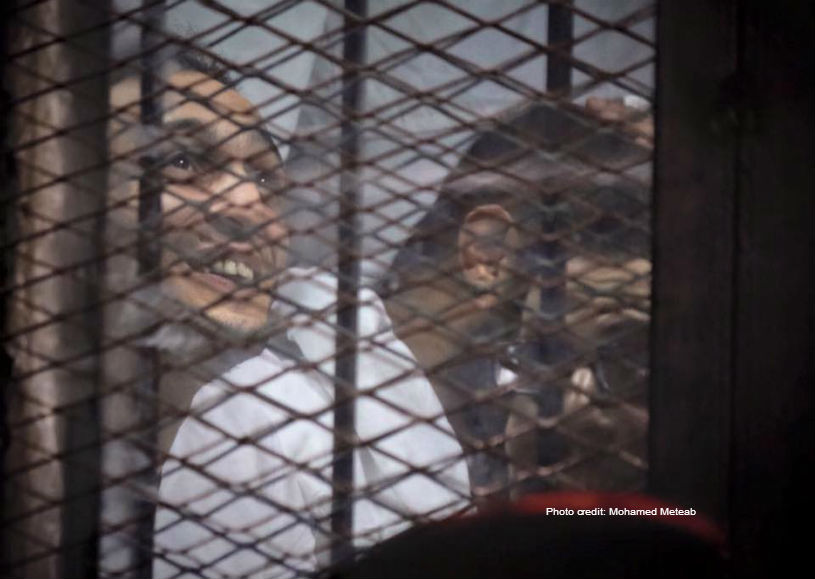
For the fourth time, the trial for Mahmoud Abu Zeid, the photojournalist known as “Shawkan,” was postponed today, April 23, by an Egyptian court, this time until May 10. He will remain in detention between now and then, and he will pass a grim milestone in two weeks: 1000 days in prison.

[Update: According to one source, a journalist named Mada Masr, “The court delayed the hearing because one of Shawkan’s co-defendants, who is in police custody, was not present in for the trial, said Karim Abdel Rady, a lawyer with the Arabic Network for Human Rights Information, who is representing Shawkan.”] The source reports that the co-defendant was not present because the police were detaining the person.

The photo above, credited to Mohamed Meteab, is from the court proceeding today: Shawkan is the smiling face on the left. Other photos from today’s hearing show him smiling the toothy grin that has become familiar to human rights supporters around the world, and other photos show the gritty reality, even when appended to a message of thanks from Shawkan himself, like this one, also from today (Below the fold):
Read More