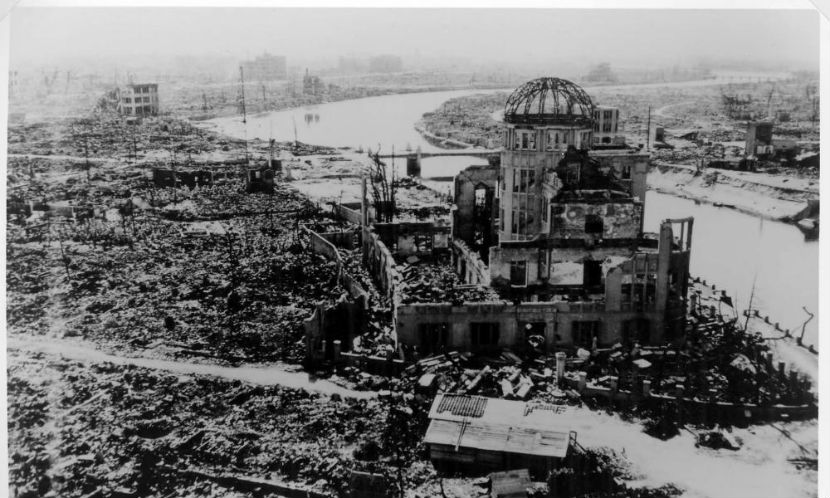
In the street, the first thing he saw was a squad of soldiers who had been burrowing into the hillside opposite, making one of the thousands of dugouts in which the Japanese apparently intended to resist invasion, hill by hill, life for life; the soldiers were coming out of the hole, where they should have been safe, and blood was running from their heads, chests, and backs. They were silent and dazed.
Under what seemed to be a local dust cloud, the day grew darker and darker.—John Hersey, “Hiroshima,” The New Yorker, August 31, 1946
The United States Of America became the first—and to this date, the only—nation to use a nuclear weapon against an enemy nation in war on this date in 1945. The Enola Gay, a Boeing B-29 Superfortress bomber, flew a mission over Japan and dropped a bomb code-named “Little Boy” on the city of Hiroshima.
Hiroshima was selected as a target in part because Tokyo was already “rubble” after a long bombing campaign. Kyoto was also favored. Hiroshima, unlike Kyoto, had a large military district.
Read More
41.386282
-74.347017
Thank you for sharing this via one of these wonderful services:
 The Gad About Town