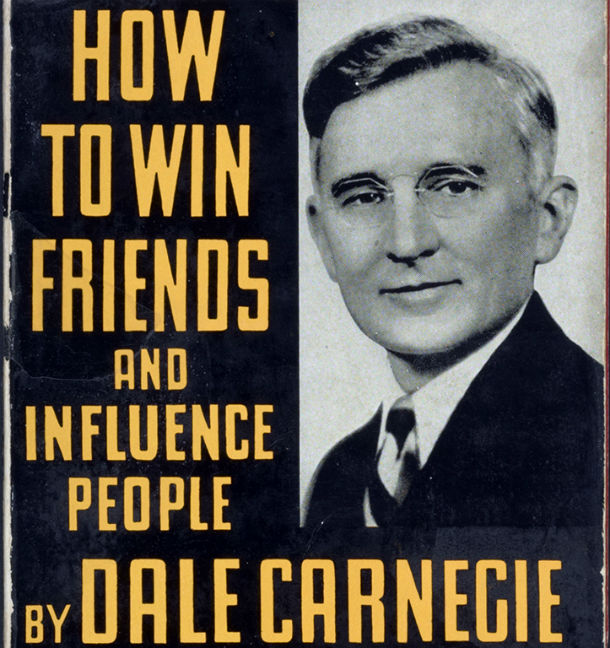
How to Win Friends and Influence Everybody

Blame Lowell Thomas. He’s as good a person to blame as anyone.
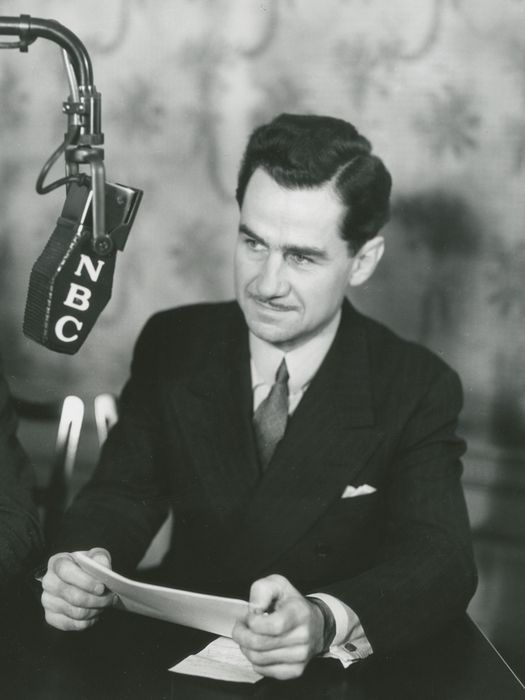
lowell thomas

Lowell Thomas

Because if you are going to make a claim—about anything at all—in the forward of a book that goes on to sell tens of millions of copies and remain continuously in print for nearly 80 years, you are going to be responsible for authoring a claim that will stick in the communal mind, that will become a part of how we as a culture think we understand ourselves. And as Lowell Thomas might have put it himself in his folksy manner of speaking, it was a doozy.*

The claim in question comes at the end of his introduction to Dale Carnegie’s “How to Win Friends and Influence People,” the first modern self-help book. His introduction is cinematic in its approach, which makes sense, as Thomas was the newsman to the movie-going public in the 1930s. Thus, the piece reads like a script to a newsreel. Thomas tells the stories of three people who had benefited from Carnegie’s famous public speaking and self-confidence course and then tells the mildly heroic tale of Carnegie himself, the entire tale, from the age of zygote till the present day, in a breezy few pages.

In his college days, we learn, Carnegie was embarrassed by his family’s farm poverty and wanted to come up with something to stand out among his classmates. (Carnegie was born in Missouri in 1888, so this would be 1906 or so at State Teacher’s College, which is now Central Missouri State University. Go Mules!) Because he was neither an athlete nor an actor, he thought he would attract attention as an orator and join the debate society.

Realizing that he had no flair for athletics, he decided to win one of the speaking contests. He spent months preparing his talks. He practiced as he sat in the saddle galloping to college and back; he practiced his speeches as he milked the cows; and then he mounted a bale of hay in the barn and with great gusto and gestures harangued the frightened pigeons about the issues of the day.

But in spite of all his earnestness and preparation, he met with defeat after defeat. He was eighteen at the time—sensitive and proud. He became so discouraged, so depressed, that he even thought of suicide. And then suddenly he began to win, not one contest, but every speaking contest in college. Other students pleaded with him to train them; and they won also.

Thomas leaves out one vital detail: What changed? Suddenly, he began to win. What changed? I want to read on. Picture pages flying off a calendar and then a train and a map of the lower 48 states with a line taking us from city to city. Maybe the picture shifts from black and white to color. Thomas was a movie maker and radio personality and he knew how to make even a quiet intellectual effort—a life spent helping others to gain self-confidence—read like a hero’s journey.

Dale Carnegie claimed that all people can talk when they get mad. He said that if you hit the most ignorant man in town on the jaw and knock him down, he would get on his feet and talk with an eloquence, heat and emphasis that would have rivaled that world-famous orator William Jennings Bryan at the height of his career. He claimed that almost any person can speak acceptably in public if he or she has self-confidence and an idea that is boiling and stewing within.

The way to develop self-confidence, he said, is to do the thing you fear to do and get a record of successful experiences behind you.

At the end, Thomas sums up Carnegie’s gift to the world: “Professor William James of Harvard used to say that the average person develops only 10 percent of his latent mental ability. Dale Carnegie, by helping business men and women to develop their latent possibilities, created one of the most significant movements in adult education.” That is the claim. The word “latent” is the only element connecting those two thoughts. James is one of those figures in American history whose quotes have proved to be very useful for popular writers even when they are taken out of context. Or, especially when they are taken out of context.

To the best of anyone’s intellectual reconstruction, James never said anything of the sort. It is known that he carefully watched a colleague educate his child in an enhanced way with the goal of achieving a superior intellect. (The child had a difficult life.) In nonacademic lectures, that is, lectures delivered to entertain and educate more than to explore ideas, James apparently used to say that human beings use only a portion of their available intellectual energy, that we do not meet our full potential. Which is probably true or perhaps is not.

Decades later, by the time Thomas wrote his sentence—please note that he reports it as something James “used to say”—the thought must have been common. So common that it acquired a specific percentage, ten percent, and shifted from human intellectual “potential” to our brains, our mental ability. We only use ten percent of our thought-thinkers. Everybody knows that. Thomas wrote this to read like an after-dinner speech, which of course is no accident: it is an introduction to Dale Carnegie’s public speaking (and more) book, and everything Lowell Thomas ever said out loud sounded like it was an after-dinner speech, anyway. In Carnegie’s world, and Thomas’, “potential” is everything. It is as American a conceit as anything we Americans ever tell ourselves about ourselves: Live up to your potential. Progress, progress, progress.

Neuroscience is not proving the thought to be correct; the closest one can come to the idea in reality is that our brains are complex and use one-hundred percent of available neurons at all times, that general maps of the brain are generally correct but each person’s brain appears to be unique and possesses fluid boundaries among those general areas, and that we at most pay attention to about ten percent of what our brain is doing at any moment anyway. (I just typed that sentence without paying attention to the location of the keys and while listening to a bird that ought not be outside my window on a cold January afternoon. My brain is humming along quite well without me. I’m not even at ten percent today.)

Earlier in Thomas’ introduction, he mentions that Carnegie has personally overseen and critiqued 150,000 speeches given by people taking his course. The source he gives is “Ripley’s “Believe-It-or-Not.” which is not a source one cites for, well, anything. And Ripley’s source for the statistic was: Dale Carnegie. Thomas continues with even more math: “If that grand total doesn’t impress you, remember that it meant one talk for almost every day that has passed since Columbus discovered America. Or, to put it in other words, if all the people who had spoken before him had used only three minutes and had appeared before him in succession, it would have taken ten months, listening day and night, to hear them all.” Well, okay. That circle of citations citing citations created for the sake of citing them is not a bad thing in and of itself; it’s after-dinner talk logic. It’s logic like that that probably landed us the “ten percent of our brains” idea in the first place. (When giving a speech, use numbers because they sound like facts.)

That “ten percent” idea was presented by one of the great communicators (Lowell Thomas) inside a sales pitch written to persuade readers to buy and read a copy of one of the great instruction manuals about honest, persuasive salesmanship. Eighty years later, we have a movie like “Lucy” depicting a hero using her remaining ninety percent. It has earned almost half a billion dollars since it was released six months ago. The estates of William James, Dale Carnegie, and Lowell Thomas should sue for a cut.

* * * *
*I did not link to the Wikipedia biography of Lowell Thomas partly because it reads like it was written by someone who did not like the late broadcaster, and also because I am a Marist College graduate who spent many hours studying and working in the broadcast studios that were available to me in the Lowell Thomas Building on the Marist campus. Go Red Foxes!

____________________________________________
The WordPress Daily Prompt for January 15 asks, “Let’s assume we do, in fact, use only 10% of our brain. If you could unlock the remaining 90%, what would you do with it?”

* * * *
Please subscribe to The Gad About Town on Facebook: http://www.facebook.com/thegadabouttown

Suis-je Charlie? (Am I Charlie?)

 
It is said that words matter. Images, too.

When violence is used as a form of literary criticism, it gives to the words and images that it dislikes a kind of power, but a different sort of power than the words or images actually possess. Words and images convey ideas in the most intimate way: from inside one human mind to another. They carry little in the way of power or anything like power. When violence is a response to words and images, violence is revealed as the nullity that it is, and the philosophy that believes that violence is a reply to words and images is revealed as a nullity, too. The words and images did not reveal that.

Even if a writer, in the writer’s intimate my-mind-to-your-mind way, writes something provocative like, “Kill me,” you can’t. Even if the writer names you in the request. Even if the writer irritates you in the writing. A bullet as a reply gives the writing a power it does not deserve and did not request or demand or require: the power to reveal the vacuum of violence inside any brain or ideology that sees the bullet as any kind of viable reply. It is an unequal exchange, even if the dead once said and wrote that they “would rather die standing than live crawling.”

In attempting to explain what happened in Paris last night, I finally found myself offering a what-if: What if everything that happened last night happened, but here, in Los Angeles, say. Someone offended by a certain animated comedy program that specializes in irking the church-, temple-, and mosque-going religious among us decides to hunt down the creators of that show in revenge for perceived insults. My listener got it, and then we shook our heads, because we live with the amnesiac’s belief—rightly or wrongly, and I hope rightly—that “it can’t happen here.”

I say “amnesiac” because it can, and it has, and it quite possibly might happen here again.

Violence astonishes. That is its only point. It certainly doesn’t silence. I am astonished by how astonished I still can be. That is why I have written twice now about last night’s senseless violence in Paris against the publisher and staff (and nearby police officers) of “Charlie Hebdo.” Bravery is a skill, and I wonder if I have cultivated it in myself. Because it is obvious to me that murder is empty and that injustice is injustice is injustice, so that any claims to a philosophical ground underneath murder is a special pleading of the worst sort. Thus when I declare that police officers ought not murder and that police officers ought not be murdered and that editorial staffs ought not be murdered and that murder is emptiness attempting to fill its own vacuum, it seems so obvious to me that it certainly does not feel like something laudable like bravery just to say it. “Je suis Charlie.” As a question it is, “Suis-je Charlie?” My answer is, I hope so.

Shortly before his death, the poet W.H. Auden told talk-show host (and former politician) Richard Crossman, “Nothing I wrote prevented one Jew from being gassed or stalled the war for five seconds.” At first glance, this places the bar very high for the role of a writer in the affairs of the world, but it is simply a stark assessment of the reality that a writer has no say in the practical matters of life and death. He is not saying that words do not matter but is instead drawing the boundary between where they do matter and where they can not. Writers are makers and not doers, not “men of action,” Auden also liked to say.

One of his most famous poems is September 1, 1939, written to mourn the outbreak of World War II. The title is of course the date Germany invaded Poland. It was written quickly, not heavily edited, and published weeks later. Auden came to reject the poem and refused three times to include it in his Collected Poems. He told Crossman that the poem possessed rhetoric that was “too high-flown.”

In the second-to-last stanza he wrote,

All I have is a voice
To undo the folded lie,
The romantic lie in the brain
Of the sensual man-in-the-street
And the lie of Authority
Whose buildings grope the sky:
There is no such thing as the State
And no one exists alone;
Hunger allows no choice
To the citizen or the police;
We must love one another or die.

Auden said that he especially rejected that last line and wanted to correct it to, “We must love one another and die,” because “or die” is not real. There is nothing we can choose versus death. But it was lines like, “Those to whom evil is done / Do evil in return” and “There is no such thing as the State,” that he probably found too “high-flown.” They are too definitive, too short to allow for nuance, too inarguable—not because they are obvious, but because they are rhetorically rendered to disallow argument. (Was “evil” done to Germany? Heck, “evil” is a thick word, and if Germany is doing evil, Mr. Auden, why not explain what you mean by that? And if Germany is doing evil, what evil is any kind of response to any evil? Injustice is injustice is injustice.)

Auden rejected the poem for the wrong reasons. “All I have is a voice,” he wrote, and even if that, too, is factually incorrect—in many if not most countries, each of us has a voice and a vote and can campaign—it is correct in an essential way: the writer is “a maker, not a doer,” is a voice, and the writer has a right to be audaciously “high-flown,” audaciously non-nuanced, audaciously incorrect. He was rejecting his own right to be audaciously incorrect.

It is understandable why he rejected the poem from his own canon: he disagreed with some thoughts and found others expressed incorrectly, just as it is understandable that the poem has been embraced by people of very different political stripes for different reasons. (President Johnson intoned “We must love one another or die” in his awful “Daisy” television ad. And the poem was reprinted in many American newspapers right after September 11, 2001. He was angry about LBJ and probably would have been irritated by the latter embrace.) Very little in the poem is accurate, but poets have the right to be inaccurate, and “All I have is a voice” is his claim to that right. Very little in the poem is accurate, except for one thing: We must love one another. It should not feel like bravery to say this, but it does, today just as much as it did in September 1939. Bravery is a skill. We must continue to hone it.

Here is the complete poem:

September 1, 1939
I sit in one of the dives
On Fifty-second Street
Uncertain and afraid
As the clever hopes expire
Of a low dishonest decade:
Waves of anger and fear
Circulate over the bright
And darkened lands of the earth,
Obsessing our private lives;
The unmentionable odour of death
Offends the September night.

 
Accurate scholarship can
Unearth the whole offence
From Luther until now
That has driven a culture mad,
Find what occurred at Linz,
What huge imago made
A psychopathic god:
I and the public know
What all schoolchildren learn,
Those to whom evil is done
Do evil in return.

 
Exiled Thucydides knew
All that a speech can say
About Democracy,
And what dictators do,
The elderly rubbish they talk
To an apathetic grave;
Analysed all in his book,
The enlightenment driven away,
The habit-forming pain,
Mismanagement and grief:
We must suffer them all again.

 
Into this neutral air
Where blind skyscrapers use
Their full height to proclaim
The strength of Collective Man,
Each language pours its vain
Competitive excuse:
But who can live for long
In an euphoric dream;
Out of the mirror they stare,
Imperialism’s face
And the international wrong.

 
Faces along the bar
Cling to their average day:
The lights must never go out,
The music must always play,
All the conventions conspire
To make this fort assume
The furniture of home;
Lest we should see where we are,
Lost in a haunted wood,
Children afraid of the night
Who have never been happy or good.

 
The windiest militant trash
Important Persons shout
Is not so crude as our wish:
What mad Nijinsky wrote
About Diaghilev
Is true of the normal heart;
For the error bred in the bone
Of each woman and each man
Craves what it cannot have,
Not universal love
But to be loved alone.

 
From the conservative dark
Into the ethical life
The dense commuters come,
Repeating their morning vow;
“I will be true to the wife,
I’ll concentrate more on my work,”
And helpless governors wake
To resume their compulsory game:
Who can release them now,
Who can reach the deaf,
Who can speak for the dumb?

 
All I have is a voice
To undo the folded lie,
The romantic lie in the brain
Of the sensual man-in-the-street
And the lie of Authority
Whose buildings grope the sky:
There is no such thing as the State
And no one exists alone;
Hunger allows no choice
To the citizen or the police;
We must love one another or die.

 
Defenceless under the night
Our world in stupor lies;
Yet, dotted everywhere,
Ironic points of light
Flash out wherever the Just
Exchange their messages:
May I, composed like them
Of Eros and of dust,
Beleaguered by the same
Negation and despair,
Show an affirming flame.

____________________________________________
The WordPress Daily Prompt for January 8 asks, “If you could choose to be a master (or mistress) of any skill in the world, which skill would you pick?”

* * * *
Please subscribe to The Gad About Town on Facebook: http://www.facebook.com/thegadabouttown

Edison’s Happy New Year

Sixteen months of embarrassingly public false starts and failed attempts led to the rarest of things from Thomas Edison: silence. He was going to allow his results to speak for themselves for once. When he and his invention were ready, one hundred thirty-five years ago tonight, on December 31, 1879, Thomas Edison invited the public to his lab in Menlo Park, New Jersey, to witness electric lights being turned on and off for the first time.

In September 1878, Edison had convinced himself that he was so close to an electric light that he announced it to the press. “I have it now! When the brilliancy and cheapness of the lights are made known to the public, illumination by carburated hydrogen gas will be discarded,” he told the New York Sun. Gas lamps inside and outside the house, with their many inherent dangers, were about to be a thing of the past.

Like many great inventors before and after him, Edison was almost as a good a salesman as inventor. He certainly was an inventor, one of the most accomplished in American history, but he was also a self-inventor. To this day, the image we associate with Edison and the image we associate with the word “inventor” are very close: that of an obsessed tinkerer in his garage, testing and refining different materials and different systems until success reveals itself. Think of the quotes from Edison one still encounters when looking for sayings about success: “Genius is one percent inspiration and ninety-nine percent perspiration.” Or, “Opportunity is missed by most people because it is dressed in overalls and looks like work.” Or, “I have not failed. I’ve just found 10,000 ways that won’t work.” Or, “Many of life’s failures are people who did not realize how close they were to success when they gave up.”

When he spoke to the Sun, he was already famous and becoming wealthy for inventing the phonograph and powerfully refining the telegraph, so dozens of investors in his electric light project came forward with enough capital to create the new Edison Electric Light Company, which is now General Electric. They knew what it would mean to be on board financially with the man who would bring electric light to every street and each house on those streets. A new world was about to be created. But not in 1878.

The investments helped. Edison was able to hire technicians and expand his lab at Menlo Park. It might have taken longer than four months for him to realize that a light bulb, a vacuum-sealed glass enclosure, was key. In March 1879, Edison once again announced that he was even closer to success. The historian Mark Essig quotes a skeptical newspaper article, from an impatient New York Daily Graphic writer:

Day after day, week after week, and month after month passes and Mr. Edison does not illumine Menlo Park with his electric light. The belief has become rather general in this country and in England that for once the great inventor has miscalculated his inventive resources and utterly failed.

(And we think the 24/7 news media we live in now is impatient. It always has been.)

When all the experiments and tinkering resulted in a successful product, Edison and his assistants knew it. They had a light bulb that was emitting more energy than was being put into it. For once he remained quiet. He wrote one friend, “It is an immense success. Say nothing.”

He put out the word that he was ready by inviting the public to his famous lab in northern New Jersey. The demand for rail tickets became so great that the rail companies added cars to the routes west. The crowd was estimated to be over three thousand, and no one in attendance was disappointed. Not even the newspaper reporters. Edison did not provide entertainment or work the crowd up with delays and announcements or speeches about the grand era to come; instead, he turned the light on and off, again and again, and allowed the public to do the same. The grand new era was here, and by September 1882, Edison’s company was providing electricity and light to customers in lower Manhattan.

(Mark Essig’s 2003 book, “Edison and the Electric Chair,” does a great job explaining the science behind the false starts; it is also a great work of history about the legal battle between Edison and Westinghouse and AC versus DC power distribution. It and some online articles helped when I noticed that today is the 135th anniversary of the debut of something I will be turning off about two minutes after midnight tonight. Happy New Year, everyone, and may the only tears any of us shed in 2015 be tears of joy.)

____________________________________________
The WordPress Daily Prompt for December 31 asks, “We cry for lots of reasons: sadness, pain, fear … and happiness. When was the last time you shed tears of joy?”

* * * *
Please subscribe to The Gad About Town on Facebook: http://www.facebook.com/thegadabouttown