‘Today, I am two separate gorillas’

The Bonzo Dog Doo-Dah Band has received a great deal of attention in recent years. Even its Wikipedia entry has grown from a stub to a forty-paragraph historical disquisition in a few short years, which surely must be a sign of something, with fourteen footnotes, two sources, and five “for further readings.” (Thank you very much, Mr. and/or Mrs. Whoever Did That.)

If you are a fan of the Bonzos, nothing I may write here will do more than remind you of something you also like. If you are not (yet), nothing that I write may convince you that you have a bright future ahead of you discovering the works of these music-comic dolt-geniuses, so here is an intro anyway (“Adolf Hitler on vibes”):

For a group that was somewhat pop, mostly tongue-in-cheek, unforgettable on stage, and almost-not-quite-but-why-couldn’t-just-one-more-person-have-bought-our-record a one-hit wonder, forty paragraphs is a lot. So perhaps I am not alone in my fandom. One of the pleasant surprises in writing this website has been the number of hits that a post I wrote about Bonzo founder Vivian Stanshall has received (in triple digits since March).

The Bonzos served as a bridge, a missing link (if you were looking for one) between The Beatles and the Monty Python group. In late 1967, the Bonzos appeared in both “Magical Mystery Tour” (partially entertaining the Beatles—John Lennon heckles them—with a performance of their song “Death Cab for Cutie”) and in the pre-Python but mostly Python-staffed afternoon television show, “Do Not Adjust Your Set.”

Here, from “Do Not Adjust Your Set,” a pre-Python Michael Palin introduces the Bonzos and Stanshall does his best worst Elvis in “Death Cab for Cutie.”

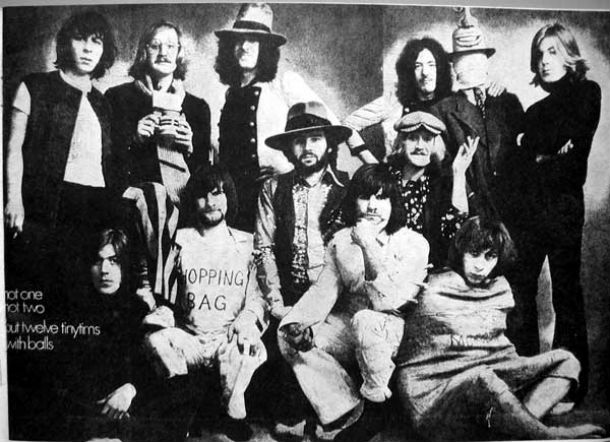
In most of their performances, Stanshall was the lead singer, focus of attention, easily distracted emcee, and camera hog whenever one was present. The basic Bonzo line-up was Neil Innes, Rodney Slater, Sam Spoons, Roger Ruskin Spear, Vernon Dudley Bohay-Nowell, “Legs” Larry Smith, and Bob Kerr. At times, the group was down to three members (when an album was required to meet a contractual obligation) and at others, more than a dozen musicians and affiliated acts might be occupying the stage.

As head song composers, Stanshall was paired up with Neil Innes, but according to Innes, “Death Cab for Cutie” was the only true collaboration between the two heads of the head-less Bonzos, because it was the only time he and Stanshall were actually in the same room while writing. Stanshall wrote wordplay-heavy songs with lines that were saturated in nonsense, and Innes was (and is) a songwriter whose Beatles-esque tunes led not only to to the Bonzos being produced by Paul McCartney (the minor hit “I’m the Urban Spaceman,” which qualified the group as an almost one-hit wonder) but also to a Beatles lawsuit in the 1970s when music he wrote for his parody group, the Rutles, was found to be too reminiscent for comfort. Several Innes songs for the Rutles now list Lennon-McCartney as co-composers. Further cementing the Beatles-Python link occupied by the Bonzos, “The Rutles” was an Eric Idle project with Innes.

Their collaboration “Mr. Apollo” combines an almost-too-catchy Innes tune with Stanshall’s absurd and long fake sales pitch for an exercise gimmick: “Five years ago, I was a four-stone apology. Today, I am two separate gorillas. No tiresome exercises. No tricks. No unpleasant bending.” The song also features a fuzzy heavy metal guitar solo, even though it dates from the era about six months before anyone had heard heavy metal guitar solos.

And here is the also too-catchy “I’m the Urban Spaceman,” which Paul McCartney produced under the pseudonym, Apollo C. Vermouth, because he was simply having too good a month in November 1968 to take credit for everything:

It is completely an Innes song, so Stanshall is relegated to court jester in performance; also, you can see how much the group dis-enjoyed lip-singing.

The Bonzos got their start in a pub in the early 1960s, when several similarly aged young men (20-somethings) hanging out there found they had similar interests, especially in kitschy old 1930s records, and started to informally perform together. Slater recounts Stanshall bringing in one such record and declaring, “Look at this! I bought it for a penny but it’s worth twice that!”

Their early performances were live and faithful renditions of the pop not-so standards that they heard on the records. But other acts were also performing live and faithful renditions of obscure 1930s records, too, so the Bonzos, many of them art students entranced by Dada, started to create their own Dadaist sound and look. The group was an act without a point that loved being an act and having no point except being an act.

By 1970, the job of jester in the court of pop music or musician in the court of comedy no longer needed to be filled. The Bonzos disbanded, sort of. Reunion line-ups performed through the 1970s and still come together. The group’s set lineup varied in name and number so whimsically anyway that it could be said that its members simply wandered away. Innes went on, as written above, to a long and varied career continuing to bridge a gap between comedy and pop music. Most of the surviving members are jazz musicians who will always be remembered as Bonzos.

The group celebrated its fortieth anniversary in 2006 with a live show that featured special guests like Stephen Fry. What it was the fortieth anniversary of was up for discussion, but 1966 was the year the group came to the attention of the larger British public, as it landed its first major label record deal and appeared on television for the first time.

And Vivian Stanshall. He died almost twenty years ago, in March 1995, because he used to smoke cigarettes and drink brandy in bed and those two things do not mix well with nodding off. He is one of those artists about whom one marvels at his inventiveness, at the waterfall of words most of his work produced, and still feels that his career was somehow smaller than it was meant to be. I certainly disagree. (I am sure his non-ghost is not thanking me, anywhere.) He left the world wanting more of him, which is what performers are always told to do.

Here is a BBC documentary about Vivian Stanshall from 2004, “The Canyons of His Mind“:

____________________________________________
The WordPress Daily Prompt for December 15 asks, “We all have our semi-secret, less-known personal favorites—a great B-side, an early work by an artist that later became famous, an obscure (but delicious) family recipe. Share one of your unsung heroes with us—how did you discover it? Why has it stayed off everyone’s radar?”

* * * *
Please subscribe to The Gad About Town on Facebook: http://www.facebook.com/thegadabouttown

Listen When I Tell You Not to Listen to Me

My gut instincts are mistake-prone.

If you are interested in the horse race nature of American politics, the drop-everything-every-four-years-so-we-can-fill-all-the-jobs-in-Washington portion of our public life, you could do no worse than live in either New Hampshire or Iowa for the year before Election Day. This is because, for reasons I could bore you with but will not, Iowa is the first state in the country to hold a vote for President, in January of election year, and New Hampshire is the second state, usually a week later. (Through the spring and summer of election year, the major political parties conduct state-by-state votes, and the winner of the most votes is sometimes, often, usually that party’s candidate for the national election in November.)

These two states fight very hard every four years to hold their place as first, fight so hard that both states always claim to be first every time, even a week apart, because Iowa uses one type of voting system and New Hampshire a completely different one. So they are both always first. It comes down to money: because they are first, both states receive a quadrennial economic boost unlike any other, with political candidates and their support teams and journalists and their support teams needing food, shelter, television time for months before January. Some nationally famous politicians have rented houses in Iowa to live in and signed year-long leases for the year of door-to-door campaigning they will do. Other states would love to be first in the nation, to attract those millions of dollars, but these two small-population states put up a winning fight with both the Democratic and the Republican parties every four years and get to be first in the nation to cast ballots.

From 2000 to 2004, I lived in Cedar Rapids, Iowa, a city of about 125,000 in a state of three million. A state that is larger than New York State but with one-sixth of the population. So that means that in 2003, I was in the second-largest city in the first of the two “First in the Nation” vote-casting states for Election 2004: Bush v. Kerry. With George W. Bush running for re-election unopposed, it meant that almost every Democrat elected to any office anywhere in the country was campaigning in Iowa.

Cedar Rapids, Iowa. In the foreground is a Quaker Oats factory. My apartment building is the red brick building smack in the middle of the photo, across the highway from Quaker Oats.

Cedar Rapids, Iowa. In the foreground is a Quaker Oats factory. My apartment building is the red brick building smack in the middle of the photo, across the elevated highway from Quaker Oats.

I am a progressive voter, to the left of most Democrats but tending to vote for members of that party. But I also fall head over ballot for every candidate who claims to be the representative from the Land of New Ideas. Rarely do we hear what those New Ideas might be or how much he or she may think they will cost, but I love the idea of New Ideas. Selling New Ideas is an Old Idea, but it gets me every time. And so my life’s list of candidates I have rooted to run for the next office higher than the one they already possessed includes several people named Kennedy, Gary Hart, the late Paul Tsongas, Bill Bradley, and, in 2003, a North Carolina senator named John Edwards. There are others, but I am blushing with embarrassment while typing this.

I should retire my political instincts. Then-Senator Edwards was one of the few politicians I have ever heard speak about rural as well as urban poverty as a blight, a blight because it is a problem that can be tackled if the country’s political will can be inspired. I was inspired. From 2004-’08, it could be said that he pushed the bigger-name candidates to the left (some might think that a good thing), but from 2004-’08 it could also be said that he was doing some other (scandalous) things.

And I met him! And my immediate in-person sense of the man was: “I do not like him.” In January 2004, days before us Democratic Iowans were to cast our first in the nation votes, our so very first votes that New Hampshire was going to be the second first, so stuff it, New England!, just days before that, I saw him speak. Great speech. People are poor. Terrific. Speech over. In the crowded room, we all discovered that that single door entrance over there was now the single door exit for everyone, including the candidate and his handlers, who must hate situations like this in Iowa and New Hampshire. I was next to him for the five minutes it took to leave. He shook my hand—he shook everyone’s hand within reach. I have met a few politicians and I have met quite a few people who ought to run for office, but I have never been rendered invisible quite as quickly as I was by that man. It may qualify as the single most bizarre social encounter I have ever had: I have been dismissed mid-conversation plenty of times, even made to feel that I offended someone, but never looked at like I did not exist.

Perhaps it was the overwhelming crowd and the fact that I did not immediately produce a way out of the room while he was looking for a way out of the room, or perhaps it was the woman behind me. Or perhaps it was because, a bright man, a good reader of juries in his lawyer life, he felt my instinct to not like him. Or perhaps it was the woman behind me who wanted and received his autograph. I have no idea.

What did I do with this instinct to not like John Edwards? I convinced myself to ignore it and campaigned for him at my caucus site on election night and swung our district over to him. My instinct to ignore my instincts can not be trusted.

I did not reach out to the former Vice Presidential nominee, former Senator, one of the more disliked men in America, for comment.

(This column originally ran on August 7, under the name “Vote for Not-Him.”)

____________________________________________
The WordPress Daily Prompt for December 6 asks, “When’s the last time you followed your instinct despite not being sure it was the right thing to do? Did it end up being the right call?”

* * * *
Please subscribe to The Gad About Town on Facebook: http://www.facebook.com/thegadabouttown

My Thinking Makes It So

In Act 2, Scene 2, of Hamlet, the doomed Rosencrantz and Guildenstern are chatting with the prince. They are old college buddies of Hamlet’s, and King Claudius (Hamlet’s step-father) and Queen Gertrude (his mother) have sent for them to learn what is bothering the young man, who has been acting with an “antic disposition” and saying strange things, half to himself and half to no one can tell who.

Hamlet greets them and speaks in the same riddling manner that he has been using with the rest:

HAMLET: Let me question more in particular, my good friends, what you have done to deserve such fortune, that she sends you to prison hither?
GUILDENSTERN: Prison, my lord?
HAMLET: Denmark’s a prison.
ROSENCRANTZ: Then the world is one.
HAMLET: A goodly one; in which there are many confines, wards, and dungeons, Denmark being one o’ the worst.
ROSENCRANTZ: We don’t think so, my lord.
HAMLET: Why, then ’tis none to you; for there is nothing either good or bad but thinking makes it so. To me it is a prison.

Hamlet quickly determines that they are not merely dropping in to talk about sports and the weather but are spies. Ultimately, he manages to have them both killed.

Shakespeare’s quip about how one’s thinking determines a thing’s relative goodness or badness has lived on through the centuries, but in most peoples’ recitations it carries about the same weight now as a Twittering teenager’s hashtagging of “YOLO.” Perhaps this is because it is delivered by a character who is speaking in riddles and jests and pretending to be mad. (“What are you reading?” “Words, words, words.”)

Four hundred years after Hamlet was first performed, “Nothing (is) either good or bad but thinking makes it so” is spoken as a longer, more profound-sounding, version of, “Don’t sweat the small stuff.” “The rain is uncomfortable for you but it’s good news for the farmers,” says the profound thinker who apparently wants me to punch him. (I once replied to this with a “Do you know any farmers? We live in the suburbs. If you do, see if they’re carrying umbrellas, too.” The person walked away, which of course was the only proper reply to my being a jerk.) (We are still friends. I have my good points.)

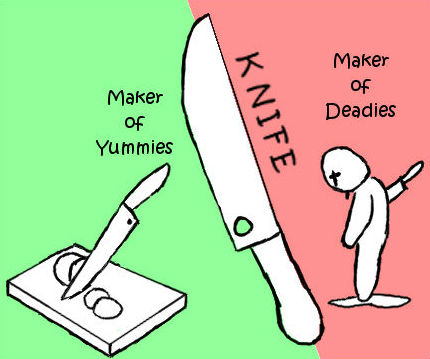
knifeconstrastMany people resist strongly and vocally when it is suggested that, taken existentially, Shakespeare and/or Hamlet is right. Our perception is all that defines good from bad. A happy event, in and of itself, is not inherently a good thing. A tragic happening is not by definition evil. There is a deep commitment to the idea that there is evil in the universe as well as good; that good inheres in things we like and love and that evil is a containable reality. This is because most of us combine and conflate the notions of sad with bad and happy with good.

Some of the saddest things that I have seen have had positive things follow them, possibly as a result of reactions to the sad thing. (I am disabled and that sucks, and I would not wish the experience on people I dislike, but being disabled gives me an income, a teeny-tiny one, which gives me time to write; a small example, that, but reality resides on a spectrum and not in an either-or zero-sum playhouse.) And some of the best things that I think I have done may turn out to have terrible consequences. Sadness exists. Tragedy is a reality. So is happiness.

Are there people who do wrong in this world? People who introduce sadness into peoples’ lives or who work for their own personal gain to the detriment of others around them? Of course. Hamlet was no murderer but he had Rosencrantz and Guildenstern killed. (Fictional characters, of course.) Hitler existed. If evil is inexplicable, well, then, so is good. We want all matters to be explicable, however, so we deploy terms like “good” and “evil” as if they are tools that explicate.

Further, our minds want there to be someone to credit or something to blame behind the good or the evil thing. There must be an explanation, goes the thinking. Thus, there must be a find-able motivation animating even the explicably good thing or evil person. The great journalist Ron Rosenbaum explores this in his famous book, “Explaining Hitler,” which confronts the book buyer from the start, the front cover. Hitler’s baby picture sits there. Historians have searched for decades for the clues to pinpoint the moment baby Adolf became Hitler. What was the cause? The explanation? It seems that it is not okay if there is not one. But “here there is no why,” as Martin Amis writes of Auschwitz.

Rosenbaum interviewed Alan Bullock, one of Hitler’s biographers. “‘Some days, I ask God,’ Bullock told me, his voice dropping to an impassioned whisper, ‘If You were there, why didn’t You stop it?’ And then he added the sad lesson of a lifetime spent attempting to explain Hitler: ‘Never believe God is omnipotent.'”

Boom! Is the Holocaust, or a holocaust, a man-made political rampage, something so far outside human imagination when it is always and only the product of human imagination?

Yehuda Bauer, a Holocaust Studies scholar, replies to Rosenbaum’s question, “Will there ever be a why?” “Bauer told me that he believes it is theoretically possible. ‘But the fact that something is explicable doesn’t say that we have explained it.'”

Terrible acts and tragedies are the horrible outliers of most human experiences. The beautiful thing is that love, great love and small love, is not. And it is just as inexplicable … until I gaze in my beloved’s eyes.

____________________________________________
The WordPress Daily Prompt for December 3 asks, “What’s the best piece of advice you’ve ever received that you wouldn’t give to anyone else? Why don’t you think it would apply to others?”

* * * *
Please subscribe to The Gad About Town on Facebook: http://www.facebook.com/thegadabouttown