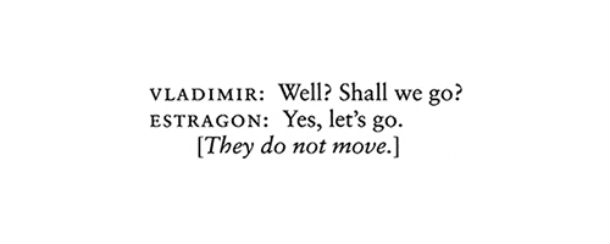
Gad Meets Godot

“Where I live, I can not speak of it. It takes too long to say its name. Who I love, same thing.”

He goes on. “So they ask us here,” he says, “Look at that.” He points. “‘No Words As Long As This,’ the sign says. And it gives a long list of long words. It is like they want a tall, short thing. Or a short but tall one. How can I fill this for them?”

“We,” I say to him. “We.”

“Right, kid. You and I. How can we give them this? This thing they ask. It is so tough. And it is close to the time we leave.”

“I have no right to tell you what to do.”

“But.”

“But. We can wait. There is a new day and it comes next.”

“Next?”

“To this day.”

“But why ask us to do this? Like this?”

“This? Oh.” They look at the sign and read out loud:

“The WordPress Daily Prompt for December 8 asks, ‘Today, write a post about the topic of your choice—using only one-syllable words.'”

“There is one word there that I do not like.”

“What is it?”

“Syllable.”

“Oh.” They do not move.

* * * *
Please subscribe to The Gad About Town on Facebook: http://www.facebook.com/thegadabouttown

Put a #Hashtag on It

Many writers will claim that they “write for themselves.” This is true enough, but attention, constructive criticism, and a few “attaboys” will make the days creep at a better than petty pace.

In this social media saturated age, in which both of my septuagenarian parents have Facebook accounts and people who state that they do not understand Twitter have a couple thousand followers on that service, drawing attention to one’s work without purchasing advertising time on the radio to scream for 30 continuous seconds seems difficult. For me, a naturally quiet sort, sharing the publication of a new piece naturally feels unnatural, like recording that 30-second Janovian advertisement. Screaming is so unseemly.

But here I am, addicted to my numbers, measuring my metrics each day. It is an inner battle between believing that what I write is worth being written (does having readers or a reader equal “worth”? No, of course not) and wanting people to discover this (un)certain idea for themselves.

In the Peter Cook-Dudley Moore film, “Bedazzled,” poor Stanley Moon (Moore) wants the affection of Margaret (Eleanor Bron). The Devil, George Spigott (Peter Cook), offers him seven wishes to win her. In one, Stanley is a gold-lamé-costumed rock star whose new hit song “Love Me!” drives all the young women, including Margaret, wild. The lyrics, and Moore’s performance, are little more than him yelling “Love Me!” The very next act, Drimble Wedge and the Vegetations, wins them all over to the Devil, George, when he speak-sings his contempt for their affections. (“I’m self-contained. Leave me alone,” goes the new hit, and his dry loathing for them makes the women in the audience desire him all the more.) Stanley gets run over in the crowd rushing to the Devil at the end of his song.


I want to be like George Spigott, the Devil, and declare my lack of outer needs like affection (so banal) and love (so, ugh, human), so that all life-forms on planet Earth will run over each other to cover me in kisses, but really, I am like Stanley. The mere thought of wanting to be like the Devil makes me that much more like Stanley, too.

There are tools to get attention in the cacophony of voices making themselves heard in our social-media-saturated world. (I used to teach freshman college English, and any time that I write something like “In the world” or “In our such-and-such world,” I always hear the nonsense phrase that I saw again and again at the beginning of my students’ papers: “In our world of today.”) But if I hit “publicize,” a fine WordPress tool made available to those of us who use it, and my post goes to Facebook, there it sits as a reminder to people who already know about this website right here. My personal friends. If it gets publicized to Twitter, it gets lost in the dozens of posts per second that whiz past any number of readers.

The hashtag tool seems to be one item that helps the world of noise organize itself. And it has helped me direct some attention toward some columns. And it has not helped me at all, also. Like all imperfect things, it is imperfect. And that is perfect, because it is something else to learn about, experiment with, and use.

And what does a hashtag do? When one posts something on the different media platforms, a label with this punctuation mark: #, is what is called hashtagged. It helps the post get clumped together with anything else so labelled, so that people who might be interested in what it is about might find it. The title of this piece, “Put a #Hashtag On It,” will automatically be clumped together with anything else containing “#hashtag” in the title or description. (How many of those might there be today? We will see.) For the last week or so, the hashtagged phrase, “#ICantBreathe” (minus the quotation marks) has been getting a lot of attention, for good and obvious reasons. It is a shorthand way of saying, “Here is a good article about this topic or concern” or “I am showing solidarity with this concern.”

Here is a good article about this: “Now Trending: Hashtags.”

But it is an imperfect tool. Yesterday was Tom Waits’ birthday and I tweeted two tribute tweets. Both had #TomWaits in the statement. One Tweet was shared and re-shared, by people I have never before encountered on Twitter, hundreds of times according to Twitter (the first one below), and the other? Well, it was not.

What was the difference between the two? I have no idea.

____________________________________________
The WordPress Daily Prompt for December 7 asks, “What’s the most important (or interesting, or unexpected) thing about blogging you know today that you didn’t know a month ago?”

* * * *
Please subscribe to The Gad About Town on Facebook: http://www.facebook.com/thegadabouttown

Wherever You Go, There You Weren’t

In recovery circles it is called, “pulling a geographic.” While sharing their stories about the past and living the inebriated life, many addicts and alcoholics learn that they have done similar things. (Although I am the only person I know of who stole a commuter train. For only five feet, but still. Sorry, Metro-North.)

One of the things that many of us did a lot of when we were trying to exert control over life was run from it. Move. Sometimes cross-country. There was nothing so bad it couldn’t be fixed without filling out a change-of-address card.

Some might call this “running away from one’s troubles,” and those “some” people would be correct, somewhat. At the time, I did not see things that way. I was taking advantage of new opportunities. And now, I am grateful for all that I have seen; as I have written somewhere, if I am content-verging-on-happy about life now, how can I resent my past? I hate some things that happened to me, some things that were done to me and some things I did, but I no longer yell at ghosts. (Understand, my life is pretty not-entangled, given that I do not yet have children.)

By the oldest of old-fashioned reckoning, counting on my fingers, I have resided at more than 20 addresses in six counties across three states in two time zones. (This includes three residences in four-and-a-half years in recovery.) And there are about a half-a-dozen “I almost lived there” cities that sit in my memory like books unread on a shelf in a library I no longer have a membership card to. Two suburbs of Boston, Massachusetts; Jersey City, New Jersey; Sheboygan, Wisconsin; Nashville, Tennessee.

Each one of those place-names sounds to me like a bullet whistling past my head, an anecdote of a disaster that I did not have to watch unfold in front of my eyes as if I was a bystander in my life instead of a participant. I had enough disasters in the places in which I resided; and, yes, I might have found recovery in any one of those fine cities and be celebrating many more years of recovery than I have, but I did not. Life is perfect where I reside, even in its many imperfections.

Oh! and California. I had a few job interviews with newspapers in the Bay Area. It was the late 1990s and several friends and acquaintances had moved to the Golden State. (Matt Coleman, Some Memories.) By the late 1990s, several had moved back to New York, of course, but not all. I have yet to set foot west of Sedona, Arizona.

Wherever I moved, the fact of successfully landing a new job, which was always the spur for any change in residence for me, carried with it the idea that I was a success in this life and had no problems ticking away in my psyche. “Sometimes sooner, sometimes later,” as the saying goes, this hubris that masqueraded as self-knowledge always resulted in the loss of employment, change of address, loss of friends.

(I never consumed on the job. I always drank off the clock. But at some point, those two facts will be over-ridden by how much one consumes off the clock and how little one produces on the job. An illustration of the progression of addiction: I liked to drink as a celebration of successes. I worked hard and earned it, went the thinking. Publish something? Go out, get congratulations from people, drink. Finish writing something? Okay, great, you’ll submit it tomorrow. Go out, get congratulations from people, drink. Get pretty far into an assignment? It’s late, you’ll get it done tomorrow. Go out, congratulate people, drink. Start something? Cool. Go out, con … people, drink. Button your shirt correctly on the first try? Drink alone. Go out tomor … soon.)

You know, I never fooled myself into believing that I was indispensable, but did I have to prove it so often?

Wherever I went, there I wasn’t, completely. Four-and-a-half years off that hamster wheel, and I feel like I can make it anywhere.

____________________________________________
The WordPress Daily Prompt for December 5 asks, “‘If I can make it there, I’ll make it anywhere,’ goes the famous song about New York City. Is there a place—a city, a school, a company—about which you think (or thought) the same? Tell us why, and if you ever tried to prove that claim.”

* * * *
Please subscribe to The Gad About Town on Facebook: http://www.facebook.com/thegadabouttown