Today in History: Oct. 21

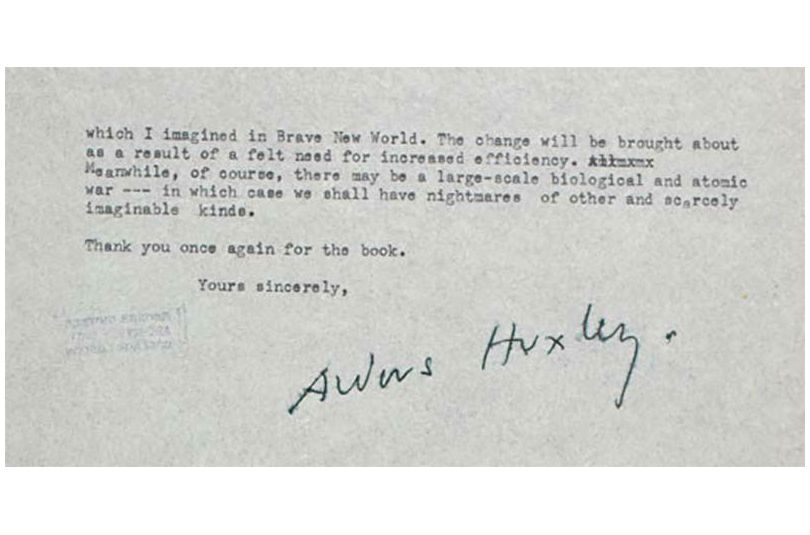
Within the next generation I believe that the world’s rulers will discover that infant conditioning and narco-hypnosis are more efficient, as instruments of government, than clubs and prisons, and that the lust for power can be just as completely satisfied by suggesting people into loving their servitude as by flogging and kicking them into obedience. In other words, I feel that the nightmare of Nineteen Eighty-Four is destined to modulate into the nightmare of a world having more resemblance to that which I imagined in Brave New World. The change will be brought about as a result of a felt need for increased efficiency. Meanwhile, of course, there may be a large scale biological and atomic war—in which case we shall have nightmares of other and scarcely imaginable kinds.—Aldous Huxley, a letter to George Orwell

Aldous Huxley and George Orwell not only wrote two of the twentieth century’s best-regarded dystopian novels—Brave New World and Nineteen Eighty-Four—but they knew each other as well: Huxley, a decade older than Orwell, taught French at Eton when Orwell was a student there and Orwell was one of his pupils.
Read More

Today in History: Oct. 20

According to Roger Patterson and his friend, Robert “Bob” Gimlin, the 950-plus frames of film they captured of a hairy creature wandering around in the great outdoors was shot on this date in 1967. The “Bigfoot film” is 49 today.

As with everything else that concerns this story, even the actual date of the filming remains unverified. Further, the original film stock itself was lost at some unrecorded point in time as it changed hands between film companies that tended to go out of business, as small independent film companies often do.

Was the film an honest-to-goodness recording of a real Bigfoot, a creature that has never been proved to exist? Or was it an honest recording of an honest-to-goodness attempt by otherwise unknown parties to play a hoax on the filmmakers? Or were the filmmakers in on a hoax and happy participants in it?
Read More

Today in History: Oct. 19

British forces led by Lord Cornwallis surrendered to the allied American and French forces in Yorktown, Virginia, on this date 235 years ago. This ended the Revolutionary War, but not completely, as skirmishes continued through the next year. Lord Cornwallis’ forces surrendered to General George Washington and the American forces but Lord Cornwallis himself sent his sword to the French forces to declare that his surrender was to the French not the new American army.

* * * *
Sir Edward Elgar’s Pomp and Circumstance March No. 1, which every American high school graduate hears one portion of (the “Trio” section), was introduced on this date in 1901 by the Liverpool Orchestral Society. Elgar conducted it himself.

Below the jump, a 1931 film of Sir Edward conducting an orchestra at the opening of the Abbey Road Studios, London, on November 12 1931. You hear him greet the players: “Good morning gentlemen. Glad to see you all. Very light programme this morning. Please play this tune as though you’ve never heard it before.”
Read More