
‘The Stuff That Dreams Are Made Of’

Alfred Hitchcock is credited with coining the term “MacGuffin,” but not the thing itself, which has been around since people started telling stories to each other. In plot terms, but not theological ones, the apple in Genesis is a MacGuffin.

Neither of the two most famous examples of a MacGuffin in film history appear in Hitchcock films, but he used the device quite frequently in his many movies (he directed more than 50 films from the 1920s through the ’70s).

In 1962, his fellow film director François Truffaut interviewed Hitchcock. The interviews were recorded and transcribed into a book, “Hitchcock/Truffaut,” published in 1967, and the subject came up:

You may be wondering where the term [MacGuffin] originated. It might be a Scottish name, taken from a story about two men on a train. One man says, “What’s that package up there in the baggage rack?” And the other answers, “Oh, that’s a MacGuffin”. The first one asks, “What’s a MacGuffin?” “Well,” the other man says, “it’s an apparatus for trapping lions in the Scottish Highlands.” The first man says, “But there are no lions in the Scottish Highlands,” and the other one answers, “Well then, that’s no MacGuffin!” So you see that a MacGuffin is actually nothing at all.

One wonders where Hitchcock had ever heard this story or if he merely invented it, since “two strangers meet on a train” could serve as a Movie Guide description for several of his plots. Hitchcock loved floating plot ideas and ideas of plots inside plots in interviews and pursued several dozen into film immortality. One has always stayed with me and I think I read it in the “Hitchcock/Truffaut” interview.

As I recall the scene he described, his lead character, played Cary Grant or James Stewart (of course) would meet with a man who runs a factory, an automated car assembly line. In a single-camera shot, the two men would walk along the line, discussing whatever it is that Grant or Stewart is searching for, and alongside them for the whole chat would be a car as it is assembled from frame to finished vehicle. The audience is supposed to barely notice the car or that the two men have been talking alongside only one car as it has acquired an engine, a roof, doors, mirrors. At the end of the line, Cary Grant happens to open the driver’s door and a body falls out. We’ve seen the same car all the way through, from when there was no place to hide a body all the way to completion, and … I think Hitchcock dismissed it in the interview with Truffaut as being an awful lot of work with too distracting a payoff.

In “Pulp Fiction,” what is inside Marcellus Wallace’s briefcase? We never find out. Perhaps it is a “royale with cheese.” Everything in that movie has to do with getting, delivering, or protecting that case. What is Charles Foster Kane’s “Rosebud” in “Citizen Kane”? In one movie, the question is answered and in the other it is not, and one could argue that neither movie would be fundamentally different if this statement was reversed. Remember how “Star Wars” starts to unfold, what it is “about”: getting R2-D2 to Obi-Wan Kenobi because there is a message from Princess Leia hidden inside.

Complications ensue.

A MacGuffin is the reason or, really, excuse, for all the characters to be in the movie (even if one of the characters is a MacGuffin him or herself) and for all of or most of the action in the plot, but it is not what the movie is about. The “holy grail” is literally not the “Holy Grail.” In “The Maltese Falcon,” Mary Astor’s character Brigid O’Shaughnessy asks Sam Spade if he would (be doing what he is about to do) if (money had possibly been acquired). (How was that for avoiding a spoiler?)

The falcon, jewel-encrusted treasure of centuries past, or not, is an innocent bystander for the entire movie. It sure looks like it is worth multiple lives, double- and triple-cheating, the sacrifice of love both real and imagined. As Det. Polhaus says in the second-to-last line, it sure is “heavy. What is it?” Sam Spade replies, and this is no spoiler even though it is the final line, “The, uh, stuff that dreams are made of.”

In any movie, if there is a box or a room that has remained locked or hidden in plain sight, the movie really is about the drive to unlock it or the search for a key and what a character might be willing to endure to acquire that key. The reward is in the journey and whatever it is you think the key is unlocking, it isn’t. In the broadest sense, having a story line at all is something of a MacGuffin.

____________________________________________
The WordPress Daily Prompt for November 17 asks, “You’ve been given a key that can open one building, room, locker, or box to which you don’t normally have access. How do you use it, and why?”

* * * *
Please subscribe to The Gad About Town on Facebook: http://www.facebook.com/thegadabouttown

Opus 40: An Update

In March I wrote a column about a fundraising campaign to help restore one of my favorite places, Opus 40, in Saugerties, NY. There has been plenty of good news since March.

Built in an abandoned bluestone quarry in upstate New York by one man, Harvey Fite, Opus 40 is a contemporary American version of Stonehenge or the collection of Easter Island moai.
Read More

Landing on a Rocky Rubber Duck

It took over a decade for the Rosetta space probe to travel approximately four billion miles. While not exactly a meander through the inner solar system—for several years it has been traveling at 34,000 miles per hour—its looping journey to Comet 67P/Churyumov-Gerasimenko actually led it be misidentified once, seven years ago this week, when astronomers noticed a previously unidentified asteroid heading our way. It was even given an asteroid name, 2007 VN84, before it was correctly identified and everyone laughed uproariously.

In August, Rosetta arrived at Comet 67P/C-G, its destination for the entire trip. Three times, the probe’s path brought it close to its home planet, which provided a gravitational swing each time to throw it farther away from the inner solar system. In one complicated months-long maneuver, it swung out by Mars, took a boost from that encounter to return to Earth at a faster speed, and then passed Mars again; that solar system pick-and-roll flung it into the asteroid belt, the rock quarry orbiting between Mars and Jupiter. The European Space Agency has provided an interactive website to illustrate this: “Where is Rosetta?

The comet is as old as comets are, billions of years old; it is made of stuff left over from the formation of the solar system. Comet 67P is a comet stuck in a stable orbit around the sun; it does not venture far beyond Jupiter’s orbit and does not come much closer to the sun than inside Mars’ orbit. One orbit, one year on Comet 67P, is about six and a half years. Every three years it is as close as it will come to the sun and every three years it is as far away as its orbit takes it. Thus, for Rosetta and its lander, it offers no surprises but many discoveries.

Right now, the comet is in the asteroid belt and making its return to the inner solar system. For the first time, it has a hanger-on. Today, Comet 67P, the Rosetta space probe, and the Philae lander are traveling partners 310 million miles from Earth.

It is the ideal comet to attempt to land on. Other comets, with longer orbits, like Halley’s Comet and other Oort cloud objects, develop a long tail as they come close to the sun, heat up, melt a little, and throw off material. They become unstable. This was spectacularly seen one year ago, when Comet ISON disintegrated as it approached the sun. Comet 67P has been through this process countless times already and is probably not going to heat up and eject too much material, but if it does, science will have a close-up seat.

In September, it started to heat up and gave Rosetta some spectacular views:

comet 67p

Jets springing from Comet 67P

Right now, comet and company are traveling at over 40,000 miles per hour, or 18 kilometers per second. As remarkable as that is, the manipulations and maneuvers to land Philae on the surface—which is dusty and icy and rocky and there is no way to know how stable that surface is or how thick the dust is without getting close and risking everything in a one-and-done landing attempt—slowed the lander to a one-meter-per-second speed after dropping it off. So the lander was traveling 40,000 miles per hour with the comet, and one meter per second closer to the comet, and the landing was not smooth: It bounced, but not off the comet entirely. Harpoons were supposed to secure it, but they did not fire for reasons still unknown. A few footpad screws appear to have been enough to settle the lander in place; millions of miles of travel and it was just like building a desk from Ikea: the big bolts that you were sure you weren’t going to use were never needed in the first place.

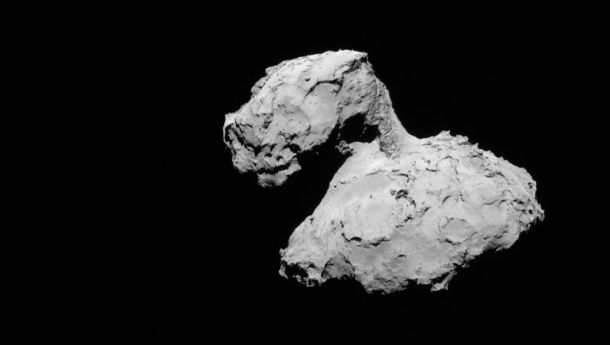
As Rosetta approached the comet earlier this year, it became apparent that the object had a complicated shape, that it has one big section and one smaller section. It is shaped like a rubber duck, and my affection for ducks is well-known. The lander is on the comet’s head, which is the smaller part, only about a mile and a half by a mile and a half.

This may be the most amazing fact of the whole project: the comet is not the size of a planet or even an asteroid; it is tiny. There is no human-sized comparison one can make to this without sounding ridiculous. It is like shooting a paperclip at a taxiing 747 and hitting an open window and landing it in a seat in first class. Or: Imagine you are driving cross-country at top speed tomorrow morning. Let’s say you are in Texas and the road is wide-open; it is like the world belongs to you. You hear your cellphone ring, try to locate it, find it but bobble it awkwardly in your hands; you accidentally bounce it out your open window, and then learn that it landed in someone’s hands while they were on top of the Eiffel Tower. Sounds silly, but it does not come close to matching the feat that the European Space Agency successfully accomplished today.

And now comes the science-y part.

____________________________________________
The WordPress Daily Prompt for November 12 asks, “Today you can write about anything, in whatever genre or form, but your post must include a speeding car, a phone call, and a crisp, bright morning. (Wildcard: you can swap any of the above for a good joke.)”

* * * *
Please subscribe to The Gad About Town on Facebook: http://www.facebook.com/thegadabouttown