No Man Is an Island
Daniel Defoe is officially credited as the author of 28 titles, but it is likely that he was the author of twice that, if one counts the pamphlets, essays, and other works he published under pseudonyms.
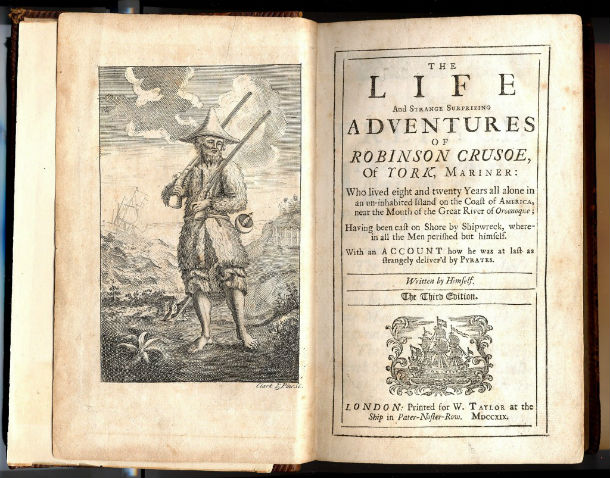
One of his titles keeps his name famous almost three centuries after he published it: “Robinson Crusoe.” Its full title on publication in 1719 was longer (ahem): “The Life and Strange Surprizing Adventures of Robinson Crusoe, Of York, Mariner: Who lived Eight and Twenty Years, all alone in an un-inhabited Island on the Coast of America, near the Mouth of the Great River of Oroonoque; Having been cast on Shore by Shipwreck, wherein all the Men perished but himself. With An Account how he was at last as strangely deliver’d by Pyrates.”
Defoe did not attach his name to the book; after that long title a single line of type is set aside with a dark line above and one below and “Written by himself” between.
Thus, from the birth of the novel in English, one of its creators started toying with the basic concept of fiction. It is the truest conceit of all fiction writing and it is there from the beginning: “This is a true story, I swear.” (“A guy told it to me once,” provided the next variation.)
Defoe was no castaway, although more than once in his life he might have desired a desert island life away from creditors and the crown. A dissenter, he was once put in the pillory and sent to Newgate Prison for writing a satirical pamphlet; a lifelong merchant who was sometimes on the unscrupulous side of unscrupulous deals, he spent time in debtors’ sanctuaries and on the run. He even died on the run, aged 70 or so. (His birth date, even the year, was not recorded.) He added the Francophilic “de” to his plain-sounding birth name of “Foe” to give himself a name redolent with upper-classiness.
And he wrote what many consider the first novel in English.
Sir Thomas Malory’s “Le Morte d’Arthur” was written and published more than two centuries before “Robinson Crusoe” and is a work of prose fiction that was popular enough to have been read by Defoe and his contemporaries, but its tales are interlocked, not interwoven. It is a collection of semi-separate tales. “Robinson Crusoe” is a first-person account of events that never happened to someone who never existed written by someone who was not that (fake) person. It is an adventure and it is a novel.
Within two decades, other types of novel were added to the fiction shelves: Samuel Richardson’s “Clarissa” and “Pamela” (picture for yourself modern-day romance novels with Fabio on the cover), Henry Fielding’s “Joseph Andrews” and “Tom Jones” (endless, convoluted plots and comic characters), and Laurence Sterne’s “Tristram Shandy” (a story about how impossible it is to tell a straight story), and most of the elements that make the novel as we still read it to this day were in place. (The mystery novel and police procedural came along later and complete the picture.)
By 1719, ships had been sailing between the Old World and the New for more than two centuries. The Caribbean was well-mapped, America was colonized by multiple countries, and the South Pacific was being explored, but the idea of a ship running aground on a previously unknown island was no mere fantasy: it was a reality and the story of a shipwrecked sailor long thought dead returning home would have been a familiar one to 18th Century readers.
One such sailor had returned home to London in 1711 after spending the years 1704–1709 alone on an island off the coast of Chile. His name was Alexander Selkirk, and while literary scholars still debate whether Defoe was writing a version of Selkirk’s story or that of one of the many other shipwrecked European sailors, it appears most likely that Robinson Crusoe’s tale is an amalgam of Selkirk’s remarkable story and the others. Crusoe was shipwrecked in the Caribbean and Selkirk had been marooned by his own request in the South Pacific; Crusoe made a friend of a local cannibal and named him Friday, and Selkirk spent more than four years utterly alone. (Why was Selkirk marooned by his own request? Rather than sail any further on what he considered a compromised and not seaworthy ship, he asked to be let off. His request was complied with, and, indeed, the ship sank further on.)
After his return to London, Selkirk was the subject of many books and gazetteer articles about his life alone far from home, but he quickly returned to his pre-maroon life of continuous bar fights interrupted by brief jail stays and took to the sea again, where he died of yellow fever in 1721. In 1966, the government of Chile renamed the island on which Selkirk had resided, Isla Más a Tierra, Robinson Crusoe Island and one of its companion islands, Isla Más Afuera, as Alejandro Selkirk Island.
The imagined life of a solitary shipwrecked sailor, far from the madding crowd and free to read his Bible (as Selkirk said he spent his days), retains its hold on readers, almost three centuries after Defoe fictionalized what was already a remarkable tale.
____________________________________________
The WordPress Daily Prompt for December 1 asks, “We’ve all been asked what five objects we’d take with us to a desert island. Now it’s your best friend’s (or close relative’s) turn to be stranded: what five objects would you send him/her off with?”
* * * *
Please subscribe to The Gad About Town on Facebook: http://www.facebook.com/thegadabouttown

November Thank-yous
This is the 30th post for the month of November 2014 on this website. I have not written something every day, but there have been a couple two-a-days, one “in memoriam” poster, and some reruns (yesterday). All adding up to a very special 30-for-30 episode.
I am beginning to feel like a host at a party with this project, and sometimes I want one reader who posts comments to meet another one (where can we all hang out for lunch?); then sometimes I will read a third person’s columns and see that those two faces have clicked “Like” on that other person’s work. “Ah, I see you two have met. Good.”
In December, The Gad About Town will be one year old on WordPress. I started this in the fall of 2013, on another blog-hosting site, and there it still sits: The Gad About Town. I might have acquired readers beyond my immediate family and immediate friends as I proceeded with the website there, but readers other than my immediate family and immediate friends started to respond to this site right here right from the start, hitting “Like,” or subscribing, or commenting. I did not know what I did not know when I moved to WordPress: That my need for instant gratification, my addiction to numbers, would be met here.
Anyway, it sometimes seemed that most of my page views on that service came from spam-generating sources (anything called “vampire” anything is not something that I feel happy about seeing visit my website fifty times in one short hour).
In the month of November, this site has been visited 1677 times so far (by real people), at a rate of 57 visits each day. Neither of those are big numbers; I am certain that many of the blogs I read every day get thousands of visits per day. There were 38 new followers, which is a term that I have decided I do not like. “Subscribers,” okay; “followers”? No. There was one award from a fellow blogger, Aruna, who writes every day at Ripples N Reflections.
A Facebook page was launched here: The Gad About Town. You can find me on Twitter over here: Mark Aldrich. There are some very supportive Twitterers who Tweet my columns to other Tweeting people. (That’s how that works, I think.) I also have Ello invites if you want one.
All of these numbers have increased dramatically since I started participating in the Daily Prompt exercise in August. Before then, I was publishing once or twice a week and approximately one person (other than my mom or girlfriend) would hit the “Like” button each post. Thank you, Susanne Leist; she is the author of “The Dead Game,” and more than once seeing her face pop up on something that I wrote cajoled me into writing a next one. That is the effect a blogging community can have: We egg each other on.
Here are some more thank yous: Judy at Lifelessons, my fellow spoonie Mary at A Body of Hope, Willow at Willow’s Corner, Leigh at Leigh’s Wordsmithery, Melissa at This, Right Now, Rebecca at Genusrosa, Dixie Copeland, The Reluctant Baptist, Lydia at A Lot from Lydia, Swoosieque at Cancer Isn’t Pink, Mark at Joatmon14, Rose Red at Gelatinous, Ina Vukic at Croatia, The War and the Future. There are other thank yous, but this list is some of the people who communicated with me in November.
In December (wait! that’s tomorrow!) I will start playing around with a new layout and, more important, get my big book co-writing project moving towards the door marked “Publish.” Thank you to all the future purchasers of that future book.
____________________________________________
The WordPress Daily Prompt for November 30 asks, “What’s the longest stretch you’ve ever pulled off of posting daily to your blog? What did you learn about blogging through that achievement, and what made you break the streak?”
* * * *
Please subscribe to The Gad About Town on Facebook: http://www.facebook.com/thegadabouttown
 The Gad About Town