Today in History: July 3

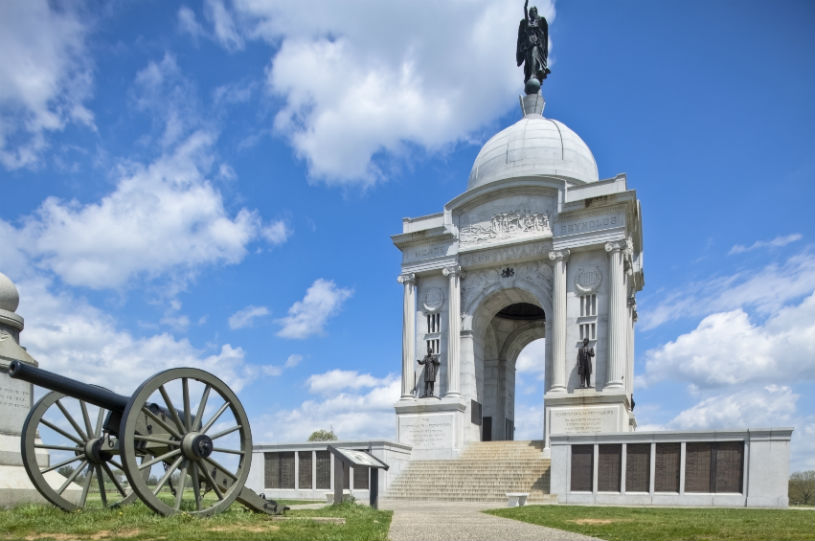
Pickett’s Charge, the disastrous infantry assault that ended the days-long Battle of Gettysburg, took place on this date in 1863 in southern Pennsylvania.

Having failed to take out the Union forces on either flank, General Robert E. Lee decided to attack the center. General Meade, the leader of the Union forces, correctly predicted this, so he and his troops waited out an artillery barrage that was intended to take out the North’s cannons. The barrage was indeed launched, but it did not damage the Union’s emplacement.

The Confederate forces assembled a mile-wide line of over 12,000 soldiers and began to march towards the Union forces across an open field, who took dead aim as the line advanced. Within an hour, the field was littered with some 7000 Confederate dead or dying, and the Union accepted a truce to allow the survivors to collect the dead and wounded.
Read More

I’m on Fire

Cooking is not something that I—what’s the word?—ah, yes: “Do.”

One does not live to be 47 without finding some food here and there, so I have eaten a thing or two most of the days I have spent here, and I must have even prepared a meal or a few in order to have made it this far. And I was not left to forage in the woods behind our house when I was growing up; my mom is an excellent and health-conscious cook. Thanks to her early adoption of a low- and sometimes no-salt kitchen, my heart will probably continue beating long after the rest of me has permanently allowed all my subscriptions to lapse.

This is not to say that I do not remember eating or cooking; oh, I do. My cooking is not memorable, though, in either direction: tasty treat or sublime sludge. I almost envy the good writers who are bad cooks (not as much as I envy the non-writers who are good cooks), because at least something interesting comes from their culinary assaults on taste and decency.
Read More

Today in History: July 2

“We have not been lucky enough to find anyone who saw him come down,” wrote H. L. Pinckney in the Charleston Mercury, “but the important fact that he was there is incontestable—and as he couldn’t have got there any other way, it was decide unanimously that he rained down.” On this date in 1843 in Charleston, South Carolina, a two-foot alligator was found on the corner of Wentworth and Anson in that city after a particularly violent thunderstorm, in which “the whole firmament growled thunder and shot lightning.”

Weather is fairly complex but it is also quite consistent. There are many stories of rainstorms bearing tadpoles and sometimes larger creatures that have been given a baffling free ride. In a world of many weather events taking place continuously, these things happen. But a two-foot-long gator, perhaps and perhaps not. As the writer in the Mercury confessed, no one saw the gator deposited with the downpour. But no one didn’t, either. By that standard, a two-foot-long alligator came down with the rain on this date in 1843 in Charleston, South Carolina.

The story was briefly popular in the national press; the clipping at the top of today’s “Today in History” is from the July 11, 1843, New Orleans Times-Picayune, but it reproduces Pinckney’s article.
Read More