Today in History: July 5

Why am I called upon to speak here today? What have I, or those I represent, to do with your national independence? Are the great principles of political freedom and of natural justice, embodied in that Declaration of Independence, extended to us? And am I, therefore, called upon to bring our humble offering to the national altar, and to confess the benefits and express devout gratitude for the blessings resulting from your independence to us?
 
I am not included within the pale of this glorious anniversary! Your high independence only reveals the immeasurable distance between us.
[…]
This Fourth of July is yours, not mine. You may rejoice, I must mourn. To drag a man in fetters into the grand illuminated temple of liberty, and call upon him to join you in joyous anthems, were inhuman mockery and sacrilegious irony. Do you mean, citizens, to mock me, by asking me to speak today?
 
What, to the American slave, is your Fourth of July? I answer: a day that reveals to him, more than all other days of the year, the gross injustice and cruelty to which he is a constant victim. …
—Frederick Douglass, July 5, 1852, speech: “What to the Slave Is the Fourth of July?”

Frederick Douglass, born a slave, was by 1850 one of America’s most famous abolitionists. (In Europe, he was one of the most famous Americans, period.) On this date in 1852, the Rochester Ladies’ Anti-Slavery Society asked him to speak on the topic “The Meaning of July Fourth for the Negro.” Some two-thousand five hundred words followed, a speech that whose title is often rendered as “What to the Slave Is the Fourth of July?”

Here is James Earl Jones reading a section of the speech, at a 2004 dramatic reading of Howard Zinn’s The People’s History of the United States. Zinn introduces (video after the jump):
Read More

Today in History: July 4

…[A]ll eyes are opened, or opening, to the rights of man. The general spread of the light of science has already laid open to every view the palpable truth, that the mass of mankind has not been born with saddles on their backs, nor a favored few, booted and spurred, ready to ride them legitimately, by the grace of God. These are grounds of hope for others; for ourselves, let the annual return of this day forever refresh our recollections of these rights, and an undiminished devotion to them.—Thomas Jefferson, letter to Roger Weightman, June 24, 1826

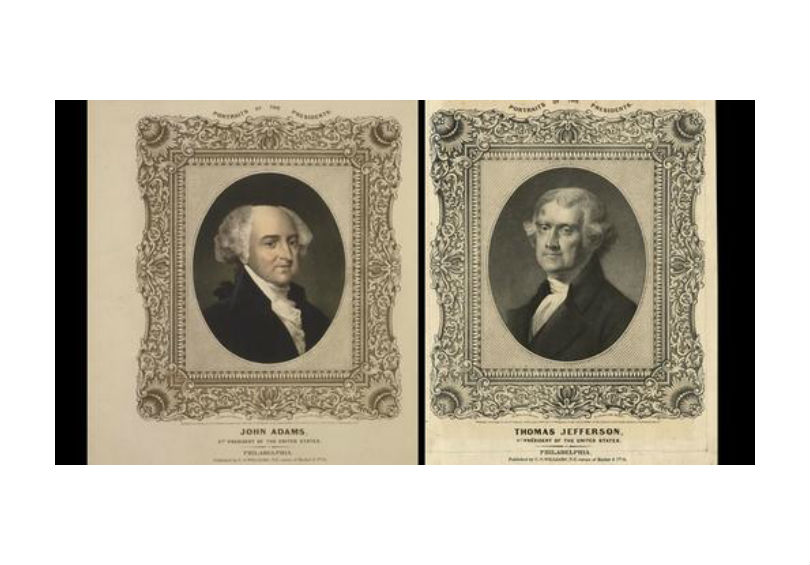
Two of America’s founding fathers, John Adams and Thomas Jefferson, died 190 years ago on this date. For each man it was a remarkable date to leave this life: Adams had pushed the legislation to declare independence from Great Britain, and he enlisted Jefferson to write the document that acted as the vehicle for independence.

July 4, 1826, was the fiftieth anniversary of independence. Adams was 90 and Jefferson was 83. They had continued their correspondence with one another and their final letters to each other date from the anniversary year. Neither man was able to attend festivities in honor of the event or his role in it.
Read More

On an Island

Daniel Defoe is officially credited as the author of 28 titles, but it is likely that he was the author of twice that, if one counts the pamphlets, essays, and other works he published under pseudonyms.

One of his titles keeps his name famous almost three centuries after he published it: Robinson Crusoe. Its full title on its publication in 1719 was longer (ahem): The Life and Strange Surprizing Adventures of Robinson Crusoe, Of York, Mariner: Who lived Eight and Twenty Years, all alone in an un-inhabited Island on the Coast of America, near the Mouth of the Great River of Oroonoque; Having been cast on Shore by Shipwreck, wherein all the Men perished but himself. With An Account how he was at last as strangely deliver’d by Pyrates.
Read More