At 2:00 p.m. EST today, the Baseball Writers’ Association of America (BBWAA) announced the winners of its Hall of Fame vote, held by mail in December. The official ballot has been growing in length recently, as the writers have failed to elect or have elected only one former player for several years in a row.
This is because some of the players on the ballot, many of them players with marquee names, are associated with on-the-field performances that may have been influenced by the consumption of performance enhancing drugs (PEDs).
While they were players, Barry Bonds, Roger Clemens, Sammy Sosa, Rafael Palmiero (who will not appear on future ballots after today’s vote), Curt Schilling, Mike Piazza, Jeff Bagwell, and Mark McGwire were often described as “first-ballot Hall of Famers,” which is a compliment bestowed on a player to denote not just ordinary Hall of Fame greatness, but the highest level. “So-and-so won’t have to wait to be recognized, he’ll be elected right away.” (The BBWAA voting rules stipulate that five seasons must have elapsed between a player’s final game and their appearance on the ballot.)
Each of the players named above is making a repeat appearance on the ballot. They can never join the pantheon’s pantheon of first-ballot Hall members. They each have one other thing in common: Each one’s name has appeared in either legal documents concerning matters related to PEDs, at worst, or mere blog posts discussing the issue, more frivolously.
Two problems are colliding with the vote this year: 1. The voters are emphasizing one hazily-defined word in their own voting criteria more than they have in the past, and 2.) The BBWAA set an arbitrary rule that voters can only check off a maximum of 10 names on any year’s ballot. (Not that the Hall will limit inductions to a maximum of 10 in a given year–the controversies should there be a tie for tenth place the one time it might happen needed to be avoided–but that any voter, and there are about 550 of them, is limited to voting for a maximum of 10 former players.)
The second problem first: I just listed eight players who are making repeat appearances on the ballot this year, and about four “first-ballot Hall of Fame” players are making their first appearance on the ballot, players whose names have not been associated with PEDs, except in articles in which it is pointed out that their names are not associated with PED use. (The four, according to me, are Greg Maddux, Tom Glavine, Frank Thomas, and either Mike Mussina or Jeff Kent. Look at that “or” there: if I were a voter, I would not be able to limit myself to 10 names.)
The 10-vote maximum rule is an arbitrary one that can easily be remedied if the BBWAA sees fit, and one or two years of allowing more to be included might clear the backlog. The reason(s) for the backlog are not so easily remedied.
The ballot states and has always stated one criteria for election to the Baseball Hall of Fame:
Voting shall be based upon the player’s record, playing ability, integrity, sportsmanship, character, and contributions to the team(s) on which the player played.
Which word do I think is the hazily-defined one? Integrity refers to how the player performed in the game on the field. Did he cheat on the field during games? If a player breaks the integrity of the game in this way, not only will he not get into the Hall, he will more than likely earn a lifetime ban from anything to do with professional baseball, like Pete Rose or the 1919 Chicago White Sox players.
“Character.” I am not the first to consider this word and its place in this particular voting rule. Is the ingestion of PEDs off the field to build up physical strength or speed up recuperation from injuries a character issue? If the chemicals were not taken by every major league player, there is the near-certainty that those players who took PEDs created for themselves an advantage over their rival “clean” players. Further, even if it is a character issue, did it have an impact on the integrity of the games they appeared in?
Many of the baseball writers and Hall voters have found their way into some tangled thickets of logic while trying to connect character and integrity. A few have found integrity by issuing blanket denunciations of the entire “Steroid Era” and not voting for anyone who played in the era. Others have found integrity by voting for the entire slate every year with the reason given that if the entire era was tainted than it was an even playing field for all and certain players excelled to a Hall level on that equal field.
The examples of tangled logic come when certain writers decide to use their ballot to draw distinctions between specific players. I have not yet seen a column or blog post in which someone has written, “Player X is alleged to have only used steroids for three seasons but for the rest of his career he is said to have been clean, while Player Y used them for the majority of his career, so he’s not getting into the Hall,” but they do come close with Barry Bonds.
With Bonds, the standard line has become something like, “He was a Hall of Fame-caliber player before he is alleged to have started using steroids, but then he started using steroids. So he’s out.”
What is a Hall of Fame for? The BBWAA has only one other stipulation about qualification under its “Automatic Election” clause: No election can be based on a single or singular performance, like a perfect game or .400 batting average. That is the only limitation. Other than that, it’s on the field performance. Is a player someone who ticket buyers spent money to see play? (I suggest Nolan Ryan as an example here.) For an extended period of time? If not, did teams keep hiring him to play, season after season for an extended length of time? (Like my pet cause, Tommy John.)
I am in the group that sees the steroid era as having been an even field and am inclined to include in the Hall all the players that excelled in the PED-infested era (which we still appear to be in). All things being equal, certain performers excelled and certain others did not, just like in any other era of the game.
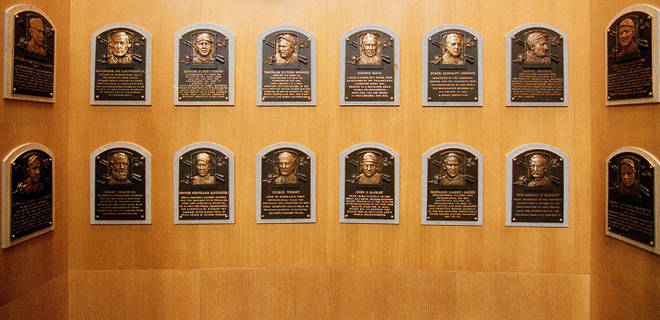
The game’s overseers banned the spitball in the 1920s, as the pitch can give an advantage to the pitcher who uses it over the pitcher who does not. But there are spitball pitchers from the spitball era with plaques in the Hall. It was a different era, so the spitball is handled as a artifact from a period in history that we are no longer in. Sort of like steroids may be in the future.
Thank you for sharing this via one of these wonderful services:


 The Gad About Town