Thinking of you today, Charles F. Brennan, III, my friend Charlie (November 2, 1960–April 7, 2014). His funeral mass card carried a quote from Emerson: “To laugh often and much; to win the respect of intelligent people and the affection of children; to earn the appreciation of honest critics and endure the betrayal of false friends; to appreciate beauty; to find the best in others; to leave the world a bit better whether by a healthy child, a garden patch, or a redeemed social condition; to know even one life has breathed easier because you have lived. This is to have succeeded.”
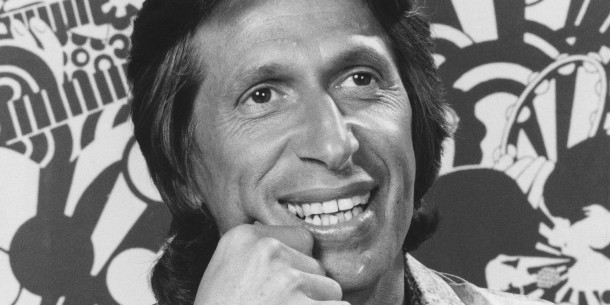
For a ten-year-old who was starting to notice two things: 1. the grown-up world had a lot of gaps in its “logic” and 2. laughter felt better than confusion, David Brenner and his droll commonsense stand-up act turned out to be a revelation. He was one of the first stand-ups I unofficially studied; I remember listening to his albums over and over, searching for the moment, the word, that would make the recorded audience laugh. That makes me pretty sure he resides in my perspective on the world. As Johnny Carson introduces him in the clip below, it was a “somewhat warped” perspective.
The news that David Brenner died today at age 78 reminded me that I had not thought about Mr. Brenner for a long time, much like most things I liked when I was 10. A love for the New York Yankees, strawberries, and comedy in general are about the only things I have in common with my ten-year-old self.
In my teen years I ignored or even rejected anything I had liked when younger, and of course, like every teenager worth the term, I also rejected anything my parents liked. So, with prejudices like these, David Brenner stood no chance in my world. He was not “edgy,” not “interesting,” not a lot of things. He was not absurd like Steve Martin and not dry like Steven Wright and not inflamed like Sam Kinison or angry like Bill Hicks. He was in my comedy DNA, but he was one of my mom’s favorite stand-ups, so he was old.
But I also liked, even loved, “old” comedians. The old vaudevillians, all of them, I adore. When YouTube started to become popular, one of the first things I looked up was Ed Sullivan clips—I wanted to see if my recollection of certain comics was right or not. I like to think I was the first person to enter “Myron Cohen” as a search term on YouTube. My parent’s generation of performers? Not old enough, I guess.
One of the first Tweets I saw today about Brenner’s death asked, “Why is it so hard to believe he was 78?” Almost every photo of him in his obituaries today is from the 1970s, with a helmet of hair and Johnny Carson nearby. He remains ever 40. Even though he was still a working stand-up at his death, he was not a television presence and had not been one for almost 20 years, when he briefly had a show on MSNBC. (Who hasn’t “briefly” had a show on MSNBC by now?) He had a couple hit books in the ’90s, but so did every comic.
Something did not happen for David Brenner that happened for a lot of comics when the next generation came along: They did not bring him on their shows very often. When Johnny moved on and Jay and Dave took up permanent residence at 11:35 p.m. and yet more talk shows proliferated, Brenner was an only occasional presence, even with the larger number of late-night stand-up slots available. Brenner was dubbed “the father of observational humor,” but only after “observational humor” became a term, after Jerry Seinfeld and Paul Reiser and others were making millions talking about how interesting it could be to find mundane the things that … actually were mundane.
Among Brenner’s generation, George Carlin started out doing fairly conventional characters before he became an unconventional character himself, one who noticed absolutely everything and filtered it through a jazz poet’s brain. Robert Klein was the cool history professor. Bill Cosby told shaggy-dog stories that made the familiar comfortable. Richard Pryor was a force of nature—the reason “Pryoresque” is not a term is because he was uniquely himself and made the unfamiliar uncomfortable. None were “observational comics,” none were professional noticers of the lack of logic in our everyday lives like David Brenner. He was one of the first.
Brenner did not yield details about his current life, but he reminisced about growing up in West Philadelphia with a novelist’s eye for detail; he did not do impressions, but he easily tossed out one-liners from cabbies he encountered and the like (they all sounded like him). He did not bring audiences into a tortured psyche like Richard Lewis; he was ever cheerful, and ever 1970s. When Johnny Carson started making his schedule easier and bringing in “guest hosts,” Brenner filled in 75 times, but all in the late ’70s and early ’80s. By the time Carson was retiring, the battle to replace him was between Letterman and Jay Leno and there were no other names.
David Brenner never found himself on the outside looking in and was thus never the subject of a “where are they now”-style re-discovery, but he also never got bigger than he was in the 1970s, when he appeared on almost every talk and game show and in every nightclub and medium size theater. For a time, he seemed as ubiquitous as a public utility, and then, for showrooms on the Vegas strip, he was a public utility: cheerfully reliable and pleasantly maintenance-free.
There are worse things to be said about a career. So even though I did not think often in recent years about the late David Brenner, I was aware he was still out there, still making people laugh. I have come to respect the people who are public utilities in our lives, and I only wish I had randomly written this appreciation yesterday instead of today, before an occasion brought it.
* * * *
Loved David Brenner. He gave me good advice early in my career (which I wrote about in my autobio). A gentleman, and really, really funny.
The story that Steve Martin tells in “Born Standing Up,” his “autobio”: “I called the comedian David Brenner for advice. David was successfully guest-hosting The Tonight Show and filling theaters and clubs. Our paths had crossed, and we had exchanged phone numbers. I explained that I was getting jobs, but the travel costs were killing me. If I got five hundred dollars for an appearance, it would cost me three hundred just to get to it. He told me the deal he always proposed to club owners. He would take the door, and they would take the bar. He said he would hire someone to stand at the entrance with a mechanical counter to make sure he wasn’t being cheated.”—”Born Standing Up,” 146-7.
41.747593-74.086810
Thank you for sharing this via one of these wonderful services:
The annual corporate image overhaul was usually followed by a frenzy of inaction, no changes outlined or implemented at all. One year, “corporate” decided that its most valuable property was the company’s image as a solution center, the place customers visited to get answers, like spiritual seekers traveling to commune with a lama on a mountaintop. The decades-old reputation of sales associates possessing a broad and deep knowledge base was the asset that was advertised, but the advertising was backed up with no internal education initiatives or local emphasis on, well, anything.
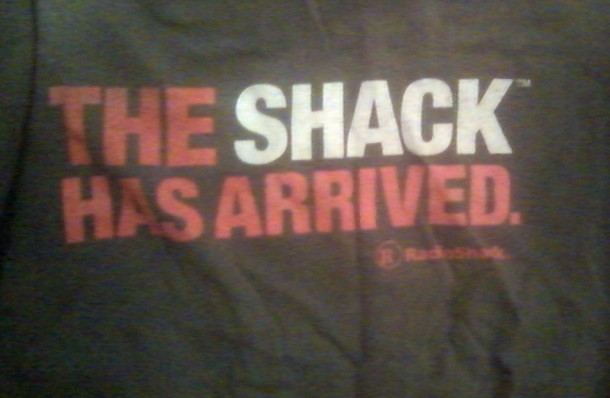
To be a bit nicer about it, I did get a pretty reliable t-shirt that I still wear sometimes, as seen in the photo above.
The latest news from RadioShack—that it is closing about 20% of its stores, that declining sales resulted in a net loss of $400 million in 2013—resulted in a statement that I overheard more than once last week: “Yeah, RadioShack went out of business. They closed yesterday.” It isn’t going out of business, not yet, and not yesterday, but how often do you hear RadioShack’s name come up in water cooler conversation anymore? And if and when you do, for the last several years, the next part of the sentence usually has been “… is going out of business.”
It is difficult to manage news properly when you have spent the last decade attempting to manage expectations.
Like many people, the first personal computer I ever used was a TRS-80 (Tandy Radio Shack-80), on which I learned the BASIC programming language and which we used in some now forgotten way to produce the very first newspaper I wrote, for my junior high school. (We also used a hand-cranked “ditto” machine.) From 1980 till 2005, I did not set foot in a Radio Shack, or give a thought to its stores or its brand. My association with the company was that it was for hobbyists and that I am not one. I bought my first computer from an Apple retailer, my phone from a department store, batteries from the local convenience store. The first and last time that I soldered something, it was not fun and I was a Cub Scout.
Running parallel to my various professional career employments has been my back-up: retail sales associate. In the 1980s, I partly paid for college by working at a Montgomery Ward (now out of business). Through the 1990s, I worked for an independent family-owned bookseller (now out of business). Starting in 2005, I worked at two RadioShacks in two locations, for two very talented managers. I became very fond of RadioShack and its long retail history, and I left the company in 2010. So yes, the only thing these various stores have in common is my employment with them and … well, at least RadioShack is still in business. As of today.
But for how long? In 1986, the Montgomery Ward in which I worked not only sold a lot of everything, but it also had its own cafeteria, so that shoppers, weary of their morning spent spending and ordering and redecorating, did not even have to leave the premises to eat. They could continue shopping after chowing down on a burger. Department store visits were destination shopping experiences, and customers could brand their entire home as Sears or Wards residences; a century ago, one could even buy a house, design plans and material and tools, from those companies’ catalogs. But one could also dash in and pick something up in an emergency—a roll of film or a pack of batteries or light bulbs or a necktie to replace the one with a fresh coffee stain. (I’m just spit-balling ideas here; that never happened to me.)
The malls replaced the department stores as destinations in themselves, plus they threw in a movie theater. Most of the major department stores have closed, except Sears and Kmart, and Sears is considered troubled by analysts and Kmart is continuously restructuring.
For a while, bookstores grew into destination experiences in the way they combined music sections with huge periodical collections and more than a few books. But by the mid-1990s, online retailers were beginning to attract attention—well, Amazon was—as well as a piece of the retail dollar. Many online retailers retain one’s entire purchase history; Amazon shows that my first purchase with it was made in 1998. At around that time, I first heard a customer reply to the information that a book was not in stock with this sentence: “I’ll drive over to Amazon and get it there.” When my colleagues and I would politely offer the information that no such thing as “an Amazon store” existed, they would correct us in return and say that they had been there the night before.
“Amazon” had come to mean “the big Barnes & Noble in the next town” for our customers, and Barnes & Noble was in trouble because of this association, too. Amazon has never had a physical store, and each retail operation that earns all 100 cents of its sales dollar from sales completed in real stores on real streets with real employees and real customers has been flummoxed for 15 years by this fact. Almost every bookstore tried to establish a dot.com enterprise only to discover—shortly after their customers discovered this first—that fulfillment meant getting the book that had been ordered into the store for the customer to pick up. And if the customers were going to visit the store for the privilege of paying shipping for a book that, if only you had stocked it there would have been no shipping charge, well, customers were going to find an alternative, like paying for shipping to their doorstep and not visiting your store.
The speed with which the book selling sector collapsed—Waldenbooks, Borders, hundreds if not thousands of independent booksellers—has only recently been rivaled. By the electronics sector.
And again, it is a combination of what was revolutionary about Amazon (and Walmart) combined with some baffling decisions and perplexing identity crises by electronics stores. The numbers are staggering, as pointed out in this Atlantic Monthly article:
RadioShack’s long slide coincides [with] the steep ascendance of Amazon as America’s great brick-and-mortar destroyer. In 2003, Amazon and RadioShack each had about $5 billion in sales, as WSJ business editor Dennis Berman pointed out. Last year, Amazon had $75 billion to RadioShack’s $3.5 billion.
Some further comparison is illuminating: At the end of 2013, RadioShack had 5,000 brick-and-mortar stores with 27,500 employees and $3.5 billion in sales, which is $127,000 in sales per employee. Its website is the 1,066th most popular in the world. At the end of 2013, Amazon had zero brick-and-mortar stores with 117,300 employees (full- and part-time) and $75 billion in sales, which is $640,000 in sales per employee.
Once upon a time, a decade ago, RadioShack and Amazon were the same size. But RadioShack has had six logos and changed its name twice since the late 1990s. Its annual Christmas advertising blitz has included gimmicks like casting Shaquille O’Neal as a spokesman, promoting itself as the public’s wireless destination, installing Amazon.com “fulfillment lockers” in stores (so Amazon customers who did not want things shipped to their homes could have them shipped to their local RadioShack (!) just to bring customers into the stores), and, it is worth repeating, decisively changing its name to “The Shack” and then decisively back. More than one writer has pointed out that “RadioShack.com” is an oxymoron and is also the history of technology in one mouthful. This year, during the most-watched Super Bowl in history, viewers saw the company make fun of itself in a way that won the company a lot of affection but probably not one single new customer.
In fact, according to the Wall Street Journal’s online publication, MarketWatch, “On March 4, RadioShack’s ‘consumer perception’ among American adults who made a purchase in the store within the previous 90 days was just 8%, according to an analysis carried out for MarketWatch by YouGov BrandIndex.” In English, of those people who recently spent real money in a real RadioShack, only 8% were aware of RadioShack as an anything. For comparison, Best Buy gets a 22% customer perception rating. So the amusing ad did nothing except declare that, yes, we know you know we think we are out-of-touch, but, um, we won’t be like that anymore. “Come see what’s possible when we do things together,” is the new slogan. Are you asking me or telling me? Um, “things?”
What do all the recent headlines generated by the news of RadioShack’s imminent imminence mean, really? What are we telling ourselves about what we think we are (maybe) going to miss, if 92% of RadioShack’s actual money-spending customers were not even aware they spent that money in a RadioShack? Most of the business analyst articles are not about the changing face of retail in the face of a hundred-year-old company’s demise but head-shaking premature obituaries, neither musings about ways forward for the company nor attempts to explain how RadioShack has managed to stay alive after so many previous obits.
RadioShack is the company whose image for more than a decade has been “the store that thinks you need to be reminded of its image.” Sometimes the R is sans serif and sometimes it is serif, sometimes we are “The Shack” and sometimes … when a company does not know why it is in business, just that it wants to remain in business, it closes, sometimes quickly, sometimes slowly.
It will always de-materialize if you don’t work for it.
41.747593-74.086810
Thank you for sharing this via one of these wonderful services: