Wherever You Go, There You Weren’t

In recovery circles it is called, “pulling a geographic.” While sharing their stories about the past and living the inebriated life, many addicts and alcoholics learn that they have done similar things. (Although I am the only person I know of who stole a commuter train. For only five feet, but still. Sorry, Metro-North.)

One of the things that many of us did a lot of when we were trying to exert control over life was run from it. Move. Sometimes cross-country. There was nothing so bad it couldn’t be fixed without filling out a change-of-address card.

Some might call this “running away from one’s troubles,” and those “some” people would be correct, somewhat. At the time, I did not see things that way. I was taking advantage of new opportunities. And now, I am grateful for all that I have seen; as I have written somewhere, if I am content-verging-on-happy about life now, how can I resent my past? I hate some things that happened to me, some things that were done to me and some things I did, but I no longer yell at ghosts. (Understand, my life is pretty not-entangled, given that I do not yet have children.)

By the oldest of old-fashioned reckoning, counting on my fingers, I have resided at more than 20 addresses in six counties across three states in two time zones. (This includes three residences in four-and-a-half years in recovery.) And there are about a half-a-dozen “I almost lived there” cities that sit in my memory like books unread on a shelf in a library I no longer have a membership card to. Two suburbs of Boston, Massachusetts; Jersey City, New Jersey; Sheboygan, Wisconsin; Nashville, Tennessee.

Each one of those place-names sounds to me like a bullet whistling past my head, an anecdote of a disaster that I did not have to watch unfold in front of my eyes as if I was a bystander in my life instead of a participant. I had enough disasters in the places in which I resided; and, yes, I might have found recovery in any one of those fine cities and be celebrating many more years of recovery than I have, but I did not. Life is perfect where I reside, even in its many imperfections.

Oh! and California. I had a few job interviews with newspapers in the Bay Area. It was the late 1990s and several friends and acquaintances had moved to the Golden State. (Matt Coleman, Some Memories.) By the late 1990s, several had moved back to New York, of course, but not all. I have yet to set foot west of Sedona, Arizona.

Wherever I moved, the fact of successfully landing a new job, which was always the spur for any change in residence for me, carried with it the idea that I was a success in this life and had no problems ticking away in my psyche. “Sometimes sooner, sometimes later,” as the saying goes, this hubris that masqueraded as self-knowledge always resulted in the loss of employment, change of address, loss of friends.

(I never consumed on the job. I always drank off the clock. But at some point, those two facts will be over-ridden by how much one consumes off the clock and how little one produces on the job. An illustration of the progression of addiction: I liked to drink as a celebration of successes. I worked hard and earned it, went the thinking. Publish something? Go out, get congratulations from people, drink. Finish writing something? Okay, great, you’ll submit it tomorrow. Go out, get congratulations from people, drink. Get pretty far into an assignment? It’s late, you’ll get it done tomorrow. Go out, congratulate people, drink. Start something? Cool. Go out, con … people, drink. Button your shirt correctly on the first try? Drink alone. Go out tomor … soon.)

You know, I never fooled myself into believing that I was indispensable, but did I have to prove it so often?

Wherever I went, there I wasn’t, completely. Four-and-a-half years off that hamster wheel, and I feel like I can make it anywhere.

____________________________________________
The WordPress Daily Prompt for December 5 asks, “‘If I can make it there, I’ll make it anywhere,’ goes the famous song about New York City. Is there a place—a city, a school, a company—about which you think (or thought) the same? Tell us why, and if you ever tried to prove that claim.”

* * * *
Please subscribe to The Gad About Town on Facebook: http://www.facebook.com/thegadabouttown

Mea cuppa

One of my superpowers is breaking things.

Now, I know that anyone can break anything with enough gumption and/or strength. At best, it is an inadvertent superpower; at worst, it is doom for the planet. I am not certain that I can not break paper.

I learned that I have this superpower the hard way: By claiming that I do not have it. I no longer remember what point I was trying to illustrate when I said to a group, “Nothing’s unbreakable. Right? Who hasn’t broken a so-called ‘unbreakable’ comb?” Perhaps I was talking with a group of fancy people who don’t buy their combs at convenience stores or truck stops, but I had had the experience of buying and later snapping in half a comb that had “unbreakable” written right on it. In. Capital. Letters.

Like some of you, no one in the group knew what I was talking about. Each one’s experience with combing his or her hair with an unbreakable comb was only as described on the tools themselves. Bendy, yes. Twisty, uh-huh. Breaky? Just me.

I once broke a Livestrong bracelet. What was I trying to do with it? Put it on my wrist. It snapped and flew across the room.

A few weeks ago, I was cooking. It happens. I was cooking something in a Pyrex pan in the oven, which is something I should not do. I have metal pans and, usually, common sense. I had a Pyrex pan in the oven, and when the dish was done, I removed it from the oven. (Most cookbooks describe this part, which is the most exciting after all, very blandly. “Remove dish from oven.” It’s the single most exciting part of the cooking experience! Whatever the opposite of overkill is, that right there is an example.)

I moved the food onto my plate and carried the Pyrex back into the kitchen. And then, because I do not think things through, I placed the thick glass cookware in the sink …

(Did you know that not all Pyrex is the same? (Thanks, online world of information.) Corning divested itself of its consumer goods division 16 years ago and licensed the name “Pyrex” to other companies, some of which use a different formula from Corning’s classic recipe, and thus produce glassware that is sometimes not as heat-resistant as Corning’s original. Of course, “heat-resistant” was always something of the point to Pyrex, so this is just terrific. If you see a Pyrex product with the red logo “PYREX” in all caps, that product is one that was made by Corning with the original formula and is stronger. The other logos are the newer products, which are not knock-offs precisely, as Corning did grant those companies licenses, but they are not made following the same formula.)

… I placed the heat-resistant glassware in the sink and hit the faucet. In a split-second, I remembered that objects right out of a hot oven react violently to cold water and I twisted the faucet back off. One drop of water (no exaggeration) left the faucet. When it hit the Pyrex, my sink was suddenly filled with shards of glass. Some of the shards were as big as a finger, let’s say someone’s middle finger, but most were smaller. Oh, and steam.

So I break things. Things that were invented because they are less likely to break.

With great power comes great responsibility, so what am I doing making my morning coffee in a press? (A fine example of which, not my personal one, is seen above.)

The French press “is essentially open-pot coffee with a sexy method for separating the grounds from the brew. The pot is a narrow glass cylinder. A fine-meshed screen plunger fits tightly inside the cylinder; you put a fine-ground coffee in the cylinder, pour boiling water over it, and insert the plunger in the top of the cylinder without pushing it down. After about four minutes the coffee will be thoroughly steeped and you push the plunger through the coffee, clarifying it and forcing the grounds to the bottom of the pot. You serve the coffee directly from the cylinder. Be certain not to use too fine a grind unless you have an athlete or a weightlifter at the table; the plunger will be almost impossible to push down through the coffee.” This is from Kenneth Davids’ classic book, “Coffee: A Guide to Buying, Brewing, and Enjoying,” and my quote is from the 1981 edition. His more recent edition changes the ground to “coarse-to-medium,” the water from boiling to “just short of boiling,” and loses the weightlifter joke. Oh, and “sexy” is changed to “sophisticated.” Too bad.

He goes on, “The plunger pot was apparently developed in Italy during the 1930s, but found its true home in France after World War II, when it surged to prominence as a favored home-brewing method.” That is why, when I first saw one in a friend’s kitchen, I asked if the thing was a “French” press. I knew that much, I guess. I also asked where one turned it on. She didn’t stop laughing long enough to tell me.

After two years of making coffee with one of these, I have broken two so far. Because that is what I do.

____________________________________________
The WordPress Daily Prompt for December 4 asks, “If your furniture, appliances, and other inanimate objects at home had feelings and emotions, to which item would you owe the biggest apology?”

* * * *
Please subscribe to The Gad About Town on Facebook: http://www.facebook.com/thegadabouttown

A Leet

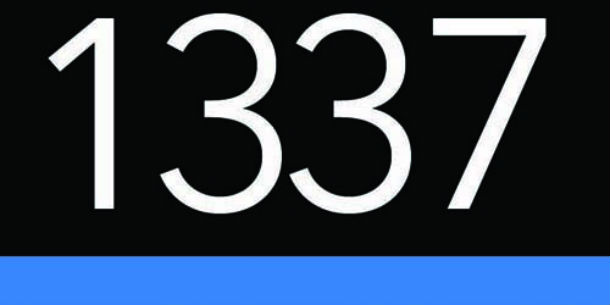
According to WordPress and other services, the number 1337 is important. It is not important for obvious reasons, like, say, reasons that are important, but for more obscure, talismanic ones.

Almost from the start, the online world has been something of a secret handshake society, but a democratic one, in which one and one’s friends can come up with a new secret handshake, and a capitalistic one, in which some secret handshakes become more popular, trendy. Elite. Or, “1337.”

Going back thirty years, users of programming language and speakers of everyday speech started to find places where the two collided. Going back thirty years, teenagers were passing messages to kids in the next aisle by typing on their calculators. Remember doing that? Certain numbers look like letters upside-down, so when one types 0.7734 that is also saying, “hello.” Here is a list of 250 such calculator-words: 250 Words You Can Spell with a Calculator.

I have had only one problem with this from thirty years ago to today: 0.7734 has never looked like “hello” to me. I just do not see it. I was the friend across the aisle from you in school who, when you showed me a secret calculator message, inadvertently said out loud, loud enough to attract the teacher’s attention, “What?”

I also do not see hidden anythings in “magic eye” posters, other than pretty fractals and colors, so I am just a generally all-around evil human being and no fun at all.

In the early days of the internet, in the era of bulletin boards and relay chat, the era in which someone typing on a keyboard in a movie was the height of real drama, those sorts of calculated calculator misspellings became a short-hand way of demonstrating one had inside knowledge about a topic at hand. Some of these terms have entered the culture at large, like newbie or pwned, and many have not.

For all of my life, I have felt like an outsider gazing in at a world of secret handshakes. Further, I am at my most uncomfortable when I try to look like I think I belong with you. Thus, when the kids in school in the ’80s who were “into computers” made it look like a secret society, I lost interest in programming. (Your loss, gaming community!) When the secret handshake society’s special vocabulary filters into the larger society and becomes a trendy lingo for a month or two or a couple of decades, it makes the world look like how I feel when I am trying to bluff my way into fitting in.

(Amusingly, I am composing this rant in a WYSIWYG in which I write my own simple HTML code and do not use a visual editor, a habit dating back to my newspaper work and a blog I started writing [now long lost] in 1997.)

1337-1xWhen one achieves 1337 of anything on a website, it is worth noting because 1337 is a lot of anything. In the case of The Gad About Town, it reached 1337 likes on November 26, when someone liked the column, “Gratitude Week.” In old-school hacker lingo, being an elite member of the community was designated by referring to them as elite, or a leet, or 1337. Again it’s the upside-down calculators that I have never looked at without saying, “What?”

Thank you to my readers and especially those who make the effort to express that they like some of the things I do. You have liked me more than 1337 times so far in ten months, which definitely makes me feel like a member of an elite.

____________________________________________
The WordPress Daily Prompt for November 28 asks, “Today, publish a post based on unused material from a previous piece—a paragraph you nixed, a link you didn’t include, a photo you decided not to use. Let your leftovers shine!”

* * * *
Please subscribe to The Gad About Town on Facebook: http://www.facebook.com/thegadabouttown