The Mother of Thanksgiving

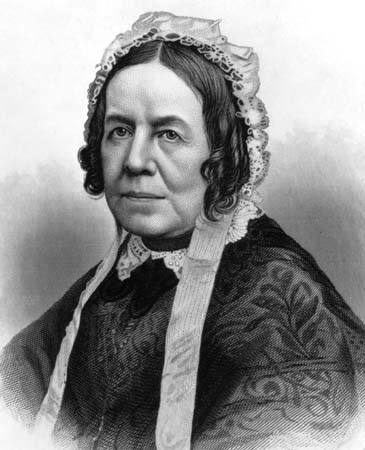
In most of her portraits, Sarah Josepha Buell Hale, the reason we celebrate Thanksgiving, looks stern. Gentle, but stern. She was an editor, but befitting a woman of her era, she employed the term, “editress.” From age 33 until her death at age 90, she wore black, to designate her as a widow in mourning from the day her husband died until the day she was to join him.
hale

Sarah Hale

Hale was the editor (“editress”) of Godey’s Lady’s Book, a pre-Civil War monthly magazine that sometimes topped 100,000 in circulation. She held the job for forty years, retiring in 1877 when she was almost 90. Her legacy as editor is a mixed one: she wrote and published articles in favor of advanced education and employment opportunities for women but her publication (and she) did not support women voting.

Gentle, but stern; she was anti-slavery and pro-North and pro-Union (she was a New Englander) but anti-war. Her point of view was that women writers wrote for women and for children.

Sarah Hale, 1831

Sarah Hale, 1831

Indeed, earlier in her career she wrote poetry for children, and one of her poems is a work so famous that it is surprising to learn that a human being wrote it: “Mary Had a Little Lamb.” Around that time, her portrait was painted by James Lambdin (no relation to Mary’s pet), an artist who painted two U.S. Presidents who were also among the first photographed. The verisimilitude of his portraits is borne out by the photos, so his portrait of young Sarah Hale, already in mourning black, must be true to life as well. Gentle, but serious.

When the idea of a campaign for a national Thanksgiving holiday came to her, she became relentless about it and marshaled all her resources. She was already a successful fundraiser and had organized supporters to see the Bunker Hill Monument completed. She was one of the founders of Vassar College. As with those causes and campaigns, Hale knew that persistence would win, eventually.

Thanksgiving days and harvest days are common around the world, but it was always a grab-bag and a movable feast in America. The Spanish settlers in St. Augustine, Florida, are believed to have held a celebration feast with the local Native Americans in September 1565. Up the coast, the first Pilgrim Thanksgiving in 1621, or later, was probably in September, also.

There is no way to separate fact from legend about the Pilgrim Thanksgiving, the one said to have been celebrated by Pilgrims and Native Americans in 1621 at Plymouth Plantation, but it is known that by 1630 Massachusetts Bay Colony was celebrating its own Thanksgiving. (The Pilgrims and the Puritans who were building Massachusetts Bay Colony were not friends, even though both groups were made of Calvinists who did not find the Anglican Church strict enough.)

(The Pilgrim William Bradford’s famous journal, “Of Plymouth Plantation,” which covers the years from around 1630 to 1650, recounts that first Thanksgiving and is a source of imagery for our collective cultural memory of that day, but it vanished during the Revolutionary War and was not found or generally known about until 1897. It is essentially a twentieth century document re-affirming what we were telling ourselves about ourselves.)

During the Revolutionary War, the Continental Congress proclaimed several Thanksgiving Days, usually after a military victory, and various colonies created their own traditions. In some years, the first few presidents (but not Jefferson) issued national proclamations of a Thanksgiving day, but in some years they did not. Various states created their own traditions. Many of the states in the American South did not.

For two decades, Sarah Josepha Hale wrote letters advocating a national Thanksgiving Day. It is her work in this matter that gives us our annual tradition. Her letters reached five presidents: Taylor, Fillmore, Pierce, Buchanan, and Lincoln. (The letter to Lincoln is shown at top.) Finally Lincoln’s administration saw the brilliance of having a national day of thanksgiving: The Civil War was going to end sooner or later and the nation, north and south or only the north alone, was going to need unifying sentiments, a healing reminder of gratitude, even a new national holiday that was not of the north or the south in its mythology but newly created for the more strongly united United States of America.

The first modern Thanksgiving was proclaimed for that year, 1863, and it has been a national holiday since. Hale was 74 years old.

Lincoln’s proclamation, dated October 3, 1863, reads:

The year that is drawing towards its close, has been filled with the blessings of fruitful fields and healthful skies. To these bounties, which are so constantly enjoyed that we are prone to forget the source from which they come, others have been added, which are of so extraordinary a nature, that they cannot fail to penetrate and soften even the heart which is habitually insensible to the ever watchful providence of Almighty God. In the midst of a civil war of unequalled magnitude and severity, which has sometimes seemed to foreign States to invite and to provoke their aggression, peace has been preserved with all nations, order has been maintained, the laws have been respected and obeyed, and harmony has prevailed everywhere except in the theatre of military conflict; while that theatre has been greatly contracted by the advancing armies and navies of the Union. Needful diversions of wealth and of strength from the fields of peaceful industry to the national defence, have not arrested the plough, the shuttle, or the ship; the axe had enlarged the borders of our settlements, and the mines, as well of iron and coal as of the precious metals, have yielded even more abundantly than heretofore. Population has steadily increased, notwithstanding the waste that has been made in the camp, the siege and the battle-field; and the country, rejoicing in the consciousness of augmented strength and vigor, is permitted to expect continuance of years, with large increase of freedom.

No human counsel hath devised nor hath any mortal hand worked out these great things. They are the gracious gifts of the Most High God, who, while dealing with us in anger for our sins, hath nevertheless remembered mercy.

It has seemed to me fit and proper that they should be solemnly, reverently and gratefully acknowledged as with one heart and voice by the whole American people. I do therefore invite my fellow citizens in every part of the United States, and also those who are at sea and those who are sojourning in foreign lands, to set apart and observe the last Thursday of November next, as a day of Thanksgiving and Praise to our beneficent Father who dwelleth in the Heavens. And I recommend to them that while offering up the ascriptions justly due to Him for such singular deliverances and blessings, they do also, with humble penitence for our national perverseness and disobedience, commend to his tender care all those who have become widows, orphans, mourners or sufferers in the lamentable civil strife in which we are unavoidably engaged, and fervently implore the interposition of the Almighty Hand to heal the wounds of the nation and to restore it as soon as may be consistent with the Divine purposes to the full enjoyment of peace, harmony, tranquility and Union.

In testimony whereof, I have hereunto set my hand, and caused the seal of the United States to be affixed.

Done at the city of Washington, this third day of October, in the year of our Lord one thousand eight hundred and sixty-three, and of the independence of the United States the eighty-eighth.

Stern, but gentle.

____________________________________________
The WordPress Daily Prompt for November 27 asks, “Is there a person you should’ve thanked, but never had the chance? Is there someone who helped you along the way without even realizing it? Here’s your chance to express your belated gratitude.”

* * * *
Please subscribe to The Gad About Town on Facebook: http://www.facebook.com/thegadabouttown
The Wall Flower, or, I Am Not D.B. Cooper

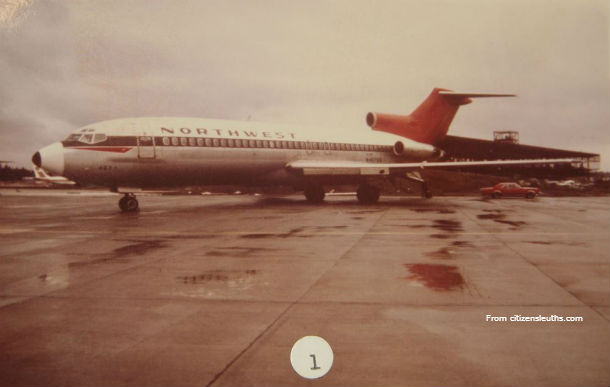
The only unsolved hijacking of an American plane took place on November 24, 1971. A person who may or may not have been named “Dan Cooper” hijacked a plane over the Pacific Northwest and demanded $200,000 and several parachutes. His demands were met, and he then demanded a flight toward Mexico City at a low altitude and slow rate of speed.

About forty-five minutes into the flight toward Mexico, somewhere over Washington state, at night, during a rainstorm, the man jumped. He and most of the money have not been found. The case remains an unsolved mystery. Because of a news media error, his name was reported as “D.B. Cooper,” and so the daring unknown hijacker has remained known by that mistaken moniker.

In 2007, an FBI Special Agent named Larry Carr opened the case files to the public to regenerate interest in the cold case and develop any new leads, if any could be developed almost four decades later. With no government funding, a team of investigators, called “Citizen Sleuths,” donated time and effort to study the case for three years and concluded nothing concrete but outlined the dozen or so most important lines of inquiry and debate.

Forty-three years on, the Cooper skyjacking remains unique in American crime annals.

cooperticket

“Dan Cooper,” not “D.B. Cooper.”

On Thanksgiving Eve, 1971, a man bought a one-way airline ticket from Portland to Seattle. In that pre-TSA era, no photo ID was copied and the passenger simply gave his name and the ticket sales clerk wrote it down: “Dan Cooper.” It was a twenty-dollar ticket and he paid cash. He boarded the plane, a Boeing 727. There were about forty people on board, passengers, crew, and Dan Cooper. He was wearing a dark suit, loafers, and a light, businessman’s raincoat. He carried a briefcase.

Cooper lit a cigarette, ordered a drink, and handed a note to the stewardess. She took it, but did not read it immediately. He got her attention again and bade her to read the note, which stated that he had a bomb and was hijacking the plane. He showed her the inside of his briefcase, and it had wires and looked like a bomb.

The stewardess conveyed the message to the pilot and he contacted the ground. In 1971, airline hijackings were surprisingly frequent: several dozen took place each year and the federal Sky Marshal program was brand-new. After the Cooper incident, passengers and their parcels began to be scrutinized regularly. Hijackings became a thing of the past until a later, more famous incident a few decades later.

The airline ordered that his demands be met. The demands: $200,000 in “negotiable American currency,” four parachutes, and that the plane be refueled in Seattle. None of the members of the crew who dealt with the man reported that he had a foreign accent, but “negotiable American currency” has perplexed everyone who has investigated the story. Who says that?

Foreign or not, he was polite. He remained in his seat, ordered and consumed a second drink, paid his tab, and offered to buy meals for the crew when they landed, for their trouble. On the ground, the money was delivered, the other passengers released, the nonessential crew released. Ten-thousand twenty-dollar bills had been assembled in several bundles of 100 bills each inside a knapsack, but each bill had been photographed, too. The plane was refueled and took off on a route towards Mexico City, the hijacker’s stated destination.

But he also had requested parachutes and that the plane be flown at the lowest altitude and slowest speed to maintain flight; he also wanted the cabin depressurized. He was to be left alone in the cabin and the aft stairs (at the back) were to be left down. (Since the Cooper incident, most commercial jets no longer have a aft set of stairs.) Told that such a configuration would be difficult to fly, he replied that he knew it would be safe, but would allow the flight to take off with the staircase in a stowed position. He would figure out how to open it himself.

About twenty minutes into the second flight, the crew detected a whoosh of air: the aft door had been opened. When they radioed to him to offer assistance, he refused any help, and that is the last anyone ever heard from the hijacker. Several minutes later, the tail of the plane bounced, indicating that he had jumped.

It was night, it was November, and it was raining. The air temperature outside the plane at its low flying altitude has been estimated as a −70°F wind chill. The hijacker did not change clothes from his dark suit, raincoat, and loafers, but he did take off his tie and leave it on the plane. So a man in dress-casual attire jumped from a 727 at night from 10,000 feet over a lot of forest. In that pre-GPS world, it is not known what land the plane was over when he jumped or when he pulled the ripcord, if he did. The plane, which was being trailed by military jets—but not for the entire trip, and not at this precise moment—landed in Reno.

The search started immediately, and in its own way, continues. The flight route has been scoured thoroughly, both on land and in the bodies of water he might have fallen into. Only two items have been found to date, and both were found years after the incident: the plane’s instruction card for lowering the back stairs, and a small portion (290 bills) of the money. None of the serial numbers have ever turned up in currency, so the money has not yet been spent. No one, not in Canada or America, neither a family nor an employer, reported a missing person in that time period who matched or came close to the description.

Anything written about the hijacker’s life before the incident is speculation, even if it is from detailed forensic analysis. For instance, it is now understood that his tie had DNA evidence on it and also bore minute particles of pure titanium, which is as curious as that sounds.

Several bundles of the cash turned up in 1980, but not quite where Cooper might have landed; they were heavily weathered, but still in rubber bands, which should have deteriorated between 1971 and 1980. Further, the area had been searched previously, and the bundles had not been found at that time. They were not complete bundles, either, as one was missing ten bills, but not from the top or bottom, the outside of the bundles. The missing bills were missing from the inside.

If Cooper was killed in the jump, nothing has turned up—no body, no items of clothing, no bones, and none of the money—in terrain that would not thoroughly absorb a human being’s existence. Except it did.

Whoever D.B. Cooper was, he probably never knew that he became an outlaw folk hero. Many novels, songs, movies and TV show episodes have offered fantasies about the case and about the outlaw who got away. In the TV show “Twin Peaks,” Kyle MacLachlan’s FBI agent character is named Dale Bartholomew Cooper, and the show is set in the Pacific Northwest. No characters comment on this, but when you think about it, it is as if Agent Cooper “parachuted into” the community.

Special Agent Carr’s conclusion on the Citizen Sleuths website sums up the infamous case:

For Cooper Sleuths, keep an eye out for a suspect from Canada, with military experience in airplanes. He would have come to this country to work in or around titanium metal fabrication. He was a gentleman, well dressed and smoked cigarettes. He was not the type to shy away from medication and knew his way around machinery, as well as the woods. Most notably, he probably lived a normal life and had one big problem that required about 200K in cash to solve.

____________________________________________
The WordPress Daily Prompt for November 24 asks, “When was the last time you took a risk (big or small), and pushed your own boundaries—socially, professionally, or otherwise? Were you satisfied with the outcome?”

* * * *
Please subscribe to The Gad About Town on Facebook: http://www.facebook.com/thegadabouttown
Cave of Stories

The aurochs is an extinct form of cattle that overlapped with humans for tens of thousands of years. It lived in Europe, North Africa, and western Asia; the last one died in 1627. We domesticated it: Our modern-day beef cattle and dairy cows are descended from the aurochs and some of them bear a deep resemblance to the extinct animal. (Picture a bullfight but make the animals taller and more muscular and thus the fight more even.) The reasons for the extinction are the familiar ones and can be summed up as: Humans have enjoyed beef for a very long time.

Early modern humans, homo sapiens, showed up around 100,000 years ago and really started to leave a mark on the landscape around 40,000 years ago. This is deep in our prehistory, and no one knows what our Upper Paleolithic ancestors were thinking. It just appears that thinking is something they were doing.

Awareness is a nice thing to have, and every creature with a nervous system has awareness. Some animals even have a form of memory and the ability to use these memories to their advantage in actions taken in the here and now. Some of us have pets that seem to have better situational awareness than people we deal with every day. Awareness is not thought and the use of awareness is not thinking; they are so close, though.

Consciousness is humanity’s great gift and burden.

By 30,000 years ago—discoveries announced in 2014 are pushing this date further back, to almost 40,000 years ago—our ancestors were painting on the stone walls of their domiciles and meeting places. We do not even know if the spots in what were then and are now caves were homes, temples, some form of market. Stone Age man was not writing things down; writing was many thousands of years in the future. We do not know what early man was communicating or how.

Most of the items found and dated from this period are simple tools—scrapers and blades—but some items have been found that may be tools for making other tools, which is a subtle shift but a huge one. When one is making a tool to make another tool, one is aware of something called “the future.”

The earliest works of art also date back some 35,000 years. Carvings of animals and “Venus” figurines, even a flute made from an antler have been found in different locations. What these represented in early man’s mind is not knowable, but items like these they are not tools for immediate use, like knives or arrows. And then there are the many cave paintings found throughout Europe, Asia, and Africa.

The majority of cave paintings depict animals, animals that were being hunted, like the aurochs, and animals that hunted, like fearsome panthers and bears. The minority of paintings are a sort of declaration of “I am here” that any child would recognize: hand prints.

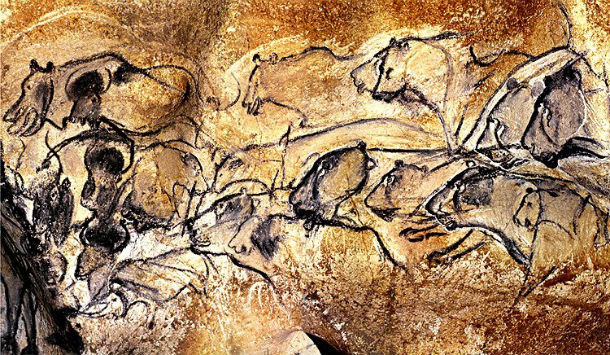
In southern France, the Chauvet Cave is one of the most famous. Rediscovered by modern man in 1994, the many investigations of the many drawings in the cave have narrowed the period in which the works were made to a remarkably specific 30,000–32,000 years ago. (In geologic terms, this is like saying a thing happened in “October” of a certain year.) The picture at top is is of lions hunting aurochs from that cave.

(The cave is the subject of a 2010 documentary, “Cave of Forgotten Dreams,” by Werner Herzog. I believe the film is still available on Netflix, for those with an account. Herzog was given unprecedented access to the inside of the cave, which has never been opened to the public and never will be in order to preserve it. If you are like me and could listen to Werner Herzog read the list of ingredients from a box of breakfast cereal, well, enjoy. It is a great documentary.)

Cave paintings are a snapshot of the birth of human consciousness, and we may be looking at different forms of story on those walls, from journalism to fiction.

The paintings depict animals on the move. Animals they use like horses, animals they hunt, like the aurochs, animals that maybe they avoid, like bears and rhinos.

chauvetfightA fight between two animals is shown. This may be an early form of journalism; the painter or painters saw this happen. The picture at top, of lions on the hunt, demonstrates that the artist or artists had already learned how to effectively use perspective. Some of the lions are in front of other lions, blocking the view of all but the legs of the lions behind them. Their heads are proportionate in size to the perspective used. The cats are not carbon copies of one generic “cat,” but are individual.

“I saw this” is a form of reporting, is awareness. The birth of consciousness came with the idea of a future. Some of the paintings may depict something like, “You can find this many animals over here, I promise you. Next Tuesday.” Some of the paintings are the first stories, fantasies about a successful hunt or accounts of past ones. Some of them are the first lies: Boasts about the number hunted.

That is where the true birth of consciousness resides, in stories.

____________________________________________
The WordPress Daily Prompt for November 23 asks, “What makes a good storyteller, in your opinion? Are your favorite storytellers people you know or writers you admire?”

* * * *
Please subscribe to The Gad About Town on Facebook: http://www.facebook.com/thegadabouttown