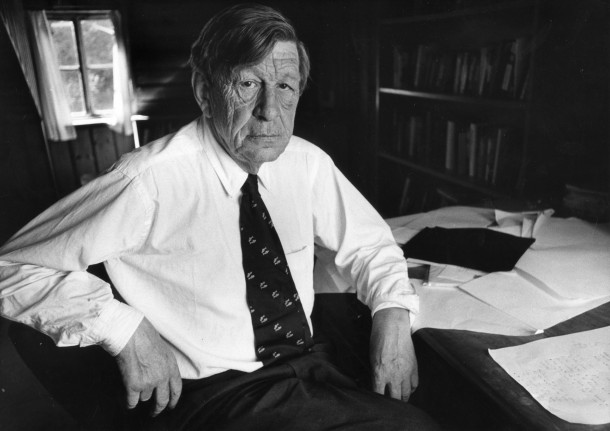
Auden’s Decency

In the documentary, “Tell Me the Truth About Love,” W.H. Auden’s friend Thekla Clark recounts the story of one of Auden’s lovers complaining to him that he thought Auden would be more “romantic,” being a poet, after all. “But you aren’t romantic,” Clark quotes the lover telling the poet. “You aren’t romantic at all.”

“If you want romance,” Clark quotes Auden replying, “screw a journalist.” (Except she does not say “screw.”)

Auden was not one for ruining a good line—or a good night—by spending it explaining the difference between romance and sentimentality.

Auden’s poetry, often about love, derived from an almost clinical study of his own personal history and emotions. A professional poetic detachment yielded a poetry that was undisturbed by sentimentality. Yet Auden is also the least cynical and one of the most humane of the great poets.

One can not declare oneself humble. Humility and decency do not allow for advertising. The moment one discusses one’s virtues, one yields them. In the same documentary, “Tell Me the Truth About Love,” Auden tells the talk-show host Michael Parkinson that “a writer is a maker, not a man of action” so everything he writes is an autobiography, is his history of his experience transformed in his senses, and that, no, he would not be writing his memoirs. The autobiography of a man of action—a politician or general or activist—may be necessary to understand them.

(The clip starts around minute three. The documentary, which first aired on the BBC in 2000, is full of interviews with Auden and his circle. Once upon a time, talk shows featured literary figures; Michael Parkinson was the Johnny Carson or Dick Cavett of Britain, minus the jokes. Actually, Dick Cavett was the Parkinson of America.)

Auden learned the difference between a man of action and a maker early on, and he learned how tempting it could be to confuse the two. In the 1930s, while a young writer, he was made into a hero of the British left, and moved to America to reacquire his privacy. Edward Mendelson quotes Auden in “The Secret Auden,” in the current issue of the New York Review of Books: “I suddenly found I could really do it, that I could make a fighting demagogic speech and have the audience roaring … . It is so exciting but so absolutely degrading; I felt just covered with dirt afterwards.”

By the 1960s, both his politics (left) and his religion (he returned to the Anglican Church of his youth in 1940) were publicly known, but he was no longer a speech maker and never was a proselytizer. From Mendelson’s article:

When he felt obliged to stand on principle on some literary or moral issue, he did so without calling attention to himself, and he was impatient with writers like Robert Lowell whose political protests seemed to him more egocentric than effective. When he won the National Medal for Literature in 1967, he was unwilling either to accept it in Lyndon Johnson’s White House during the Vietnam War or “to make a Cal Lowell gesture by a public refusal,” so he arranged for the ceremony to be held at the Smithsonian, where he gave an acceptance speech about the corruption of language by politics and propaganda.”—The Secret Auden,”

To accept an award from one’s adopted country and relocate the ceremony from the heart of power to the nation’s museum, and then to turn the ceremony into a lecture about corruption is, when available, a different sort of bravery than an attempt to make one’s absence into a loud presence.

Edward Mendelson is Auden’s literary executor, and in the New York Review article, he reveals that he is still learning of some of Auden’s acts of decency, 40 years after the poet’s death. Charities he quietly funded, a manuscript donated for a sale to pay for a friend’s surgery, a prisoner who wrote him once and began a lifelong correspondence course in literature. Even the story of a woman from his congregation in Manhattan who “was suffering night terrors, so he took a blanket and slept in the hallway outside her apartment until she felt safe again.”

There is even this story, revealed last year in a letter to the Times of London:

Sixty years ago my English teacher brought me to London from my provincial grammar school for a literary conference. Understandably, she abandoned me for her friends when we arrived, and I was left to flounder. I was gauche and inept and had no idea what to do with myself. Auden must have sensed this because he approached me and said, “Everyone here is just as nervous as you are, but they are bluffing, and you must learn to bluff too.”

Auden knew, Mendelson writes, that good and evil exist, but that human beings fall on a spectrum between the two. Most are not evil people attempting to be saintly but good people striving to become better. There “are those who, like Auden, sense the furies hidden in themselves, evils they hope never to unleash, but which, they sometimes perceive, add force to their ordinary angers and resentments, especially those angers they prefer to think are righteous. On the other side are those who can say of themselves without irony, ‘I am a good person,’ who perceive great evils only in other, evil people whose motives and actions are entirely different from their own. This view has dangerous consequences when a party or nation, having assured itself of its inherent goodness, assumes its actions are therefore justified, even when, in the eyes of everyone else, they seem murderous and oppressive.” When one’s nation declares itself a force for good in the world, maybe one should make sure the passport is up-to-date. Auden once wrote, “Many a sore bottom finds/A sorer one to kick.”

We do not practice what we thoroughly possess. We say we “practice” kindness because we do not possess it, not to the degree that makes us kind. We practice love because we are not loving but can always be more so. The humble acts of decency and kindness may not change the universe, but they may change an individual’s universe. In the often misquoted line from his amused and amusing 1957 poem, “The More Loving One,” Auden says, “If equal affection cannot be,/Let the more loving one be me.”

* * * *
Mendelson mentions Thekla Clark in his New York Review article, in one more anecdote about Auden’s quiet defense of doing the right thing, and adds that he learned of this “in a documentary film, ‘Wystan: The Life, Love and Death of a Poet,’ by Michael Buergermeister, which had its premiere in Oxford last year.” It is the only mention I have found of this documentary. On Buergermeister’s own website, only this trailer for the film appears:

It is tantalizing.

Chicago’s Cult of Harry: Harry Caray at 100

When I moved to the Midwest in the summer of 2000, I learned that Phil Rizzuto was not the baseball announcer who had coined the phrase, “Holy cow!” I also learned that there was a controversy about this, and that, as a Yankee fan and native New Yorker—and worse, someone unaware of a controversy—I was on the wrong side of said dispute. Born wrong.

No, I was informed, the recently departed Harry Caray was the first to use the phrase on-air and was the announcer with whom it should be associated. Not the beloved Yankees announcer. For Cubs fans, a long-simmering resentment against all things New York became easy to openly express after a “Seinfeld” episode featuring a Phil Rizzuto keychain that exclaimed “Holy cow!” when its head was squeezed unfairly cemented in popular culture the notion that the saying was Rizzuto’s.

Upon learning that I was from New York and a sports fan, one new friend—in our very first conversation—brought up the issue. “You know who used to say ‘Holy cow,’ right?” As an astute observer of humankind and its many denizens, I picked up that there was only one answer and if I said “The ‘Scooter'” I would be inciting conversational violence. But I was not certain what the correct answer was. From my lofty, ivory tower, New York post, I was oh-so dimly aware that Harry Caray, the voice of several Midwest baseball teams over several decades, who had passed away just two seasons before, had been in a feud with my beloved Yankees announcer. Or that Cubs fans were in a feud. I also “knew” that it was possible that both used a really common euphemistic exclamation, Caray in the broadcast booth and Rizzuto on the field and later in the booth.

When I am confronted with a statement that is either false, uninformed, or ill-informed, but I do not see the value in debating the merits of facts, I will respond to such statements with a nod and say something like, “That is an idea.” Period. No emphasis on any syllable. Or even more aggressively passive-aggressively, “That is a sentence.” As if I am attempting an escape from a hostage-taking situation. I shared my theory about how both iconic baseball figures may have come up with the expression independently, since it is a common euphemistic exclamation, with my new Midwestern friend. He replied with a nod and said, with no emphasis on any syllable, “That is an idea.”

Harry Christopher Carabina was born in St. Louis, Missouri, 100 years ago today, March 1, 1914. For over fifty years he was a mostly regional, sometimes national, baseball and college football announcer. At some point in his career, he realized that as an announcer, he was not only the eyes of the fan in the broadcast booth, he was the fans’ voice, too. He wasn’t their representative, he was one of them, one lucky enough to be paid to watch a game he loved to watch. Thus, even though he had been an official broadcaster for teams that Cubs fans naturally detest—the White Sox and the Cardinals—when he became the voice of the Cubs in 1981, he was embraced as if he had always secretly been a Cubs fan. WGN, the station that broadcast the Cubs, was also one of the first “superstations,” which made him a nationally famous quirky regional personality. (Upstate New York, where I am from, did not have WGN, so Harry Caray was as much a rumor to me as Phil Rizzuto, heard on the non-national non-superstation WPIX, was to my Iowa friend.)

By the late 1990s, Will Ferrell started performing his Harry Caray impression on “Saturday Night Live,” and many other performers followed suit, but really, they are performing an impression of Will Ferrell’s Harry Caray impression. From my lofty ivory tower New York perch, I only knew Ferrell was poking fun at an elderly and much-loved baseball broadcaster, one much like my own beloved ‘Scooter’ Rizzuto. I did not understand why the impression continued after Caray’s death in 1998, but again, I was living in New York.

Former Cubs pitcher Ryan Dempster is noted for his pretty funny impression of Will Ferrell’s Harry Caray:

Because it is almost the same distance to every major metropolis with a major league sports team, Cedar Rapids, Iowa, where I lived, is one of the luckiest cities in the country for a sports fan. “Local” television broadcasts include the Cubs, the White Sox, the Cardinals; and the Bears, the Vikings, the Rams. I became a Cubs fan in part, I believe, because of all the day games that they play and that I could listen to while at my job writing instruction manuals. In August 2001, my “That is a sentence” friend and I drove to Chicago for a memorable day: a Friday afternoon loss game against the rival St. Louis Cardinals and dinner at Harry Caray’s Italian Steakhouse, a day that made me feel like I was finally a Midwesterner. The meal was terrific, and the Harry Caray name is now more associated with the seven establishments bearing his name and caricature (see the photo at the top of this post) than with the memorable broadcaster himself.

Which is too bad. Harry Carabina, born in desperate poverty in St. Louis, authored one of the unique success stories in baseball, in broadcasting, in America, when he invented Harry Caray. The success of those restaurants some sixteen years after his death, the fact that comedians still get gentle laughs at his memory, his long career, all stem from one man’s brilliant and rare talent at becoming beloved.

A last word from Harry Caray himself, from the last day of the 1991 season:

The Mag. Glass Pelican & You

The Magnificent Glass Pelican (MGP) is a live half-hour radio comedy show that my friends and I have written, produced, and acted in for over two decades. Lately, it has been an improvised half-hour, produced by us and scripted live on-air.

It is broadcast from a college FM radio station during the school year, and even though none of us has had any connection with the school as an educational institution for many many years, no one seems to have noticed our graying hair and lack of school books, so the station keeps inviting us back. Or we bribed them when we could not help ourselves. This current season is our twenty-second.

That’s a lot of comedy.

Some of the members, “Pelicans” we call ourselves, have had long careers in the creative arts, some have gone on to careers in technical writing. Myself, I am retired. Among our influences are the usual suspects: Monty Python, Firesign Theater, Del Close. The late Matt Coleman, a beloved friend and eternally a Pelican, once declared to a newspaper interviewer that we “separate the wheat from the chaff and keep the chaff!”

Each Wednesday night at 7:30 p.m. (tonight), the MGP half-hour is broadcast on 88.7 FM WFNP (“The Edge”) in the Rosendale-New Paltz, New York, area or is streaming live here at this link. This is at 7:30 p.m. Eastern, and the broadcasts are not archived, so if you can check us out live tonight, thank you.

Here are two samples of our work, via my friend John’s SoundCloud stream; he is a founder of the Magnificent Glass Pelican and of the great rock/pop group, the Sweet Clementines. The first skit, “My Mother,” was written for us by our friend Brian Scolaro, who once upon a time shared a studio with us. I play the jury foreman. “We find the defendant guilty.”

And “Radio Pirates” is a personal favorite.

Again and always, thank you for listening.