Daily Prompt: Factory Unmade

The WordPress Daily Prompt for July 31 asks, “Automation has made it possible to produce so many objects—from bread to shoes—without the intervention of human hands (assuming that pressing a button doesn’t count). What things do you still prefer in their traditional, handmade version?”

Give me an old-fashioned, handmade iPad every time. You know the kind: Each one unique and prone to its own errors and quirks but the one that does some things uniquely better than any other iPad.

I know. It doesn’t exist, and why should it? But I have had favorite typewriters. And I continue to insist that I did not like the “feel” of certain computers, knowing that they are each the same, but still insisting that I can feel a relationship.

In one of my all-time favorite conversations, a friend and I attempted to identify whether various everyday objects were digital or analog. Not digital and analog devices and tools themselves, mind you. Not a digital watch versus a watch with a face, or “old” things versus “newfangled” digital things. We were looking at whether a device’s form or its function define its role in our world. (Of course, strictly speaking, we all live in an analog world in which digital—either/or—devices play a part.) In our game, if an object’s function defined its form, we declared it analog. If form ruled function, it was digital. (I know that this is a very incomplete analogy for digital versus analog.)

We were on a golf course while having this discussion, and we decided that my eight-iron was analog and his putter digital. You should have seen that putter.

In another conversation, this with my college roommate-slash-house philosopher Mike Pizzo, I found myself explaining in too much detail my ideas about this same concept. He sat patiently, waited for my big finish, and replied, “It’s heart versus brain,” which was his own pet analogy for, well, everything, but it also worked here.

Digital tools break tasks down into minute, discrete chunks. Analog audio records a stream containing a wave of sound, and a vinyl record or magnetic tape plays that stream of sound back; digital recorders also capture a sound wave but do so by capturing snippets of it at regular intervals, and digital players play back those snippets so quickly that it sounds like a stream of sound.

(Here’s a way to understand analog and digital. When I need to remember a letter’s place in the alphabet, I still sometimes silently sing the “Alphabet Song” I learned when I was a child and stop when I get to the letter in question. That is analog. If my brain was digital, each of the 26 letters would be equal and unique unto itself and I would be able to call up a letter’s file in question—the file for “G” says it is the seventh letter, for instance, but I needed to sing the song and count on my fingers to get that—without using its relation to the other letters in the alphabet.)

Digital audio and video are infinitely reproducible and can be manipulated almost to infinity (“that picture is fake! It was Photoshopped!”), and analog audio and video are not. In the digital world, there is no such thing as the phenomenon of “copies of copies,” in which a later generation copy of a document looks very little like the original, master document.

Conversations about a world that is only either digital or analog are digital; the rest are analog.

We live in a (mostly) digital world, a world that offers infinite reproducibility along with speed, the ability to produce the same loaf of bread or pair of pants or pop song again and again, the ability to meet goals more quickly by performing multiple, discrete tasks at the same time when once upon a time one had to perform those tasks in a particular order. (To get to “G,” I had to recite the alphabet part-way. What if I had all 26 letters’ files running in my head at the same time? “G” would be always already available to me.)

Automation gives us the ability to run multiple tasks at the same time with perpetually reproducible results. It gives us products that we can not have a personal relationship with, in spite of my insistence that I have a “feel” with certain computer keyboards. When perpetual reproducibility is something that is desired as a thing in itself, it can be disastrous.

Chaplin ridicules the heartlessness of automation for the sake of automation in one of his greatest films, 1936’s “Modern Times.” (If you are bothered by the sound of silverware scraping on a plate, this clip may irritate you.) It is a part of the famous 15-minute factory scene in which Chaplin’s Little Tramp eventually loses his mind while performing his gruelingly mindless drudge of a job (tightening bolts that are subsequently hammered by the worker beside him). The sales pitch for the “feeding machine” offers it as a way to “eliminate lunch hour” and stay ahead of the competition by keeping workers on the job while they are eating. Of course, the dance that is required to maintain anything like smooth operations is a delicate one and once any small element goes awry, the Tramp is almost beaten to death by the napkin holder.

Was my computer or your iPad built by a worker while they were being fed by a machine that held them in place on the assembly line?

I guess in my sloppy way I’m calling this “digital.” As in the conversation with my friend in which we declared certain things analog (handmade) and others digital, things that are not thought of in these terms, I offer the example of my haircut. The worst haircuts that have ever been foisted on me were automated in this way: a single set of clippers, five minutes and, “Next!” Those haircuts make me look like I have an audition next week for a acting job as a Marine gone bad. (And I am not an actor.) My current barber is more hands-on and takes 40 minutes on my head. He utilizes each pair of scissors in his arsenal. Each task on my head is addressed in turn and not rushed. He does not try to attack the whole job at once with a pair of (digital) clippers, unlike the mall hair cutters. I leave feeling like a piece of marble that had been worked on by Michelangelo. There is a line out his door most Saturday mornings.

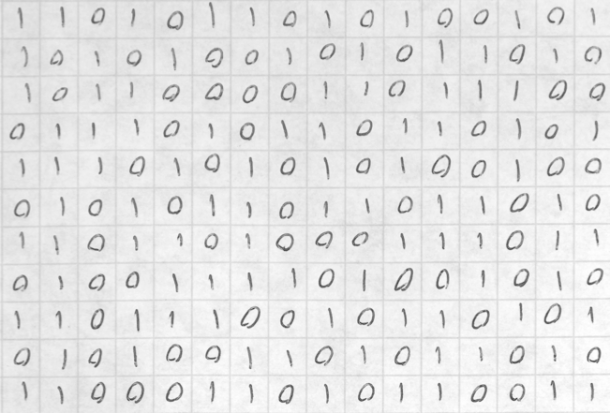
The products of automation, much of the digital world, gives us a lot that is disposable, forgettable. Merely a long sequence of zeroes and ones. Useful, yes, but I like having things that show evidence of a human hand at work, evidence that someone cared. Like my killer haircut. I guess I want to see a hand-written sequence of zeroes and ones that would make a quirky iPad.

One Moment in Bob Dylan’s 73 Years

Bob Dylan turns 73 today.

On February 20, 1991, Dylan was handed a Grammy “Lifetime Achievement Award” (will they grant him a second one in a few years? the man is still working) by Jack Nicholson. The First Gulf War was underway and there was no threat of protest or off-message anti-war messages from the show business crowd attending. (That war went very very well, if you recall.) So Dylan and his band played a violent version of his song “Masters of War,” sadly unrecognizable from his unpunctuated singing—would that he had enunciated the lyrics, but Dylan does not do the obvious even when he does the obvious—and then he accepted the cheap plaque (in the clip it looks like something the Grammy people bought at a Kinko’s) and delivered a brief speech:

“Well, my daddy, he didn’t leave me much, you know he was a very simple man, but what he did tell me was this, he did say, son, he said.” (There was a long pause, nervous laughter from the crowd.) “He said so many things, you know? He say, you know it’s possible to become so defiled in this world that your own father and mother will abandon you and if that happens, God will always believe in your ability to mend your ways.”

It took him less than a minute, even with his nervous hat fumbling and pauses, but Dylan had just delivered an Old Testament sermon from Psalms 27:10 about the disfigurement of a life spent enslaved to the material things to the bejeweled, genially war-applauding, Hollywood crowd.

Vivian Stanshall: Not an Eccentric

The Bonzo Dog Doo-Dah Band played the role of jester in the court of the Beatles in the late 1960s, and Vivian Stanshall was the charismatic, curious leader of the leaderless and leader-resistant Bonzos. The missing link between the Beatles and Monty Python (if one was needed), in 1967 the Bonzos appeared in both “Magical Mystery Tour” (partially entertaining the Beatles with a performance of “Death Cab for Cutie”) and in the pre-Python but mostly Python-staffed afternoon television show, “Do Not Adjust Your Set.”

Here, Michael Palin of the Pythons introduces the Bonzos, and Stanshall does his best worst Elvis in “Death Cab for Cutie.”

 
Stanshall, a writer for whom no declarative statement could be too perplexing (“I’ve never met a man I didn’t mutilate”), was paired up with Neil Innes, a songwriter whose Beatles-esque melodies led not only to to the Bonzos being produced by Paul McCartney (the minor hit “I’m the Urban Spaceman”) but also to a Beatles lawsuit after music for his parody group, “The Rutles,” was thought to be too reminiscent for comfort. (Further cementing the Beatles-Python link, “The Rutles” was an Eric Idle project.)

Their collaboration “Mr. Apollo” combines an almost-too-catchy Innes tune with Stanshall’s absurdly deep baritone and lengthy fake sales pitch for an exercise gimmick: “Five years ago, I was a four-stone apology. Today, I am two separate gorillas. No tiresome exercises. No tricks. No unpleasant bending.” It also features a heavy metal guitar lick invented about six months before heavy metal.

 
Vivian Stanshall was born 71 years ago tomorrow, March 21; few people have spent their lives (his ended in a house fire in 1995, a sadly Stanshall-esque end if anyone did not deserve one) confounding more people and delighting in the resulting stares than he. After the Bonzos disbanded, if they ever truly did—the group’s set lineup varied in name and number whimsically and reunited a number of times, so it could be said that its members simply wandered away—Stanshall became known as a presence. He was a person about whom wild anecdotes proliferated, usually starring Stanshall, his friend Keith Moon, and their friend, alcohol; whose voice was heard on overnight radio talk shows that had no set sign-off time except daybreak; and who semi-occasionally emerged with enormously creative, incredibly language-saturated audio theater pieces, usually concerning the fictional family of Sir Henry Rawlinson. (In one of the oddest of all possible odd coincidences, Stanshall and the real Sir Henry share a death date, precisely one century apart, March 5, 1895 and 1995.)

Joycean in its surreal ambitions, Stanshall’s “Sir Henry at Rawlinson End” always opts for the obscure joke and invented pun over the profound statement, which resembles Joyce in many of his Joycean ambitions, too. The recorded piece was made into a film starring Trevor Howard and Stanshall that may as well have been a rumor until its DVD release a few years ago. One can piece together the hour-long film from clips on YouTube. The Rawlinson family saga offers an English Addams Family whose adventures take place in a landscape of long-standing family games with long, obscure, histories behind them and traditions that must be celebrated by exploding them. It is aristocracy viewed through the eyes of an alien, not just to these traditions, but to the idea of tradition.

The opening sentence: “English as tuppence, changing yet changeless as canal-water, nestling in green nowhere, armored and effete, bold flag-bearer, lotus-fed Miss Havishambling, opsimath and eremite, feudal-still reactionary Rawlinson End. The story so far.”

 
According to radio legend John Peel, the friend on whose programs the Rawlinson stories were first dictated, Stanshall’s appetite for drink and tranquilizers hindered his career. “Unreliability and prevarication, on an epic scale,” is how Peel mournfully described his friend’s habits of work, in a comment about how working with Stanshall could yet be extraordinary and worth the effort.

In most articles, Stanshall is described as an eccentric, a member of the famous English eccentric class. No other country is said to celebrate its eccentrics more than England, or to reflect more on the idea of having a group of people called “eccentrics,” and Stanshall offered plenty of material to draw from: living on a houseboat, showing up in a Nazi officer’s uniform for photo sessions with Keith Moon, cultivating an epic beard. He dressed the part, alternating between hobo-chic and carnival barker classy.

 
But for those who insisted he was an eccentric in the classic, “English” sense, Stanshall had a reply:

A few years ago a woman from the Daily Mail phoned to inform me they were doing a piece on Sir John Betjeman and they would like me to companion him in the article, I being representative of the younger English eccentric. She wanted to know if was still doing it. Well, I don’t do it, I’m merely myself, … I’m whatever you like, just don’t expect me to join in. I do like games, though. You see, I’m not different for the sake of being different, only for the desperate sake of being myself. I can’t join your gang: you’d think I was a phony—and I’d know it.

“For the desperate sake of being myself.” That is as true and good a personal code as any statement one could come up with towards having a worthwhile life.

Around the time of the “Sir Henry at Rawlinson End” film, 1980, Stanshall provided his friend Steve Winwood, one of the least cynical or eccentric of performers, with a lyric that is confident in its obscurity (“my rock and roll is putting on weight”) and yet sweet and plain in its sentiment (“This time to the sky I’ll sing, if clouds don’t hear me/To the sun I’ll cry, and even if I’m blinded/I’ll try moon gazer…because with you I’m stronger”). “Arc of a Diver” does not seem like a Vivian Stanshall lyric because it is.


She bathes me in sweetness, I cannot reveal
For sharing dreams I need my woman
This humble expression…meagerly dressed
My eyes so mean it has no meaning
But jealous night and all her secret chords
I must be deaf…on the telephone…I need my love to translate
 
I play the piano, no more running honey
This time to the sky I’ll sing if clouds don’t hear me
To the sun I’ll cry and even if I’m blinded
I’ll try moon gazer, because with you I’m stronger…I’m stronger…I’m stronger
 
Arc of a diver…effortlessly…my mind in sky and when I wake up
In daytime or nighttime…I feel you near
Warm water breathing…she helps me hear
But jealous night and all her secret chords
I must be deaf…on the telephone…I need my love to translate
 
This time to the sky I’ll sing if clouds don’t hear me
To the sun I’ll cry and even if I’m blinded
I’ll try moon gazer…because with you I’m stronger
 
But jealous night and all her secret chords
I must be deaf…on the telephone…I’ll need my love to translate
 
This time to the sky I’ll sing if clouds don’t hear me
To the sun I’ll cry and even if I’m blinded
I’ll try moon gazer…because with you I’m stronger
 
Lean streaky music…spawned on the streets…I hear it but with you I have to go
Cause my rock ‘n’ roll…is putting on weight…and the beat. it goes on
Arc of a diver…effortlessly…my mind in sky and when I wake up, woah-oh-oh
Daytime and nighttime…I feel you near
Warm water breathing…she helps me hear
 
But jealous night and all her secret chords
I must be deaf…on the telephone…I’ll need my love to translate
 
With you my love we’re going to…raid the future
With you my love we’re going to stick up the past
We’ll hold today to ransom…’til our quartz clock stop…until yesterday
Woah, until yesterday
Until yesterday
Til our quartz clock stop

____________________________________________
Follow The Gad About Town on Facebook! Subscribe today for daily facts (well, trivia) about literature and history, plus links to other writers on Facebook.

Follow The Gad About Town on Instagram!

Creative Commons License
This work is licensed under a Creative Commons Attribution-NoDerivs 3.0 Unported License.