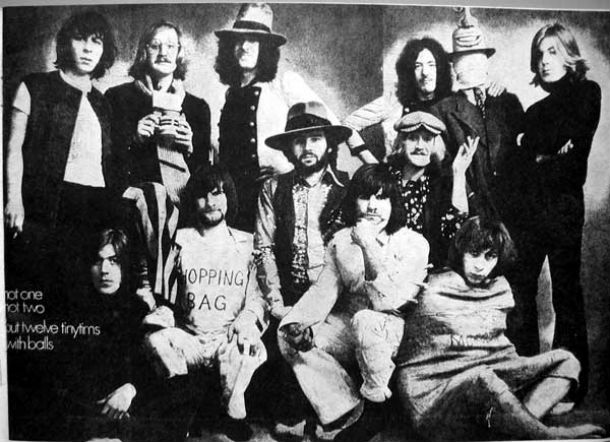
‘Today, I am two separate gorillas’

The Bonzo Dog Doo-Dah Band has received a great deal of attention in recent years. Even its Wikipedia entry has grown from a stub to a forty-paragraph historical disquisition in a few short years, which surely must be a sign of something, with fourteen footnotes, two sources, and five “for further readings.” (Thank you very much, Mr. and/or Mrs. Whoever Did That.)

If you are a fan of the Bonzos, nothing I may write here will do more than remind you of something you also like. If you are not (yet), nothing that I write may convince you that you have a bright future ahead of you discovering the works of these music-comic dolt-geniuses, so here is an intro anyway (“Adolf Hitler on vibes”):

For a group that was somewhat pop, mostly tongue-in-cheek, unforgettable on stage, and almost-not-quite-but-why-couldn’t-just-one-more-person-have-bought-our-record a one-hit wonder, forty paragraphs is a lot. So perhaps I am not alone in my fandom. One of the pleasant surprises in writing this website has been the number of hits that a post I wrote about Bonzo founder Vivian Stanshall has received (in triple digits since March).

The Bonzos served as a bridge, a missing link (if you were looking for one) between The Beatles and the Monty Python group. In late 1967, the Bonzos appeared in both “Magical Mystery Tour” (partially entertaining the Beatles—John Lennon heckles them—with a performance of their song “Death Cab for Cutie”) and in the pre-Python but mostly Python-staffed afternoon television show, “Do Not Adjust Your Set.”

Here, from “Do Not Adjust Your Set,” a pre-Python Michael Palin introduces the Bonzos and Stanshall does his best worst Elvis in “Death Cab for Cutie.”

In most of their performances, Stanshall was the lead singer, focus of attention, easily distracted emcee, and camera hog whenever one was present. The basic Bonzo line-up was Neil Innes, Rodney Slater, Sam Spoons, Roger Ruskin Spear, Vernon Dudley Bohay-Nowell, “Legs” Larry Smith, and Bob Kerr. At times, the group was down to three members (when an album was required to meet a contractual obligation) and at others, more than a dozen musicians and affiliated acts might be occupying the stage.

As head song composers, Stanshall was paired up with Neil Innes, but according to Innes, “Death Cab for Cutie” was the only true collaboration between the two heads of the head-less Bonzos, because it was the only time he and Stanshall were actually in the same room while writing. Stanshall wrote wordplay-heavy songs with lines that were saturated in nonsense, and Innes was (and is) a songwriter whose Beatles-esque tunes led not only to to the Bonzos being produced by Paul McCartney (the minor hit “I’m the Urban Spaceman,” which qualified the group as an almost one-hit wonder) but also to a Beatles lawsuit in the 1970s when music he wrote for his parody group, the Rutles, was found to be too reminiscent for comfort. Several Innes songs for the Rutles now list Lennon-McCartney as co-composers. Further cementing the Beatles-Python link occupied by the Bonzos, “The Rutles” was an Eric Idle project with Innes.

Their collaboration “Mr. Apollo” combines an almost-too-catchy Innes tune with Stanshall’s absurd and long fake sales pitch for an exercise gimmick: “Five years ago, I was a four-stone apology. Today, I am two separate gorillas. No tiresome exercises. No tricks. No unpleasant bending.” The song also features a fuzzy heavy metal guitar solo, even though it dates from the era about six months before anyone had heard heavy metal guitar solos.

And here is the also too-catchy “I’m the Urban Spaceman,” which Paul McCartney produced under the pseudonym, Apollo C. Vermouth, because he was simply having too good a month in November 1968 to take credit for everything:

It is completely an Innes song, so Stanshall is relegated to court jester in performance; also, you can see how much the group dis-enjoyed lip-singing.

The Bonzos got their start in a pub in the early 1960s, when several similarly aged young men (20-somethings) hanging out there found they had similar interests, especially in kitschy old 1930s records, and started to informally perform together. Slater recounts Stanshall bringing in one such record and declaring, “Look at this! I bought it for a penny but it’s worth twice that!”

Their early performances were live and faithful renditions of the pop not-so standards that they heard on the records. But other acts were also performing live and faithful renditions of obscure 1930s records, too, so the Bonzos, many of them art students entranced by Dada, started to create their own Dadaist sound and look. The group was an act without a point that loved being an act and having no point except being an act.

By 1970, the job of jester in the court of pop music or musician in the court of comedy no longer needed to be filled. The Bonzos disbanded, sort of. Reunion line-ups performed through the 1970s and still come together. The group’s set lineup varied in name and number so whimsically anyway that it could be said that its members simply wandered away. Innes went on, as written above, to a long and varied career continuing to bridge a gap between comedy and pop music. Most of the surviving members are jazz musicians who will always be remembered as Bonzos.

The group celebrated its fortieth anniversary in 2006 with a live show that featured special guests like Stephen Fry. What it was the fortieth anniversary of was up for discussion, but 1966 was the year the group came to the attention of the larger British public, as it landed its first major label record deal and appeared on television for the first time.

And Vivian Stanshall. He died almost twenty years ago, in March 1995, because he used to smoke cigarettes and drink brandy in bed and those two things do not mix well with nodding off. He is one of those artists about whom one marvels at his inventiveness, at the waterfall of words most of his work produced, and still feels that his career was somehow smaller than it was meant to be. I certainly disagree. (I am sure his non-ghost is not thanking me, anywhere.) He left the world wanting more of him, which is what performers are always told to do.

Here is a BBC documentary about Vivian Stanshall from 2004, “The Canyons of His Mind“:

____________________________________________
The WordPress Daily Prompt for December 15 asks, “We all have our semi-secret, less-known personal favorites—a great B-side, an early work by an artist that later became famous, an obscure (but delicious) family recipe. Share one of your unsung heroes with us—how did you discover it? Why has it stayed off everyone’s radar?”

* * * *
Please subscribe to The Gad About Town on Facebook: http://www.facebook.com/thegadabouttown
Gad Meets Godot

“Where I live, I can not speak of it. It takes too long to say its name. Who I love, same thing.”

He goes on. “So they ask us here,” he says, “Look at that.” He points. “‘No Words As Long As This,’ the sign says. And it gives a long list of long words. It is like they want a tall, short thing. Or a short but tall one. How can I fill this for them?”

“We,” I say to him. “We.”

“Right, kid. You and I. How can we give them this? This thing they ask. It is so tough. And it is close to the time we leave.”

“I have no right to tell you what to do.”

“But.”

“But. We can wait. There is a new day and it comes next.”

“Next?”

“To this day.”

“But why ask us to do this? Like this?”

“This? Oh.” They look at the sign and read out loud:

“The WordPress Daily Prompt for December 8 asks, ‘Today, write a post about the topic of your choice—using only one-syllable words.'”

“There is one word there that I do not like.”

“What is it?”

“Syllable.”

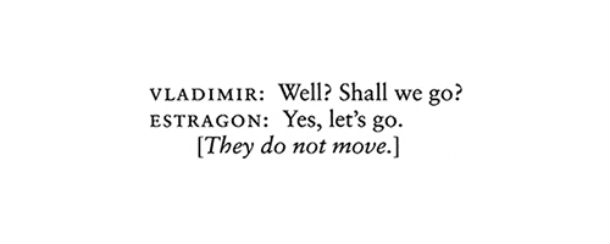
“Oh.” They do not move.

* * * *
Please subscribe to The Gad About Town on Facebook: http://www.facebook.com/thegadabouttown

Clean-up in Aisle Shakespeare

There is nothing wrong with Shakespeare that couldn’t be fixed by getting rid of all the violence, and, oh! those sad endings. So many of his plays end with a pile of bodies on stage and no detective to sort it all out for us and arrest the bad guys. No one leaves the theater smiling after seeing one of those productions.

For the first few generations of critics and theater producers that followed Shakespeare, this was a common attitude. The audiences loved Shakespeare from the start, the 1590s, when his plays started to be performed in London, even if they missed some of his … finer points. There were a lot of entertaining murders, after all.

Dr. Simon Forman was a doctor and astrologer of the era who would be forgotten except he kept a diary about his day-to-day life in 1610. In it, he recounts seeing several Shakespeare plays live in production at the Globe Theater. He describes seeing “Macbeth” on April 20, 1610, in what may have been the earliest production of the tragedy. He only devotes a couple paragraphs to describing the play and crams several acts into this:

Simon Forman's diary

Simon Forman’s diary

Then was Macbeth crowned kings; and then he, for fear of Banquo, his old companion, that he should beget kings but be no king himself, he contrived the death of Banquo, and caused him to be murdered on his way as he rode. The next night, being at supper with his noble men whom he had to bid to a feast, to the which also Banquo should have come, he began to speak of noble Banquo, and to wish that he were there. And as he did thus, standing up to drink a carouse to him, the ghost of Banquo came and sat down in his chair behind him. And he, turning about to sit down again, saw the ghost of Banquo, which fronted him so, that he fell into a great passion of fear and fury, uttering many words about his murder, by which, when they hard that Banquo was murdered, they suspected Macbeth. Then MackDove fled to England to the kinges sonn, and soon they raised an army and cam to Scotland, and at Dunstonanse overthrue Macbeth. In the meantime, while MacDove was in England, Macbeth slew MackDove’s wife and children, and after in the battle MackDove slewe Macbeth. Observe also how Macbeth’s queen did rise in the night in her sleep, and walked and talked and confessed all, and the doctor noted her words.

“Macbeth” was an action movie. Did Dr. Forman notice the themes of ambition, the arrogance inside pointless ambition, or the violence that that begets? Perhaps, but the revenge plot seems to have been the shiny bauble that caught his attention.

Enter Nahum Tate to the rescue. The Poet Laureate from 1692 till his death in 1715, in 1681 he wrote “King Lear.” You may have heard of “King Lear,” but that one, the one by William Shakespeare, is too sad. Cordelia is killed, Lear carries her dead body to the stage where he then dies, every audience member with a heart is weeping, and “Who wants a snack now? Anyone?” Everyone wants to go to bed and hide under the covers. Dr. Samuel Johnson thought that Shakespeare had gone too far in killing Cordelia; it “shocked” him, he said. He preferred “The History of King Lear” by Nahum Tate.

Tate’s Lear ends with Lear killing Cordelia’s executioners and Lear’s subsequent announcement of a wedding: He is giving Cordelia’s hand in marriage to Edgar. Lear then says that he is old and will retire to die sometime soon and gives his kingdom to the newly engaged. Edgar speaks the last line: “Truth and Virtue shall at last succeed.”

Tate did not try to put across his play as Shakespeare’s; the title page of the printed edition says it was “revised with alterations” and he writes a poem of praise to his forebear:

‘Twere worth our While t’ have drawn you in this day
By a new Name to our old honest Play;
But he that did this Evenings Treat prepare
Bluntly resolv’d before-hand to declare
Your Entertainment should be most old Fare.
Yet hopes, since in rich Shakespear’s soil it grew,
‘Twill relish yet with those whose Tasts are True,
And his Ambition is to please a Few.

Shakespeare’s rich soil. He goes on to state that plays ought to teach morals:

Why shou’d these Scenes lie hid, in which we find
What may at Once divert and teach the Mind?
Morals were alwaies proper for the Stage,
But are ev’n necessary in this Age.
Poets must take the Churches Teaching Trade …

This is a perfectly reasonable aesthetic stance and one that can be argued over, but not here, not today.

For over a century, Tate’s Lear was the play that theater-goers saw when they attended a production of King Lear. In the mid-1800s, the tragic ending was restored and around that time Shakespeare’s original version became the revolutionary and new version that everyone was talking about.

In the early 1800s, Thomas Bowdler came up with an idea: an edited edition of Shakespeare. His thinking was that if Shakespeare’s plays are of value, why not make those values more obvious? His “Family Shakespeare” promised to be an edition “in which nothing is added to the original Text: but those words and expressions are omitted which cannot with propriety be read aloud in a family.” A parent or teacher could confidently place the “Family Shakespeare” in the hands of a pupil and leave them alone with it “without fear”:

From [it] the pupil may derive instruction as well as pleasure; may improve his moral principles, while he refines his taste; and without incurring the danger of being hurt with any indelicacy of expression, may learn the fate of Macbeth, that even a kingdom is dearly purchased, if virtue be the price of acquisition.

Bowdler’s version of Macbeth sounds a bit boring after Dr. Forman’s description of an action-movie Macbeth from two centuries before.

Among his edits, Bowdler changed “Out, damned spot!” to “Out, crimson spot!” and he converted Ophelia’s suicide in “Hamlet” to an accident, which gives the lie to his claim that there would be “nothing added to the original text.”

Just as Tate was ridiculed in his time yet saw his renditions of the plays become popular in their own right, Bowdler was also ridiculed in his time but saw his editions become the best known version of Shakespeare’s plays for generations.

His name became a verb: “To bowdlerize” means to clean up a famous work and make it more “family-oriented.” A hundred years later, the entry for Thomas Bowdler in the 1911 Encyclopedia Brittanica, the most famous edition of that encyclopedia, plainly states what drives bowdlerization: “false squeamishness.”

____________________________________________
The WordPress Daily Prompt for November 8 asks, “A restaurant that removed your favorite item from the menu, a bad cover of a great song … Write a post about something that should’ve been left untouched, but wasn’t. Why was the original better?”

* * * *
Please subscribe to The Gad About Town on Facebook: http://www.facebook.com/thegadabouttown