‘You must learn to bluff, too’

2014 was (is) the Unpredictable Year in The Gad’s house. For one thing, I had resolved to not start a sentence with a number this year (I just failed that right there in front of all of you) or address myself in the third-person using the amusing name I gave to this blog (fail numero two).

There is an expression, “The only constant in life is change,” and the person in my life who used to utter this expression every single day that I saw him died in May. What a terrible way to illustrate a notion. There were “I love you’s” spoken in the hospital, so that friendship ended as a completed thought for us both.

At this time last year, I was living in a different house in a different town altogether and even though I had plans to move house in 2014, it was not to where I am living on this December 22.

So it goes,” wrote Kurt Vonnegut, many times. Often it was a sigh spoken by one of his characters, a philosophy of acceptance in three words and not one word more because there was nothing more (for them) to say, and at other times it was uttered with a tone of defiance: Acceptance as defiance. “You want me to fight back? Don’t hold your breath.”

From the birth of the calendar, in the year before counting, cultures have connected two opposite modes of thought to the new year. It is a time for reflection and even atonement, for clearing the wreckage of the past year if there is any, and it is a time for resolve, for aspirations and plans for the coming year, which are usually desires to make plans to be somehow different than one was in the immediate past.

No one resolves to perform deeds for which they will have to atone the next new year, at least no one that I know does, but the coming year is the territory in which one will make mistakes or cross people the wrong way. So it goes.

There were other goodbyes in 2014. Because I moved to a town that is forty-five minutes from where I lived for the last several years and I do not drive, there are some friends I have not seen in eight months. Sometimes friends who live a cross-country flight away can seem closer than those who live an hour drive away. Do not feel sorry, or anything, for me: I’m not exactly using up anyone’s phone batteries.

One goodbye was a surprise, and I wrote about it a few months ago: “Requiem.”

Because I work at living my life in the moment, expecting success, this year has in fact been a great, interesting, love-filled year. If I had even tried to make a resolution at the start of 2014, it would have been something like that statement: Accept the year to come as great, interesting, and love-filled, but also work hard at presenting life as great, interesting, and love-filled to those around me. I have no clue if I achieved that second clause, other than the working at it part. I worked at it. As a result, most of life is a pleasant surprise and those things that aren’t are that way for a reason I will figure out. (Anyone reading this who is a parent can probably tell that I am not one.)

I keep returning to a charming story about Auden (more from him later this week) that was published last year, an anecdote about his kindness. I want to work at being more like this:

Sixty years ago my English teacher brought me to London from my provincial grammar school for a literary conference. Understandably, she abandoned me for her friends when we arrived, and I was left to flounder. I was gauche and inept and had no idea what to do with myself. Auden must have sensed this because he approached me and said, “Everyone here is just as nervous as you are, but they are bluffing, and you must learn to bluff, too.”

So it goes. Let’s bluff our way together into 2015.

____________________________________________
The WordPress Daily Prompt for December 22 asks, “We’re entering the final days of 2014—how did you do on your New Year’s resolutions these past 11.75 months? Is there any leftover item to be carried over to 2015?”

* * * *
Please subscribe to The Gad About Town on Facebook: http://www.facebook.com/thegadabouttown

‘For the Time Being,’ Part 1

During World War II, the poet W.H. Auden wrote a book-length poem entitled “For the Time Being.” It is subtitled, “A Christmas Oratorio,” and he desired that it be set to music; because it is fifty-two pages long as is, before the addition of music or stage directions, he could have easily subtitled it, “The Longest Christmas Oratorio: Bring Snacks.” Benjamin Britten decided that composing music for the full work was too difficult so he set two short sections to music.

“For the Time Being” was published in 1944. I will explore it a bit more tomorrow. It is found in Auden’s Collected Poems. Here is one section:

At the Manger
MARY:

O shut your bright eyes that mine must endanger
With their watchfulness; protected by its shade
Escape from my care: what can you discover
From my tender look but how to be afraid?
Love can but confirm the more it would deny.
     Close your bright eye.

Sleep. What have you learned from the womb that bore you
But an anxiety your Father cannot feel?
Sleep. What will the flesh that I gave do for you,
Or my mother love, but tempt you from His will?
Why was I chosen to teach His son to weep?
     Little One, sleep.

Dream. In human dreams earth ascends to Heaven
Where no one need pray or ever feel alone.
In your first few hours of life here, O have you
Chosen already what death must be your own?
How soon will you start on the Sorrowful Way?
     Dream while you may.

____________________________________________
The WordPress Daily Prompt for December 19 asks, “The holiday season: can’t get enough of it, or can’t wait for it all to be over already? Has your attitude toward the end-of-year holidays changed over the years?”

* * * *
Please subscribe to The Gad About Town on Facebook: http://www.facebook.com/thegadabouttown
Words and Things

The only message worth devoting much time and effort to communicating is love. Today, a sad news day, is a good day to remember that.

A few months ago I wrote about two artists who played with the question of whether what they are depicting is anything more or less than words on a page or paint on a surface. Both George Herbert and Arcimboldo (and Andy Warhol, in his own way) make art of the question, What is art? Is it what it depicts, an idea about what it depicts, both at the same time (which makes it a third option), or something less than? Is art, by definition, always a misfire, in that a depiction of a thing is not the thing and never can be?

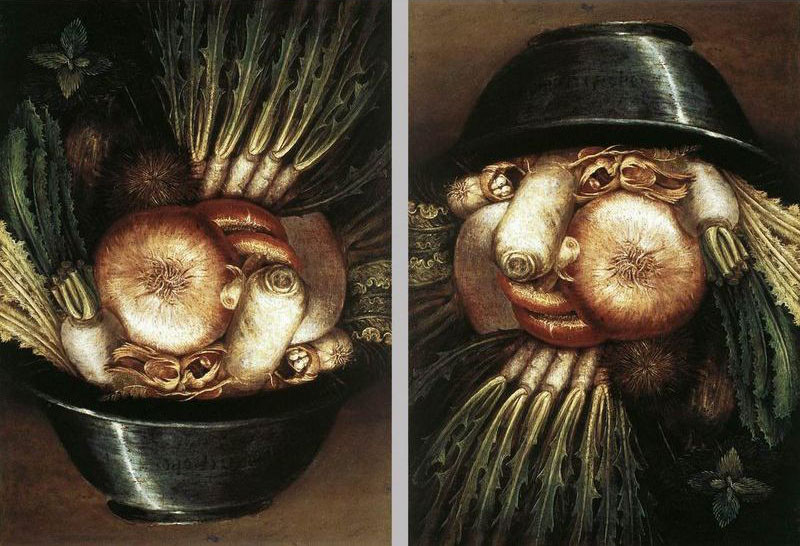
Arcimboldo painted portraits of character types rather than individuals; for instance, a librarian composed entirely of books or a gardener made of vegetables in a bowl. That latter painting depends on the viewer to decide to see the bowl filled with veggies or a human “face.”

When is a face a face and when is it a bowl of root vegetables? When is a painting a painting and something greater than a collection of chemicals on canvas?

Vegetables In A Bowl, Or, The Gardener

George Herbert wrote poems about the only idea that he deemed to be worth considering: The eternal love of his Christian God and man’s time-and-space-and-language-constrained attempt to return that love. Two of his poems are written in the shape of what they are about. Like Arcimboldo painting a root vegetable for a nose, Herbert uses words to build an item; in one, “The Altar,” each word is a “stone” making up the altar that the poem is conceived as being:

A broken ALTAR, Lord, thy servant rears,
Made of a heart and cemented with tears;
Whose parts are as thy hand did frame;
No workman’s tool hath touch’d the same.
A HEART alone
Is such a stone,
As nothing but
Thy pow’r doth cut.
Wherefore each part
Of my hard heart
Meets in this frame
To praise thy name.
That if I chance to hold my peace,
These stones to praise thee may not cease.
Oh, let thy blessed SACRIFICE be mine,
And sanctify this ALTAR to be thine.

One word, a single syllable, too many or one word mislaid or deleted, and there is no altar there. It is an altar made of words but no less central to the life of a church than an altar made of stone. The poem appears in the only book of poems that he compiled himself, a book titled “The Temple,” which walks the reader, a “dejected poor soul,” through a church. Thus, his altar, “The Altar,” is central in the book. (At Herbert’s request, the book was published posthumously, with his stated desire that it might bring “consolation of [to] any dejected poor soul.”)

It is probably an untranslatable poem, in fact if not sentiment. (Indeed, an admittedly brief survey has not yielded one.) The shape of the poem is dictated by the number of syllables in his choice of words; it is a translation of an object, a real thing, into words anyway, and as such is forever a failure. It is a “broken altar.” The human heart is the only perfect, unbroken, stone for worship, is the only true altar. All that his mind can make is something out of these pieces of meaning, words, and if he can get out of his own way (“if I chance to hold my peace”), these words as assembled here only exist to worship and love. They are what they are, words, and the words each on their own are not an altar, and a spoken version of this poem is not an altar, either. When is an altar an altar? At what point is a poem something other than, more than, words on a page?

However well-constructed it may be—it looks like an altar, for crying out loud—it does not matter. It is no altar. Not even a photorealistic painting of an altar would be an altar. Further, no altar is truly an ALTAR, as no earthly object is made of the only stone of faith that exists: the human heart “cut” by God.

Herbert’s faith was that of a man for whom questions about faith were a part of it. His worship and his poetry exist in a space of failure, where a poem of an altar is not an altar but is a sort of altar, an attempt at one. His poetry depicts a figure who is struggling in every way to comprehend and return eternal love and who is met every time by a figure who replies that it is all a bit easier than he is making it. But all I have is language, Herbert’s speakers proclaim: “We say amiss / This or that is: / Thy word is all, if we could spell.”—”The Flower.”

Herbert often describes the moment when the perceiving of love comes easily, and it is always sensuous, often reads as if it is written to a new love:

Who would have thought my shriveled heart
Could have recovered greenness? It was gone
Quite underground; as flowers depart
To see their mother-root, when they have blown
—”The Flower”

But Herbert’s worshipper is always doubting himself, his faith, whether his faith is correct or not. In “Love (iii),” Herbert’s speaker is an unworthy guest in God’s (Love’s) home, but his host is gently persistent:

Love bade me welcome: yet my soul drew back.
Guiltie of dust and sinne.
But quick-ey’d Love, observing me grow slack
From my first entrance in,
Drew nearer to me, sweetly questioning
If I lack’d anything.

A guest, I answer’d, worthy to be here:
Love said, You shall be he.
I the unkinde, ungrateful? Ah, my deare,
I cannot look on thee.
Love took my hand, and smiling did reply,
Who made the eyes but I?

Truth Lord, but I have marr’d them: let my shame
Go where it doth deserve.
And know you not, sayes Love, who bore the blame?
My deare, then I will serve.
You must sit down, sayes Love, and taste my meat:
So I did sit and eat.

So if poetry is always at best an approximation of True Love, why not try to sing this struggle, as well? The “cheerfully agnostic” (which pretty much describes me, as well) English composer Ralph Vaughan Williams created five songs out of four Herbert poems a little over a century ago. The suite is called “Five Mystical Songs,” and one, “Love Bade Me Welcome,” is a setting of “Love (iii).” Some churches use the last song, “Antiphon,” as a hymn sung by the congregation.

Here is Sir Thomas Allen performing the set (in two sections) with the BBC Symphony Orchestra:

____________________________________________
The WordPress Daily Prompt for December 16 asks, “You have to write a message to someone dear to you, telling that person how much he/she means to you. However—instead of words, you can only use 5-10 objects to convey your emotions. Which objects do you choose, and what do they mean?”

* * * *
Please subscribe to The Gad About Town on Facebook: http://www.facebook.com/thegadabouttown