
To Be Brief … No Such Thing in Some Books
Most copies of “Tristram Shandy” by Laurence Sterne are about 600 pages long. The book is a fictional autobiography in which Tristram, the not-quite hero of a story that is not quite his own, attempts to tell us about his life from birth onward. However, he does not even begin to begin telling us about his birth and his first day on earth until the fourth volume because, like his own conception on page 1, his story is much interrupted.
(On page one, at the very moment Tristram is to be conceived, his mother asks his father if he remembered to wind the clock, an ill-timed interruption that, according to Tristram, produced an author who is incapable of telling a story straight to its end without breaks, questions, and digressions.)
The full title of Sterne’s masterpiece is “The Life and Opinions of Tristram Shandy, Gentleman,” and it was published over almost eight years from 1759 to 1767. It made the Irish writer world-famous and wealthy.
At the end, one more character brings in one more story and Tristram’s mother asks, “L–d, what is all this story about?” It is the second-to-last sentence in the book and it is also the question most readers ask as they conclude reading Sterne’s great comic novel. “Tristram Shandy” is one of the most entertaining novels in English because it never gets to its point.
Christopher Ricks once described Sterne’s novel as “the greatest shaggy-dog story in the language.” By the end of all these pages Tristram has only brought us all the way into his own toddlerhood, leaving with us the thought that, should he continue the attempt to tell his life-story, he will never catch up to himself.
Thus, not much of Tristram Shandy’s life nor many of his opinions appear in the book, but many other characters—and their opinions—do. The title is the novel’s first joke. Tristram Shandy is not a character in his own story. He often criticizes himself for his many digressions and his way of not getting to the meat of his story very quickly, but he always steps away from criticizing himself, and he even sets out in one chapter to finally tell his own story in a “tolerable straight line,” but not before drawing his narrative schemes for the volumes we have just read in a series of diagrams:
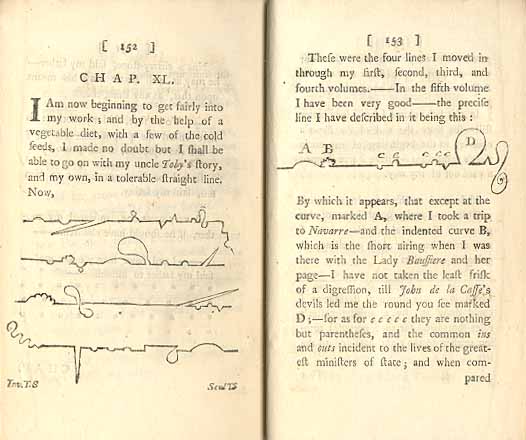
He opens a chapter in which he promises a straight story with an interruption about how hard it is to do that. He identifies for us which interrupting anecdote corresponds to which bend away from the “tolerable straight line” and defends the sections that he labeled with “ c c c c c ” as “nothing but parentheses, and the common ins and outs” of life. Several paragraphs later, Tristram lays out an estimate for us: If he writes two volumes a year for the next 40 years, he will be all caught up … to where he is now, 40 years before that imagined future, at which time he would have written thousands of pages yet have decades of life yet to tell us about.
Tristram recognizes that his own storytelling method has created a paradox for himself: If it took him one year to bring himself in his own story to one full day old, yet he lived 364 additional days in that writing process, that means that 364 days have been added to his job, 364 days that he did not write about because he had not yet gotten to them in the process of getting to be one day old in the narrative. “… [A]t this rate I should just live 364 times faster than I should write”—just?! that implies he might slow down!—”It must follow, an’ please your worships, that the more I write, the more I shall have to write—and consequently, the more your worships read, the more your worships will have to read.”
Sterne’s Shandy is self-entrapped in an ever-present present which interferes in real time with his recounting of the past. And Sterne loved finding every conceivable method to interrupt his character’s storytelling. Shandy wants desperately to be brief, but how brief should he be? How brief can he be? If an experience takes X amount of time to live through, and if a story about that experience takes more than X amount of time to tell—because listeners need the context and background—then every story in a life takes longer to tell than however much time it took to live it. Every writer will live forever by that logic.
Tristram’s mother asks at the end, “What is all this story about?” At the moment, Obadiah has been complaining about a cow that will not give birth, perhaps because the Shandy bull was not successful in impregnating it. He thinks he is owed a calf. Tristram’s mother asks her question and the answer is about both Obadiah’s story and the book we are have been reading: “‘L–d! said my mother, what is all this story about?—’ ‘A Cock and a Bull, said Yorick—And one of the best of its kind, I ever heard.'”
Cue the rimshot. A “cock and bull story” is a derogatory term for a fanciful tale; Obadiah’s complaint was literally an accusation having to do with that phrase. It also describes the book in the reader’s hands. Sterne’s punchlines are brief, as they always should be, but there are many of them in Tristram Shandy, as he builds joke after joke, scene after scene, chapter upon chapter.
__________________________________
The WordPress Daily Prompt for September 20 asks, “‘I would have written a shorter letter, but I did not have the time.’—Blaise Pascal. Where do you fall on the brevity/verbosity spectrum?”
There is an expression, “Brevity is the soul of wit.” And another: “The more the merrier.” As in “Tristram Shandy,” the punchlines and wit should be quick and brief, but plentiful.

 The Gad About Town