The One Who Got Away

More so for Sylvia Plath than many other writers, readers develop protective feelings for her. Many openly express the idea that “only they” get her or are her best reader. Reading biographies of the dead poet, one encounters language akin to a lover describing the one who got away. Plath, a suicide, is a love who got away, for reader after reader.

The other Plath scholars or even her casual readers (if such readers exist) are viewed as rival suitors, as dead wrong for her, as individuals mishandling her bones. Some biographers refer to her by her given name, “Sylvia,” rather by than her personal and professional name, Plath, thus treating her as a familiar. Others are deeply offended by this practice, which does indeed appear to be something reserved for this poet alone. It has the effect of making her the star of a soap opera that she never cast herself in.

(Until her death in 1995, I was friends with and a student of a Sylvia Plath scholar at SUNY New Paltz, Dr. Carley Bogarad. If ghosts existed, I wish hers was looking over my shoulder today.)

In a letter that she never sent to one of her lovers, Richard Sassoon, Plath wrote, “Perhaps when we find ourselves wanting everything, it is because we are dangerously close to wanting nothing.” The sentence was unseen by anyone, including Sassoon, until it was published in 2000, when her unabridged journals were finally published. (Thus Kris Kristofferson did not know he was echoing Sylvia Plath in his song, “Me and Bobby McGee.”) Since its publication, it has become a ubiquitous Tumblr meme, always attributed to Plath but rarely given in context. Did a character in her one novel, “The Bell Jar,” enunciate this emotional equation? Or did she, herself?

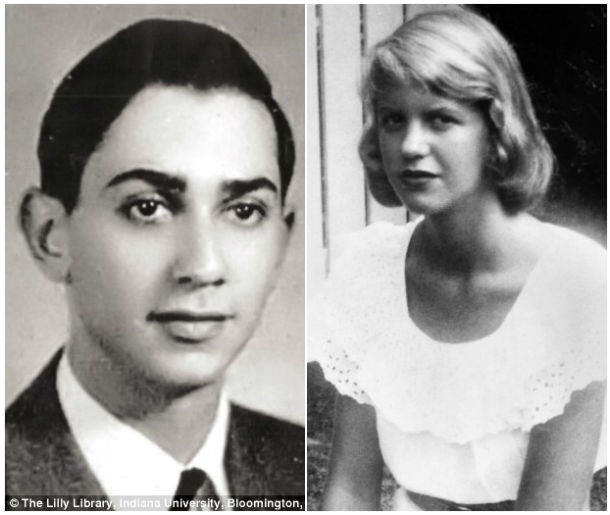
In the photo at top, Sassoon is seen as Plath would have known him, in the mid-1950s; next to him is a famous photo of Plath, also from that era.

Richard Sassoon was one of Plath’s lovers before her marriage to Ted Hughes. They met in 1954 and broke up a few years later. A literature student at Yale and a British citizen, Sassoon was different from the American boyfriends she had spent time with so far: He could keep up with her, intellectually and in other ways. In the official Plath list of lovers, he is “the one who got away,” as it was his absence that “catapulted” Plath onto the path that led her to Ted Hughes. (In Plath’s words, Hughes “blasted” Sassoon from her.)

At the beginning of 2013, two new biographies were published on the occasion of the 50th anniversary of her death. In both, Sassoon plays a spectral role in Plath’s story, but one of the biographers managed to contact him. Andrew Wilson wrote “Mad Girl’s Love Song: Sylvia Plath and Life Before Ted,” in which he argues that, had Sassoon not left Paris when Plath hunted him down to confront him over his feelings for her, she would not have returned to Hughes. Wilson at least made contact with Sassoon, who made it clear that he has not yet and will never speak of his long-dead lover. According to Wilson, Sassoon found Plath “as various as the sea.”

A professional biographer named Carl Rollyson published “American Isis: The Life and Art of Sylvia Plath” at the same time. (The first part is an unfortunate title in today’s international climate.) Wilson’s book is about Plath’s life before Hughes and Rollyson’s book is about her last days and the long fight over her works, legacy, and image fought between Hughes, Plath scholars (my teacher among them), and Hughes and Plath’s children. Rollyson has written many many biographies, mostly about movie stars (Marilyn Monroe) and literary figures (Plath, Susan Sontag); his own website makes it sound like he is interested in making the lives of literary figures seem more like those of movie stars and the movie stars appear more like literary figures. Since sex is a universal experience, period, it is certainly universal in these biographies.

But it is in Rollyson’s book that one finds something that almost could be a reply from Sassoon to Plath’s unsent letter and thus unenunciated thought about the closeness between wanting everything and wanting nothing. On page 79, he writes, “The arch and elusive Sassoon could be quite a trial at times. Here is trying to placate Plath:

‘Please do not say you do not know me. That has depressed me a little. … And do you think I know myself well enough to tell you? … I have said much about the world—surely not without some self-revelation. And I have made you smile, I have made you laugh—perhaps I have even made you cry—was this not me! and me alone?'”

She never sent the letter anyway, and Sassoon’s plea (which does not strike my ears as making him a “trial”) reveals a man who could live in the gray shades of life, embrace and be frustrated by the small smiles and cries, to a lover who lived with an all-or-nothing perspective. Her tempestuous life continued with another lover, Hughes.

In “The Bell Jar,” Plath’s heroine Esther Greenwood—who is often described by critics as Plath’s “alter ego”; the authorial fallacy seems to always be excused when discussing Plath’s works, but sometimes a writer’s creations are just that—Greenwood closes her narrative with another famous Plath quote: “I took a deep breath and listened to the old brag of my heart. I am, I am, I am.”

Plath’s writing remains vibrant and scary and vital. Its heart does indeed continue on.

____________________________________________
The WordPress Daily Prompt for December 9 asks, “‘Perhaps when we find ourselves wanting everything, it is because we are dangerously close to wanting nothing.’—Sylvia Plath”

* * * *
Please subscribe to The Gad About Town on Facebook: http://www.facebook.com/thegadabouttown
Gad Meets Godot

“Where I live, I can not speak of it. It takes too long to say its name. Who I love, same thing.”

He goes on. “So they ask us here,” he says, “Look at that.” He points. “‘No Words As Long As This,’ the sign says. And it gives a long list of long words. It is like they want a tall, short thing. Or a short but tall one. How can I fill this for them?”

“We,” I say to him. “We.”

“Right, kid. You and I. How can we give them this? This thing they ask. It is so tough. And it is close to the time we leave.”

“I have no right to tell you what to do.”

“But.”

“But. We can wait. There is a new day and it comes next.”

“Next?”

“To this day.”

“But why ask us to do this? Like this?”

“This? Oh.” They look at the sign and read out loud:

“The WordPress Daily Prompt for December 8 asks, ‘Today, write a post about the topic of your choice—using only one-syllable words.'”

“There is one word there that I do not like.”

“What is it?”

“Syllable.”

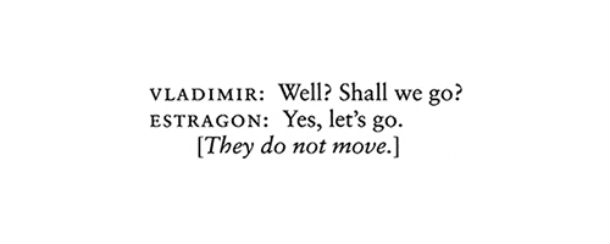
“Oh.” They do not move.

* * * *
Please subscribe to The Gad About Town on Facebook: http://www.facebook.com/thegadabouttown
My Thinking Makes It So

In Act 2, Scene 2, of Hamlet, the doomed Rosencrantz and Guildenstern are chatting with the prince. They are old college buddies of Hamlet’s, and King Claudius (Hamlet’s step-father) and Queen Gertrude (his mother) have sent for them to learn what is bothering the young man, who has been acting with an “antic disposition” and saying strange things, half to himself and half to no one can tell who.

Hamlet greets them and speaks in the same riddling manner that he has been using with the rest:

HAMLET: Let me question more in particular, my good friends, what you have done to deserve such fortune, that she sends you to prison hither?
GUILDENSTERN: Prison, my lord?
HAMLET: Denmark’s a prison.
ROSENCRANTZ: Then the world is one.
HAMLET: A goodly one; in which there are many confines, wards, and dungeons, Denmark being one o’ the worst.
ROSENCRANTZ: We don’t think so, my lord.
HAMLET: Why, then ’tis none to you; for there is nothing either good or bad but thinking makes it so. To me it is a prison.

Hamlet quickly determines that they are not merely dropping in to talk about sports and the weather but are spies. Ultimately, he manages to have them both killed.

Shakespeare’s quip about how one’s thinking determines a thing’s relative goodness or badness has lived on through the centuries, but in most peoples’ recitations it carries about the same weight now as a Twittering teenager’s hashtagging of “YOLO.” Perhaps this is because it is delivered by a character who is speaking in riddles and jests and pretending to be mad. (“What are you reading?” “Words, words, words.”)

Four hundred years after Hamlet was first performed, “Nothing (is) either good or bad but thinking makes it so” is spoken as a longer, more profound-sounding, version of, “Don’t sweat the small stuff.” “The rain is uncomfortable for you but it’s good news for the farmers,” says the profound thinker who apparently wants me to punch him. (I once replied to this with a “Do you know any farmers? We live in the suburbs. If you do, see if they’re carrying umbrellas, too.” The person walked away, which of course was the only proper reply to my being a jerk.) (We are still friends. I have my good points.)

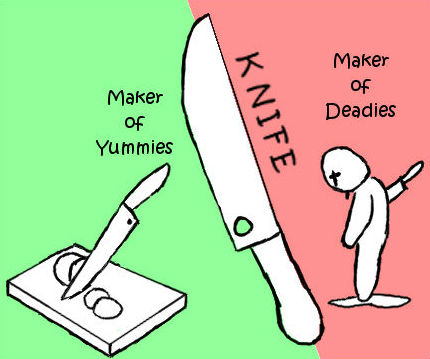
knifeconstrastMany people resist strongly and vocally when it is suggested that, taken existentially, Shakespeare and/or Hamlet is right. Our perception is all that defines good from bad. A happy event, in and of itself, is not inherently a good thing. A tragic happening is not by definition evil. There is a deep commitment to the idea that there is evil in the universe as well as good; that good inheres in things we like and love and that evil is a containable reality. This is because most of us combine and conflate the notions of sad with bad and happy with good.

Some of the saddest things that I have seen have had positive things follow them, possibly as a result of reactions to the sad thing. (I am disabled and that sucks, and I would not wish the experience on people I dislike, but being disabled gives me an income, a teeny-tiny one, which gives me time to write; a small example, that, but reality resides on a spectrum and not in an either-or zero-sum playhouse.) And some of the best things that I think I have done may turn out to have terrible consequences. Sadness exists. Tragedy is a reality. So is happiness.

Are there people who do wrong in this world? People who introduce sadness into peoples’ lives or who work for their own personal gain to the detriment of others around them? Of course. Hamlet was no murderer but he had Rosencrantz and Guildenstern killed. (Fictional characters, of course.) Hitler existed. If evil is inexplicable, well, then, so is good. We want all matters to be explicable, however, so we deploy terms like “good” and “evil” as if they are tools that explicate.

Further, our minds want there to be someone to credit or something to blame behind the good or the evil thing. There must be an explanation, goes the thinking. Thus, there must be a find-able motivation animating even the explicably good thing or evil person. The great journalist Ron Rosenbaum explores this in his famous book, “Explaining Hitler,” which confronts the book buyer from the start, the front cover. Hitler’s baby picture sits there. Historians have searched for decades for the clues to pinpoint the moment baby Adolf became Hitler. What was the cause? The explanation? It seems that it is not okay if there is not one. But “here there is no why,” as Martin Amis writes of Auschwitz.

Rosenbaum interviewed Alan Bullock, one of Hitler’s biographers. “‘Some days, I ask God,’ Bullock told me, his voice dropping to an impassioned whisper, ‘If You were there, why didn’t You stop it?’ And then he added the sad lesson of a lifetime spent attempting to explain Hitler: ‘Never believe God is omnipotent.'”

Boom! Is the Holocaust, or a holocaust, a man-made political rampage, something so far outside human imagination when it is always and only the product of human imagination?

Yehuda Bauer, a Holocaust Studies scholar, replies to Rosenbaum’s question, “Will there ever be a why?” “Bauer told me that he believes it is theoretically possible. ‘But the fact that something is explicable doesn’t say that we have explained it.'”

Terrible acts and tragedies are the horrible outliers of most human experiences. The beautiful thing is that love, great love and small love, is not. And it is just as inexplicable … until I gaze in my beloved’s eyes.

____________________________________________
The WordPress Daily Prompt for December 3 asks, “What’s the best piece of advice you’ve ever received that you wouldn’t give to anyone else? Why don’t you think it would apply to others?”

* * * *
Please subscribe to The Gad About Town on Facebook: http://www.facebook.com/thegadabouttown