Tapping into ‘Echo Spring’

Every alcoholic has a collection of anecdotes that can be simultaneously heartbreaking, outrageous, and hilarious. Perhaps they are hilarious only to fellow alcoholics; perhaps they can not even be listened to by outsiders. For an outsider, most alcoholic anecdotes may as well conclude with the same punchline, an interchangeable rubber-stamped ending: “And then I got away with it again.” Or, “I didn’t die that time, either.” And then comes the next hair-raising—or eyebrow-raising—tale.

There are two standard anecdotes, one usually about outrageous behavior, and another about the pit at the end of the road. Almost everyone who drinks has a few of the first sort of story.

“I thought things were going great and I was happy to be sober and proud to be in recovery, but I kept having these urges. I was in a good mood and I talked about the urges and people helped me understand. And now it’s two weeks later and I don’t remember these two weeks.” That is the second kind of story; I heard it from someone today. The speaker had “picked up,” which is recovery-speak for “drank.” He “went out” is another phrase.

In her 2013 book, The Trip to Echo Spring, Olivia Laing quotes Andrew Turnbull’s biography of F. Scott Fitzgerald (pictured above):

He describes Fitzgerald in his room at the Grove Park Inn making endless lists “of cavalry officers, athletes, cities, popular tunes. Later, he realized that he had been witnessing the disintegration of his own personality and likened the sensation to that of a man standing at twilight on a deserted range with an empty rifle in his hands and the targets down.” The images are drawn from Fitzgerald’s own account in “The Crack-up,” but somehow have more impact here. (Laing, 84)

That is the second kind of story, too.

Towards the end of my drinking, but really, nowhere near the end, I remember extemporizing for several hours straight about NASCAR to a friend. Now, I am a racing fan so I have a fan’s knowledge base, but I remember feeling like I had turned into an obsessed young boy who has discovered the backside of his baseball cards and wants to read off every single statistic out loud to everyone. And the moment came from nowhere. It was possibly a symptom of delirium tremens, but I recall feeling safe in settled facts and unsafe in the open field of conversation. The subject matter of the facts was chosen at random, by me, and could have been any other topic area, but I cleverly picked one that none of my friends shared enthusiasm for. There could be no conversation. For my friend, it must have felt like what Turnbull described about watching Fitzgerald as I rattled off lists of winners and possible routes to the championship for certain race teams. For hours. (“Cavalry officers, athletes, cities.”) I also remember that I detected an intervention in my future and I figured that if I spoke continuously, no intervention could happen. Instead, I probably hastened one.

That is the second kind of story. My brain was firing blanks, a lot of them in rapid succession, as confidently as my brain had ever fired off substantive thoughts in graduate school classes or in front of classrooms, but blanks anyway. A line from a Robert Lowell poem, “Eye and Tooth,” haunted me: “I am tired. Everyone’s tired of my turmoil.”

Laing’s book mixes travel narrative, expository journalism, and literary biography in pursuit of a personal answer to a large question: “I wanted to know what made a person drink and what it did to them. More specifically, I wanted to know why writers drink, and what effect this stew of spirits has had upon the body of literature itself.” She picks six male, American, Twentieth-century, writers—Ernest Hemingway, F. Scott Fitzgerald, Tennessee Williams, John Berryman, John Cheever, and Raymond Carver—as her biographical subjects, even though she is young, British, female. These figures give her sufficient distance to look more closely at the subject; she alludes to being raised in a house “under the rule of alcohol.” She adds, “There are some things that one can’t address at home,” and decides to travel to America.

What I wanted was to discover how each of these men—and along the way, some of the many others who have suffered from the disease—experienced and thought about their addiction. If anything, it was an expression of my faith in literature, and its power to map the more difficult regions of human experience and knowledge. (Laing, 12)

(The ‘Echo Spring’ of her title comes from Williams’ “Cat on a Hot Tin Roof,” in which Brick, to get away from Big Daddy, excuses himself. Big Daddy asks, “Where you goin’?” and Brick replies, memorably, “I’m takin’ a little short trip to Echo Spring.” Echo Spring is his brand of bourbon and the nickname for the liquor cabinet holding it.)

It is the first kind of story, the outrageous anecdote, the prurient tale, that Laing says that she wants avoid, and she successfully does; the hair-raising bits are kept to a minimum, and, when seen, sketched very deftly, as on page 82: “Once, in the 1920s, he stripped to his underclothes in the audience of a play.” That was Fitzgerald at his hijinks-loving “best.” Fitzgerald’s fellow famous Baltimoran appears in the next sentence, at his most pruriently judgmental. “According to Mencken, [Fitzgerald] shocked a Baltimore dinner party ‘by arising at the dinner table and taking down his pantaloons, exposing his gospel pipe.'”

Laing finds and expresses the empathy that can be found in Fitzgerald’s apparent fondness for drunkenly dropping trou, though, and writes about the mask that baldly revealing oneself can prove to be: “Undressing is an act of concealment sometimes. You can yank down your pants and show off your gospel pipe and still be a man in mortal terror of revealing who you are.” An alcoholic will shock to prevent a embarrassing conversation about his drinking.

It is that mortal terror that animates much addiction and certainly contributed to the art these six writers created; to her credit, Laing’s empathy is clear-eyed and clear-hearted and she does not look for redemption where there is none. That second kind of story is too heart-breaking, after all, and each of her six writers lived it. Fitzgerald, Hemingway, and Berryman did not survive theirs.

____________________________________________
The WordPress Daily Prompt for January 14 asks, “Open your nearest book to page 82. Take the third full sentence on the page, and work it into a post somehow.” This was it: “Once, in the 1920s, he stripped to his underclothes in the audience of a play.”

* * * *
Please subscribe to The Gad About Town on Facebook: http://www.facebook.com/thegadabouttown

James Joyce, A Portrait of the Artist, Sitting

For most of 1928, James Joyce’s attention was unequally divided among many projects and complications: He was keeping a wary watch over German and French translations of “Ulysses,” his 1922 novel; readying sections of his next novel, which was still officially titled “Work in Progress” (published as “Finnegan’s Wake” years later, in 1939); defending “Work in Progress” from negative reviews and letters from friends who were urging him to quit his experimental writing; explaining to his patrons when new sections of “Work in Progress” could be expected so that he could have an income; and losing his eyesight.

He was 46 years old, living in Paris with his partner, Nora, and their two children, and life was complicated. He was engaged in writing the novel that became “Finnegan’s Wake,” and his artistic ambition for it and its effect on him were both unsparing. “Ulysses” tells a story of a single day, June 16, 1904, in a particular place, Dublin, using as many types of storytelling and modes of rhetoric as he could use. Joyce intended “Work in Progress” to do the same thing but for the idea of nighttime; it is entirely inside the sleeping and dreaming mind of some unknown person, and it is written in a sort of pidgin English animated by puns.

His letters to his patrons tended to obscure matters even further and made it more challenging to continue funding his project. In one 1927 letter to his most important supporter, Harriet Shaw Weaver, he wrote something with “the intention of enlightenment,” as his biographer Richard Ellmann cheerfully puts it, but what he sent read:

I am making an engine with only one wheel. No spokes, of course. The wheel is a perfect square. You see what I’m driving at, don’t you? I am awfully solemn about it, mind you, so you must not think it is a silly story about the mooks and the grapes. No, it’s a wheel, I tell the world. And it’s all square. (Ellmann, 597)

Weaver tried to get in the spirit of his constant riddling and urged him to square the wheel, a suggestion for which he thanked her but further explained that he was doing something different than that. By 1928, financially and artistically discouraged, he declared to one friend

Critics who were most appreciative of “Ulysses” are complaining about my new work. They cannot understand it. Therefore they say it is meaningless. Now if it were meaningless it could be written quickly, without thought, without pains, without erudition; but I assure you that these twenty pages now before us cost me twelve hundred hours and an enormous expense of spirit.” (Ellmann, 598)

Thus, Weaver traveled from London to Paris in 1928 to see for herself how things were going, on the occasion of Joyce’s 46th birthday. The visit reassured both parties and later that year he received word of an advance payment from two American publishers.

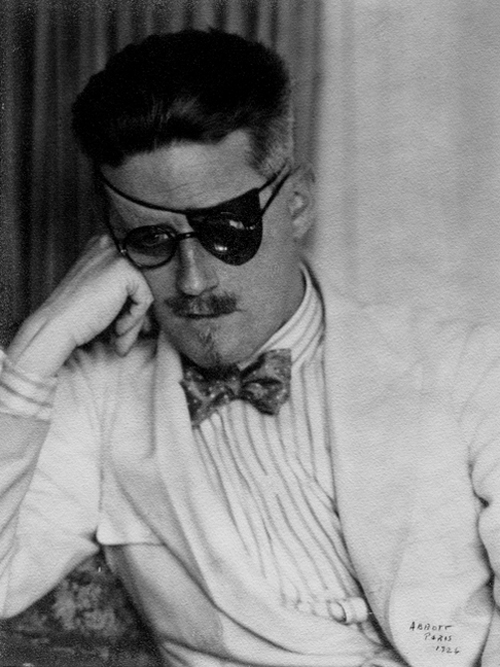
This is the James Joyce captured in Berenice Abbott’s famous portrait of the artist: At rest and a bit more confident in his world. The left lens in his eyeglasses is shaded, evidence of the ongoing battle to save his sight. It is one of the two or three most famous photos of the author, the one fondly parodied on the album cover for “If I Should Fall From Grace with God”:
Pogues

james-joyceAbbott was an American who became more famous in later years for her portraits of New York City during the Great Depression. She spent the decade of the 1920s learning her craft, working with the photographer Man Ray, and opened her own studio in 1927. She had photographed Joyce before, in 1926, and that photo session saw the author wearing an eye patch after surgery (and a soul patch under his lower lip):


joyce sans hatJoyce apparently liked sitting for Abbott, as there are several other photos from the 1928 session, without the stylish fedora and cane, but obviously from the same session, as he is wearing the same striped necktie. I think the one at left captures Joyce with more feeling; perhaps without the protection the hat and cane afforded him he let his guard down. The iconic photo of an iconic literary figure is followed by a photo of a weary, but not wary, momentarily confident, 46-year-old artist.

* * * *
James Joyce died 74 years ago today, January 13, 1941.

____________________________________________
The WordPress Daily Prompt for January 13 asks, “Pick a random word and do Google image search on it. Check out the eleventh picture it brings up. Write about whatever that image brings to mind.” When one searches Google Images for images of the great author, the famous Berenice Abbott photo, the one at the top of this column, is number 11.

* * * *
Please subscribe to The Gad About Town on Facebook: http://www.facebook.com/thegadabouttown
Suis-je Charlie? (Am I Charlie?)

 
It is said that words matter. Images, too.

When violence is used as a form of literary criticism, it gives to the words and images that it dislikes a kind of power, but a different sort of power than the words or images actually possess. Words and images convey ideas in the most intimate way: from inside one human mind to another. They carry little in the way of power or anything like power. When violence is a response to words and images, violence is revealed as the nullity that it is, and the philosophy that believes that violence is a reply to words and images is revealed as a nullity, too. The words and images did not reveal that.

Even if a writer, in the writer’s intimate my-mind-to-your-mind way, writes something provocative like, “Kill me,” you can’t. Even if the writer names you in the request. Even if the writer irritates you in the writing. A bullet as a reply gives the writing a power it does not deserve and did not request or demand or require: the power to reveal the vacuum of violence inside any brain or ideology that sees the bullet as any kind of viable reply. It is an unequal exchange, even if the dead once said and wrote that they “would rather die standing than live crawling.”

In attempting to explain what happened in Paris last night, I finally found myself offering a what-if: What if everything that happened last night happened, but here, in Los Angeles, say. Someone offended by a certain animated comedy program that specializes in irking the church-, temple-, and mosque-going religious among us decides to hunt down the creators of that show in revenge for perceived insults. My listener got it, and then we shook our heads, because we live with the amnesiac’s belief—rightly or wrongly, and I hope rightly—that “it can’t happen here.”

I say “amnesiac” because it can, and it has, and it quite possibly might happen here again.

Violence astonishes. That is its only point. It certainly doesn’t silence. I am astonished by how astonished I still can be. That is why I have written twice now about last night’s senseless violence in Paris against the publisher and staff (and nearby police officers) of “Charlie Hebdo.” Bravery is a skill, and I wonder if I have cultivated it in myself. Because it is obvious to me that murder is empty and that injustice is injustice is injustice, so that any claims to a philosophical ground underneath murder is a special pleading of the worst sort. Thus when I declare that police officers ought not murder and that police officers ought not be murdered and that editorial staffs ought not be murdered and that murder is emptiness attempting to fill its own vacuum, it seems so obvious to me that it certainly does not feel like something laudable like bravery just to say it. “Je suis Charlie.” As a question it is, “Suis-je Charlie?” My answer is, I hope so.

Shortly before his death, the poet W.H. Auden told talk-show host (and former politician) Richard Crossman, “Nothing I wrote prevented one Jew from being gassed or stalled the war for five seconds.” At first glance, this places the bar very high for the role of a writer in the affairs of the world, but it is simply a stark assessment of the reality that a writer has no say in the practical matters of life and death. He is not saying that words do not matter but is instead drawing the boundary between where they do matter and where they can not. Writers are makers and not doers, not “men of action,” Auden also liked to say.

One of his most famous poems is September 1, 1939, written to mourn the outbreak of World War II. The title is of course the date Germany invaded Poland. It was written quickly, not heavily edited, and published weeks later. Auden came to reject the poem and refused three times to include it in his Collected Poems. He told Crossman that the poem possessed rhetoric that was “too high-flown.”

In the second-to-last stanza he wrote,

All I have is a voice
To undo the folded lie,
The romantic lie in the brain
Of the sensual man-in-the-street
And the lie of Authority
Whose buildings grope the sky:
There is no such thing as the State
And no one exists alone;
Hunger allows no choice
To the citizen or the police;
We must love one another or die.

Auden said that he especially rejected that last line and wanted to correct it to, “We must love one another and die,” because “or die” is not real. There is nothing we can choose versus death. But it was lines like, “Those to whom evil is done / Do evil in return” and “There is no such thing as the State,” that he probably found too “high-flown.” They are too definitive, too short to allow for nuance, too inarguable—not because they are obvious, but because they are rhetorically rendered to disallow argument. (Was “evil” done to Germany? Heck, “evil” is a thick word, and if Germany is doing evil, Mr. Auden, why not explain what you mean by that? And if Germany is doing evil, what evil is any kind of response to any evil? Injustice is injustice is injustice.)

Auden rejected the poem for the wrong reasons. “All I have is a voice,” he wrote, and even if that, too, is factually incorrect—in many if not most countries, each of us has a voice and a vote and can campaign—it is correct in an essential way: the writer is “a maker, not a doer,” is a voice, and the writer has a right to be audaciously “high-flown,” audaciously non-nuanced, audaciously incorrect. He was rejecting his own right to be audaciously incorrect.

It is understandable why he rejected the poem from his own canon: he disagreed with some thoughts and found others expressed incorrectly, just as it is understandable that the poem has been embraced by people of very different political stripes for different reasons. (President Johnson intoned “We must love one another or die” in his awful “Daisy” television ad. And the poem was reprinted in many American newspapers right after September 11, 2001. He was angry about LBJ and probably would have been irritated by the latter embrace.) Very little in the poem is accurate, but poets have the right to be inaccurate, and “All I have is a voice” is his claim to that right. Very little in the poem is accurate, except for one thing: We must love one another. It should not feel like bravery to say this, but it does, today just as much as it did in September 1939. Bravery is a skill. We must continue to hone it.

Here is the complete poem:

September 1, 1939
I sit in one of the dives
On Fifty-second Street
Uncertain and afraid
As the clever hopes expire
Of a low dishonest decade:
Waves of anger and fear
Circulate over the bright
And darkened lands of the earth,
Obsessing our private lives;
The unmentionable odour of death
Offends the September night.

 
Accurate scholarship can
Unearth the whole offence
From Luther until now
That has driven a culture mad,
Find what occurred at Linz,
What huge imago made
A psychopathic god:
I and the public know
What all schoolchildren learn,
Those to whom evil is done
Do evil in return.

 
Exiled Thucydides knew
All that a speech can say
About Democracy,
And what dictators do,
The elderly rubbish they talk
To an apathetic grave;
Analysed all in his book,
The enlightenment driven away,
The habit-forming pain,
Mismanagement and grief:
We must suffer them all again.

 
Into this neutral air
Where blind skyscrapers use
Their full height to proclaim
The strength of Collective Man,
Each language pours its vain
Competitive excuse:
But who can live for long
In an euphoric dream;
Out of the mirror they stare,
Imperialism’s face
And the international wrong.

 
Faces along the bar
Cling to their average day:
The lights must never go out,
The music must always play,
All the conventions conspire
To make this fort assume
The furniture of home;
Lest we should see where we are,
Lost in a haunted wood,
Children afraid of the night
Who have never been happy or good.

 
The windiest militant trash
Important Persons shout
Is not so crude as our wish:
What mad Nijinsky wrote
About Diaghilev
Is true of the normal heart;
For the error bred in the bone
Of each woman and each man
Craves what it cannot have,
Not universal love
But to be loved alone.

 
From the conservative dark
Into the ethical life
The dense commuters come,
Repeating their morning vow;
“I will be true to the wife,
I’ll concentrate more on my work,”
And helpless governors wake
To resume their compulsory game:
Who can release them now,
Who can reach the deaf,
Who can speak for the dumb?

 
All I have is a voice
To undo the folded lie,
The romantic lie in the brain
Of the sensual man-in-the-street
And the lie of Authority
Whose buildings grope the sky:
There is no such thing as the State
And no one exists alone;
Hunger allows no choice
To the citizen or the police;
We must love one another or die.

 
Defenceless under the night
Our world in stupor lies;
Yet, dotted everywhere,
Ironic points of light
Flash out wherever the Just
Exchange their messages:
May I, composed like them
Of Eros and of dust,
Beleaguered by the same
Negation and despair,
Show an affirming flame.

____________________________________________
The WordPress Daily Prompt for January 8 asks, “If you could choose to be a master (or mistress) of any skill in the world, which skill would you pick?”

* * * *
Please subscribe to The Gad About Town on Facebook: http://www.facebook.com/thegadabouttown