Hello Darkness, My Good Buddy

At once sarcastic and tender, W.H. Auden’s “The More Loving One” asks us to imagine a night sky empty of stars:

Looking up at the stars, I know quite well
That, for all they care, I can go to hell,
But on earth indifference is the least
We have to dread from man or beast.

 
How should we like it were stars to burn
With a passion for us we could not return?
If equal affection cannot be,
Let the more loving one be me.

 
Admirer as I think I am
Of stars that do not give a damn,
I cannot, now I see them, say
I missed one terribly all day.

 
Were all stars to disappear or die,
I should learn to look at an empty sky
And feel its total dark sublime,
Though this might take me a little time.
— “The More Loving One,” W.H. Auden, 1957

I might very well like a starless sky and call it sublime or subtle in its black-on-black nuance, the poet declares, and not mourn the sight of a supernova, which is after all the explosive death of a star, and I may not notice the absence of one should it simply blink out, but in all matters, “If equal affection cannot be,/Let the more loving one be me.”

In all matters attracting my human attention, be it the night sky or my beloved’s face, let the more loving one be me.
Read More
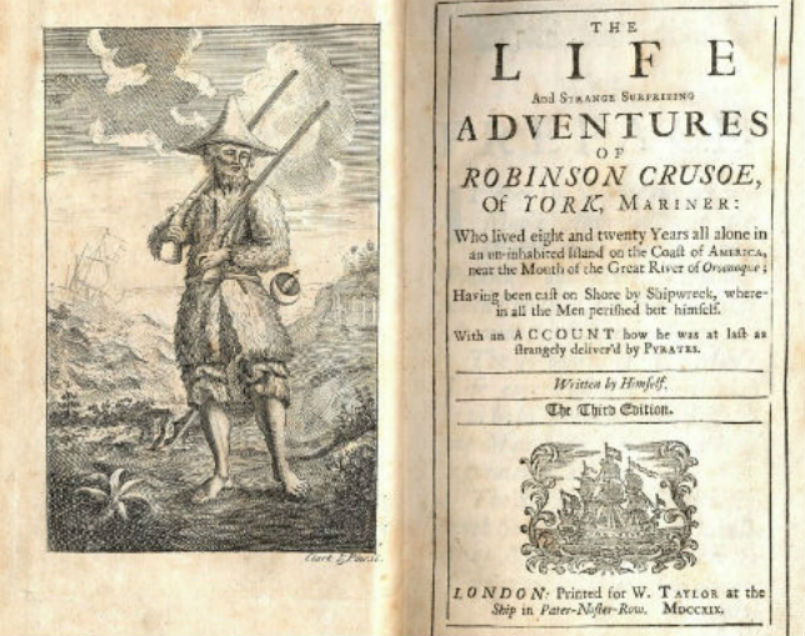
On an Island

Daniel Defoe is officially credited as the author of 28 titles, but it is likely that he was the author of twice that, if one counts the pamphlets, essays, and other works he published under pseudonyms.

One of his titles keeps his name famous almost three centuries after he published it: Robinson Crusoe. Its full title on its publication in 1719 was longer (ahem): The Life and Strange Surprizing Adventures of Robinson Crusoe, Of York, Mariner: Who lived Eight and Twenty Years, all alone in an un-inhabited Island on the Coast of America, near the Mouth of the Great River of Oroonoque; Having been cast on Shore by Shipwreck, wherein all the Men perished but himself. With An Account how he was at last as strangely deliver’d by Pyrates.
Read More

Auden’s ‘The Way’

At one point in “The Quest,” his modernist version of a quest romance told in 20 sonnets, the poet W.H. Auden derides occult fascinations as “an architecture for the odd.”

The particular sonnet, which in some editions is titled “The Tower,” but in Auden’s official Collected Poems is simply called number “IX,” concludes with a warning from magicians caught in their own tower:

Yet many come to wish their tower a well;
For those who dread to drown, of thirst may die,
Those who see all become invisible:
 
Here great magicians, caught in their own spell,
Long for a natural climate as they sigh
“Beware of Magic” to the passer-by.

Read More