‘Like something almost being said’

To a friend, Philip Larkin wrote about his latest volume of poems, High Windows, “The new printing of HW came out, with 3 mistakes corrected but a new one introduced: there is talk of another—printing, not mistake.” (The Complete Poems of Philip Larkin, ed. by Archie Burnett, 2012)

High Windows contains many of Larkin’s most loved poems: “To the Sea,” “The Trees,” “Forget What Did,” “High Windows,” “This Be The Verse,” “Annus Mirabilis,” “Going, Going.” They are his most loved even though they are—or because they are—his bleakest. “This Be The Verse” opens with an attempt to shock: “They fuck you up, your mum and dad/They may not mean to, but they do … .”
Read More
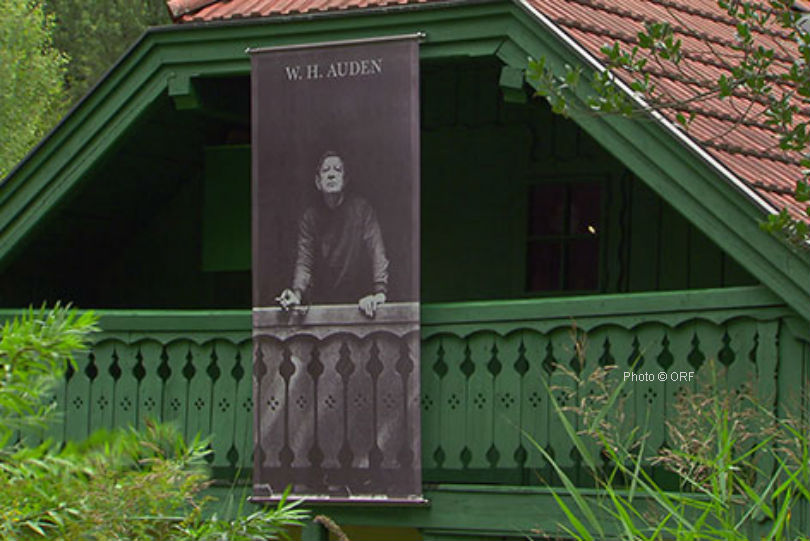
Auden at Home

In About the House, published in 1965, W. H. Auden gives readers a tour of his home in Kirchstetten, Austria. Each of the twelve poems in the section titled “Thanksgiving for a Habitat,” bears a dedication to an individual, one of Auden’s friends.

(“Down There,” about the cellar, is dedicated to Irving Weiss, and “Up There,” about the attic, is dedicated to Anne Weiss. Irving Weiss taught in the English Department of SUNY New Paltz and retired in 1985, before I was a student in that department, but he was still around when I was there. Anne was his wife. For me, “Auden dedicated a poem to him” may as well have been the caption under his face each time I saw Professor Weiss. He is still alive, 94 years old, and a profile of him in a recent Long Island newspaper does not mention any of the above.)

Back to Auden’s home (pictured in a recent photo at top with a poster bringing the master back to the porch outside his upstairs study):
Read More

Step by Step

Six years today …

* * * *
Every alcoholic in recovery has a collection of anecdotes that can be simultaneously heartbreaking, outrageous, and hilarious. Perhaps they are hilarious only to fellow alcoholics; perhaps they can not even be listened to by outsiders. For an outsider, most alcoholic anecdotes may as well conclude with the same dark punchline, an interchangeable rubber-stamped ending: “And then I got away with it again.” Or, “I didn’t die that time, either.” And then comes the next hair-raising—or eyebrow-raising—tale.

Every alcoholic in recovery is living a story with a weird ending, if they remain in recovery. It is that two-word pair there, “in recovery,” that provides the surprise, the weirdness, a period of life as surprising to behold as some of the antics, the many bizarre actions and activities and inactions and inactivities that were surprising for outsiders to watch unfold in the previous life.
Read More