To Be Brief … No Such Thing in Some Books

Most copies of “Tristram Shandy” by Laurence Sterne are about 600 pages long. The book is a fictional autobiography in which Tristram, the not-quite hero of a story that is not quite his own, attempts to tell us about his life from birth onward. However, he does not even begin to begin telling us about his birth and his first day on earth until the fourth volume because, like his own conception on page 1, his story is much interrupted.

(On page one, at the very moment Tristram is to be conceived, his mother asks his father if he remembered to wind the clock, an ill-timed interruption that, according to Tristram, produced an author who is incapable of telling a story straight to its end without breaks, questions, and digressions.)

The full title of Sterne’s masterpiece is “The Life and Opinions of Tristram Shandy, Gentleman,” and it was published over almost eight years from 1759 to 1767. It made the Irish writer world-famous and wealthy.

At the end, one more character brings in one more story and Tristram’s mother asks, “L–d, what is all this story about?” It is the second-to-last sentence in the book and it is also the question most readers ask as they conclude reading Sterne’s great comic novel. “Tristram Shandy” is one of the most entertaining novels in English because it never gets to its point.

Christopher Ricks once described Sterne’s novel as “the greatest shaggy-dog story in the language.” By the end of all these pages Tristram has only brought us all the way into his own toddlerhood, leaving with us the thought that, should he continue the attempt to tell his life-story, he will never catch up to himself.

Thus, not much of Tristram Shandy’s life nor many of his opinions appear in the book, but many other characters—and their opinions—do. The title is the novel’s first joke. Tristram Shandy is not a character in his own story. He often criticizes himself for his many digressions and his way of not getting to the meat of his story very quickly, but he always steps away from criticizing himself, and he even sets out in one chapter to finally tell his own story in a “tolerable straight line,” but not before drawing his narrative schemes for the volumes we have just read in a series of diagrams:
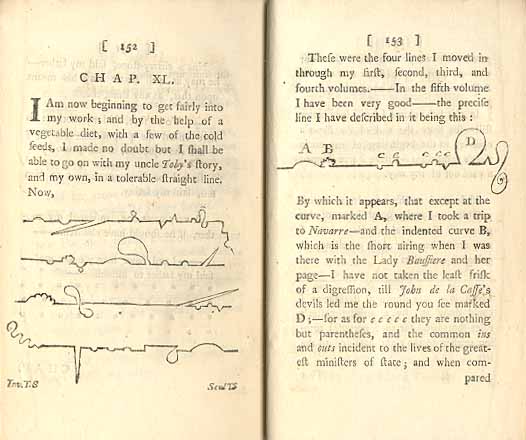
tristram

He opens a chapter in which he promises a straight story with an interruption about how hard it is to do that. He identifies for us which interrupting anecdote corresponds to which bend away from the “tolerable straight line” and defends the sections that he labeled with “ c c c c c ” as “nothing but parentheses, and the common ins and outs” of life. Several paragraphs later, Tristram lays out an estimate for us: If he writes two volumes a year for the next 40 years, he will be all caught up … to where he is now, 40 years before that imagined future, at which time he would have written thousands of pages yet have decades of life yet to tell us about.

Tristram recognizes that his own storytelling method has created a paradox for himself: If it took him one year to bring himself in his own story to one full day old, yet he lived 364 additional days in that writing process, that means that 364 days have been added to his job, 364 days that he did not write about because he had not yet gotten to them in the process of getting to be one day old in the narrative. “… [A]t this rate I should just live 364 times faster than I should write”—just?! that implies he might slow down!—”It must follow, an’ please your worships, that the more I write, the more I shall have to write—and consequently, the more your worships read, the more your worships will have to read.”

Sterne’s Shandy is self-entrapped in an ever-present present which interferes in real time with his recounting of the past. And Sterne loved finding every conceivable method to interrupt his character’s storytelling. Shandy wants desperately to be brief, but how brief should he be? How brief can he be? If an experience takes X amount of time to live through, and if a story about that experience takes more than X amount of time to tell—because listeners need the context and background—then every story in a life takes longer to tell than however much time it took to live it. Every writer will live forever by that logic.

Tristram’s mother asks at the end, “What is all this story about?” At the moment, Obadiah has been complaining about a cow that will not give birth, perhaps because the Shandy bull was not successful in impregnating it. He thinks he is owed a calf. Tristram’s mother asks her question and the answer is about both Obadiah’s story and the book we are have been reading: “‘L–d! said my mother, what is all this story about?—’ ‘A Cock and a Bull, said Yorick—And one of the best of its kind, I ever heard.'”

Cue the rimshot. A “cock and bull story” is a derogatory term for a fanciful tale; Obadiah’s complaint was literally an accusation having to do with that phrase. It also describes the book in the reader’s hands. Sterne’s punchlines are brief, as they always should be, but there are many of them in Tristram Shandy, as he builds joke after joke, scene after scene, chapter upon chapter.

__________________________________
The WordPress Daily Prompt for September 20 asks, “‘I would have written a shorter letter, but I did not have the time.’—Blaise Pascal. Where do you fall on the brevity/verbosity spectrum?”
There is an expression, “Brevity is the soul of wit.” And another: “The more the merrier.” As in “Tristram Shandy,” the punchlines and wit should be quick and brief, but plentiful.


Daily Prompt: Reading People

The woman next to me on the plane was in acute distress. She did not tell me this herself, but she appeared to me to be bearing a weight of grief and/or worry. I did not know what the source of upset was. She checked and re-checked her watch, and kept shifting her weight in her seat but kept herself leaning forward like an intense talk show host. She picked up the Airfone (this was in 2000) and considered doing something with it but returned it to its cradle. She picked it up again. She put the mandatory flight nuts in her handbag and did not accept a soda or water.

I am a dunderhead when it comes to feelings. With some experience in public speaking, I find that I can read a room more accurately than I can read an individual. Furthermore, I can tell when someone is ticked off at me far more capably than I can tell if a person is happy about something I have done or said or even if they are happy I am in their life. I need a lot of positive reinforcement.

On the plane, I knew that my ego wanted me to be this woman’s white knight and to be an attractive shoulder for her to lean against, but because I knew that this was what my ego wanted (or believed it wanted—what if she had leaned against me and actually wanted to talk and cry?), I knew I should simply keep reading my magazine. I did.

Anyone in a relationship knows their partner well enough that they can tell from a “Hello” text message with no other words or punctuation whether their partner is happy, upset, or confused by something. Or all of the above at the same time. Usually, not always, but usually, my girlfriend and I avoid the confusion that texting or other quick modes of communication can bring, and, when one of us detects something is off, we turn it into a phone call. We keep matters open and clear. I am grateful that we have not had many fights, but our worst fights have come when one of us did not phone and the communications got snarled and then so did we.

Was the woman beside me trying to get my attention with all her huffing and not-quiet sobbing? Anyone’s attention? Was she with the people across the aisle? They appeared to be a couple. Was she with them? No. Definitely no. There are ways to have a private moment in public spaces and then there are ways to have private moments in ways that may earn, well, the legitimate sympathy—and even empathy—of strangers. I do not profess to know that I can identify the difference between these two types of moment, in the moment. This fellow passenger on a flight from Cincinnati, Ohio, to Newburgh, New York, was proving to be a test of my ability to read a human being.

If I do not know my own emotions very well, which is something I started to write about recently (“For Crying Out Loud!“), I am not going to be able to correctly interpret another complicated human being’s complicated emotional displays. And I did not know my emotional inner life very well back in 2000; I did not know how complex the palette of emotions on display can be.

It may be that the woman beside me on the plane had brief moments of wanting to pour her heart out to me separated by moments of unapproachable grief or whatever she was suffering, but my default facial expression resides somewhere between poker-faced and perturbed by a distant sound that only I hear. (Look at my portrait accompanying this web site.) I probably looked as unwelcoming as possible, and then confused things when I would attempt to look welcoming, “just in case” she wanted to talk. I asked, “Are you okay?” and her shoulders replied with a surprised shudder and nothing else, no look in my direction, no words.

The landing was suspenseful, which is to say that technically it was uneventful but each sound from outside the plane, each bump of turbulence as our plane dropped into the thicker air, was audibly registered by the passenger beside me. Perhaps she was merely a nervous flyer? No. On the ground she took or placed (I do not remember which) a call on her cell phone to get a hospital address. She rushed to the front of the plane with no words to me or anyone, without waiting for the go-ahead from the air stewards.

__________________________________
The WordPress Daily Prompt for September 17 asks, “Are you a good judge of other people’s happiness? Tell us about a time you were spot on despite external hints to the contrary (or, alternatively, about a time you were dead wrong).”

There will be no column from The Gad About Town tomorrow, September 18, as I will be attending a television show taping in NYC. Yay, me.

Daily Prompt: ‘Beauty is truth, truth beauty …’

(Some thought-fragments about art with a small a and Beauty with a capital B.) (Or vice versa.)

The title is from the final lines of Keats’ “Ode on a Grecian Urn,” which the poet ends by telling us that the centuries-old vase he has been describing serves as a reminder that, “‘Beauty is truth, truth beauty,—that is all / Ye know on earth, and all ye need to know.'” Earlier the poet also says, “Heard melodies are sweet, but those unheard / Are sweeter … .”

The ones I can not hear, because I am a mere mortal and what I hear on Earth is all I need to know, those are the sweeter ones. O, vile mortality!

* * * *
Some experiences are almost universal: without sharing a common language, audiences will laugh at many of the same things. A person slipping on a banana peel. The fish-slapping dance. Analysis of comedy kills comedy (unless one is making fun of analyzing comedy) because laughter is more than a feeling, it is a reaction; when honestly expressed, it comes in an instant. Conversely, some experiences are unique to each one of us: all of us experience physical and/or emotional pain, but the best any of us can do is talk around it in an attempt to almost come close to describing it. Pain management specialists present their patients with a chart of a series of faces and ask the patients to circle the grimacing face that “matches” how they feel. It is simplistic, but it does something important in that it asks us to leave language, which can be misinterpreted, aside.

Language. The most vile and hateful sentiments can be expressed in sentences that might sound pretty when they are spoken. There is probably a language in which the sentence “I am going to kill you” would make me swoon just before I got shot.

* * * *
What makes me laugh might make you cry (if you were the person who slipped and fell) and what makes me cry might make you laugh. There is much ugliness in this world and someone somewhere finds harsh and violent things funny.

I find the sentence on that poster at the top, “We all have within us our own …,” which is a piece of typical Facebook inspiration-stuff, a poster that is designed to elicit a hopeful gaze or something, to be clunky and, worse, empty. Sunsets are nice and all, but why put words all over one? (I would rather the Kadampa Center had just put a picture of their temple on there.)

* * * *
To the best we can tell, birds are singing shopping lists to each other. “Seeds over here, seeds over here; nice sturdy branch I’m standing on.” The most boring and necessary stuff, but pretty to our ears, a sweet unheard melody to Keats.

* * * *
alainWe teach each other what we find beautiful. The cartoon at right captures, without words, something of this. Artists in a class learn to depict reality, but what about the world made Egyptians in the era of the pyramids and pharaohs depict things and humans as they did? We look the same now as we did then, but the art seen in the ancient (and beautiful) monuments does not look like our twenty-first century reality. Did life in the ancient world look all that different to eyes that are biologically identical to ours?

Certainly not. The same cartoon could be drawn about art classes from other eras: the flat crowds with identical faces in Giotto’s scenes, the extraordinary gowns and suits that probably rendered most people who wore them immobile for longer than the time it took to to sit for just the start of a portrait.

* * * *
Someone might bring up the Cubists, Picasso specifically. At different points in the cultural history of art, the visual and the performing arts diverge from mass notions of “pretty.” They always seem to reconvene, usually when the mass notions of pretty start to include the works of art the masses once rejected. Rocks were thrown at the orchestra during the debut performance of Stravinsky’s “The Rite of Spring,” because it sounded so odd. You might hear snippets of it in television ads during NFL games now.

I can tell you that for me, Picasso’s drawing line is voluptuous and his color scheme, well, beautiful. And the intellectual challenge the Cubists presented themselves and attempted to conquer: to include time and time’s passage in a static form, painting (which is why two eyes will appear on the same side of a human head—think of any photo you have taken in which someone turned away just as the camera snapped); I find the intellectual challenge and game and the attempt to meet and match it exciting and, well, here is that word again: beautiful.

Here is one of David Hockney’s “joiners,” a type of photo-collage that he explored in the 1970s and ’80s. It is made of 77 Polaroid photos of a swimming pool taken as the sunlight shifted through the day, photos taken over the period of time that it would take to make 77 Polaroid photos with one camera and one artist. Pretty as a sunset but with time added as a design element as important as color in the image. It is a Cubist sunset. It is a beautiful attempt at one. hockney-sun-on-the-pool

* * * *
The WordPress Daily Prompt for September 16 asks, “We’ve all heard that beauty is in the eye of the beholder. Do you agree? is all beauty contingent on a subjective point of view?” The answer is a definite and thus easily questioned simultaneous yes and no.

There is a famous “Twilight Zone” episode that I am sure someone else has referenced in their response, titled “The Eye of the Beholder,” in which a world that culturally dictates notions of physical beauty sends away people that we Americans of a certain era might find beautiful. We live in neither a world of only sunsets and platitudes and easy listening music nor in one in which we force one precise, single idea of beauty on one another, and that, that in itself, is beautiful. (Sadly, this is not true in every country, not right now; in some countries, Rod Serling’s script might seem to present a pretty good idea.)