
Daily Prompt: Life Is Steep

I read a phrase today that I think should be used more commonly. Where I saw it, though, I do not remember. It appeared to be a typo, but if it was written like this on purpose, it looked like an artful accident. The writer described a learning experience as a “learning curb.” How great a pair of words is that?

I like collecting phrases like that. I enjoy proudly coining them myself even more, so I wish I could claim credit for this one. But I can not. I wish I could credit this writer—but does he or she know that there were was this epic phrase in their post? As I said, it looked like an accident, a typo. In the context it looked like they thought they had typed “learning curve.”

Many of my learning experiences did not have mere learning curves or even steep learning curves; indeed, there were “learning curbs,” on which I banged my forward progress to a sudden stop or flipped my vehicle.

Learning to drive, of course. An easy example. My first driving teacher was my father, and he is still with us and driving, and I am still here, so he must have done a good job. (I no longer drive, because of my spinal muscular atrophy; more than once I have watched my right leg move when I meant to move my left leg, my left for my right, and neither leg when motion from either one would have been good, which sucks and is sufficient to keep me unambitious about driving again. There are cars with hand controls, though.) My sole memory of my father teaching me to drive is his selection of an unreasonably steep hill in the City of Poughkeepsie (Noxon Street) to test my parallel parking skills. It was smart in that it made the lesson difficult and made the point: For my dozen years as a driver, I successfully avoided all parallel parking situations. I parked across town and walked to avoid parallel parking. I still have dreams in which I fall off the side of a city.

My next driving instructor was a coach at my high school, and he made me aware of something that I have struggled with my entire life, and not only when driving: I am a control freak, to use that overused expression. He gazed on my white knuckles pushed against the steering wheel, my fingers spread wide to enclose as much of the wheel as I could hold in my hands at once, and said, “Relax your hands. Those cars have drivers, too. You can only drive this one.”

I failed my first driving test. Of course. Sixteen years old (or whatever age) and a white, preppy-ish, suburban kid, like the boy-child I was? If anyone reading this is a driving tester, I hope you please flunk anyone matching that description, at least once. I earned my license on the second test, which my memory tells me I took later that same day, but knowledge of how things actually happen on Planet Earth tells me that this could not have been so.

I am a control freak. And I usually fail the first test, the tests in life where any coincidences between information in books and the facts in reality are revealed to be rare or nonexistent. (Any script that any retail manager has given me, no matter how well I have memorized it, has been blown up by the first real customer on the sales floor, who inevitably asked me something that did not appear anywhere in the script. Like if I knew the location of a bathroom.) But life has given me more than my share of second chances at these tests, more than I deserved or expected, deserve or expect. Eventually I learned that you can drive your vehicles far better than I can drive yours for you, as long as I pay attention to mine. Life gives us some steep learning curbs.

__________________________________
The WordPress Daily Prompt for September 25 declares, “Our free-write is back by popular demand: today, write about anything—but you must write for exactly ten minutes, no more, no less.”
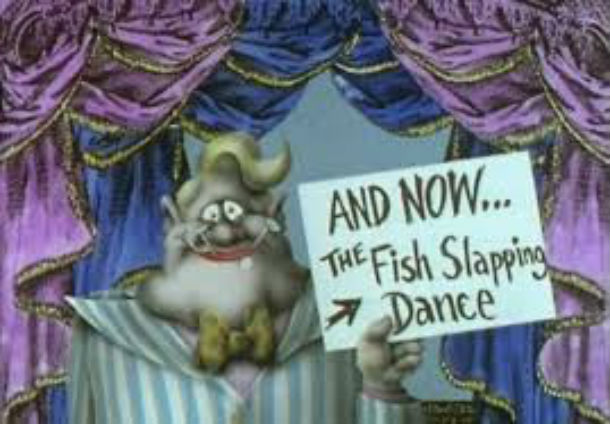
The Fish-Slapping Dance

“If you had to come up with one question, the answer to which would determine whether or not you could be friends with a person you’ve just met, what would it be? What would the right answer be?”

“That’s a great question. Oddly comprehensive, yet a little intrusive at the same time.”

“I agree, but my usual ice breaker question is to ask people that I have just met what their ice breaker question is. So, what is it?”

“Did you want more coffee?”

“That’s your question?”

“No. Your cup is empty. Free refills, hon’.”

* * * *
The speed with which one can determine the depth or length of a friendship—somewhere between forever and not at all—is inequal to the facts of a friendship. How many reminiscence-conversations have you had with friends in which you have learned that either your memory of meeting a friend is faulty or that the friend did not like you on first encounter? I have had both types.

I hinted in a recent column, okay, I explicitly stated in a recent column that if you find the “Fish-Slapping Dance” funny, you and I will more than likely be friends for life.

It may be the Monty Python troupe’s quickest route to the biggest laugh. I wrote, “If you do not find the ‘Fish-Slapping Dance’ funny, it may be because you find the waste of intellectual effort offensive. Or perhaps fish jokes generally turn you right off. ‘How is this funny?’ becomes the same question as ‘Why is this funny?’ ‘Why is T H I S on my screen?’ The ‘Fish-Slapping Dance’ actually can be seen as a depiction of the ‘How is this funny?’ conversation. Michael Palin, the ‘little fishes,’ dances the question, and then John Cleese, the ‘big fish,’ delivers the only possible retort: ‘It is or it is not.’ Splash.”

I can over-intellectualize and explain how the bit does not work, but every attempt I make falters the moment Michael Palin hits the water, when I laugh, sometimes quietly and sometimes out loud, every time.

I knew approximately two things when I wrote this a couple of months ago: that my girlfriend, the closest friend I have, probably does not know much if any Monty Python material and that I do not know if we share a sense of humor, even though she and I laugh a lot at many of the same things and same comics. For instance, her response after listening to some recordings of my radio show was to say that it was nice hearing my voice and that I sounded like I was enjoying myself. It is a comedy show.

Thus, I was rather nervous when I posted the Monty Python video above, several weeks ago, as she might very well read what I wrote, view the classic bit of comedy, and then instant message a break-up with me. I did not know what I did not know, but I was going to learn sooner or later. Are we companions for life, based on one sixteen-second joke?

“I’ve been sitting in my office, laughing at that.” she wrote me that night. Thus, my belief that the Monty Python “Fish-Slapping Dance” is the litmus test of comedy, a proof of companionability, was sustained.

Kindergartners may have the most effective conversations for establishing a friendship: favorite color, up versus down, best food. Matters of eternal importance like those. I try to remember this and always keep track of what is important to me, just in case someone wants to know on the spot: Green, the number 4, the letter N, the word Yes.

__________________________________
The WordPress Daily Prompt for September 23 asks, “If you had to come up with one question, the answer to which would determine whether or not you could be friends with a person you’ve just met, what would it be? What would the right answer be?

Daily Prompt: Four Minutes and 24 Years

The benches in front of 1 Penn Plaza, along West 34th Street, are lively at lunchtime and look like they remain so long after lunch, as deliverymen pick up and drop off all day long and limo drivers waiting for their VIPs kibitz with one another and with passersby who want to know how famous the person about to become their next brush with fame is and whether he or she is worth pausing for on their way to their next New York City attraction.

There was no reason for me to be in front of the famous skyscraper to make this observation last Thursday afternoon. Five minutes before passing the limo drivers and their VIPs and the lunchtime crowd, I was finishing up being lost in Penn Station, the renowned train- and bus- and everything else station (flying saucers will someday land there because it is shaped like one). Ten minutes before that, frustrated that I could not find a sign directing me to exactly where I was going, many many blocks away, I reasoned that any door with sunlight coming through it and people’s shadows walking past must lead to the outside and a street, any street, and the possibility that, once there, I would be able to figure out where I am. In New York City, on the streets, I am (usually) okay, since it is one of the easiest cities to negotiate on foot. It’s a grid. (Mostly.)

That hunch led me up one staircase to plate glass doors that entered into Madison Square Garden. I headed back down that staircase.

Out on the street, I made my way back around MSG to the front of Penn Station and then onward, north along 8th Ave. to have coffee with a college classmate and then meet up with other friends to attend a taping of “The Colbert Report.”

The college classmate and I had not seen each other in almost 24 years, when I had thrown a post-graduation party he attended; thoughts and memories of this party were on my mind while I strolled up 8th. Cars were blocking the crosswalk, so instead of waiting to cross, I turned right and started over to 7th, where I would continue my northward stroll.

This is how small a moment any moment can truly be. Had the crossing been available, I would have continued on 8th. But sitting on a bench on 34th Street at that moment was another college classmate, in fact the co-host of that post-graduation party, someone I have not seen or spoken with in three years and who did not know I was in New York City. He has an office in 1 Penn Plaza and was on his lunch break, people-watching.

Had I walked past ten minutes earlier, I would have missed him, but I had just spent those ten minutes escaping from Penn Station.

“Is that … Kevin? Really?” I thought to myself. Can’t be. I was not going to say anything; I was going to walk past the person who I assumed was a merely a stranger with a familiar face, since how could it be that I would bump into a long-ago friend in this giant city; a hunch had just now almost gotten me lost in Madison Square Garden. I had better leave the hunching business to others, I thought.

“Mark?” That settled it; it was my old friend. With one friend waiting for me in a restaurant in midtown and about 20 more blocks to walk, I had about four minutes to bring my graduate school housemate up to date. He had the same four minutes to bring me up to date. What was I doing in the city. What was he doing on that bench. Our relationship statusi, our work situations, my physical condition. How long it had been since. How utterly baffling the fact of what we were experiencing right then was. Why I was not taking the subway instead of walking 20-plus blocks. We finally, after all these years, exchanged phone numbers.

“How long has it been?” That was my other friend’s first question as I walked in the restaurant, a few minutes later. I reminded him: 24 years. And an extra 10 minutes because I had run into someone. He, too, was on his lunch break, so we had limited time in which to reacquaint each other with each other. Relationships, work, life.

How much time does it really take to tell someone what you’ve done and seen? Maybe it only takes about four minutes to (re)establish who you are and the rest is elaboration with anecdotes.

Who am I? Someone who takes 10 minutes to get out of a wide-open train station but is happy at the social accident that was thus made possible.

* * * *

colbert ticket2

My thumb.

__________________________________
The WordPress Daily Prompt for September 22 asks, “You’re about to enter a room full of strangers, where you will have exactly four minutes to tell a story that would convey who you really are. What’s your story?”