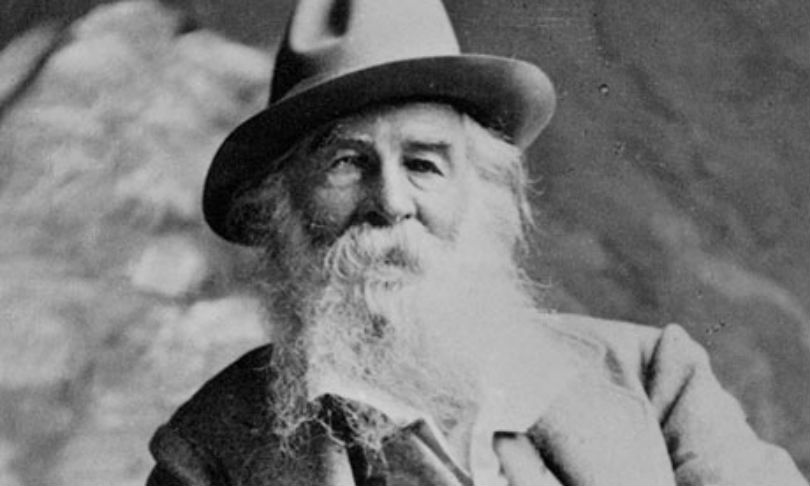
Song of Myself
I celebrate myself, and sing myself,
And what I assume you shall assume,
For every atom belonging to me as good belongs to you.
I loafe and invite my soul,
I lean and loafe at my ease observing a spear of summer grass.
My tongue, every atom of my blood, form’d from this soil, this air,
Born here of parents born here from parents the same, and their parents the same,
I, now thirty-seven years old in perfect health begin,
Hoping to cease not till death.
Creeds and schools in abeyance,
Retiring back a while sufficed at what they are, but never forgotten,
I harbor for good or bad, I permit to speak at every hazard,
Nature without check with original energy.—Section 1, “Song of Myself,” Walt Whitman, 1855
By the end of his life in 1892, Walt Whitman had published eight revised editions (eight or so; there is some debate on this matter) of his major volume of poems, “Leaves of Grass,” culminating in a ninth edition, what he himself called the “deathbed edition.”
“L. of G. at last complete—after 33 y’rs of hackling at it, all times & moods of my life, fair weather & foul, all parts of the land, and peace & war, young & old,” he wrote a friend. He was only 72 when he died, but with his white beard and self-presentation as a man who had existed for the entire country’s history, he seemed older.
It all started on the 4th of July. On this date 160 years ago, Whitman published the first edition of “Leaves of Grass,” a book that contained twelve poems, each without a name, and starting with the opener, a poem that became known over time as “Song of Myself.”
Read More
 The Gad About Town