
Suis-je Charlie? (Am I Charlie?)
It is said that words matter. Images, too.
When violence is used as a form of literary criticism, it gives to the words and images that it dislikes a kind of power, but a different sort of power than the words or images actually possess. Words and images convey ideas in the most intimate way: from inside one human mind to another. They carry little in the way of power or anything like power. When violence is a response to words and images, violence is revealed as the nullity that it is, and the philosophy that believes that violence is a reply to words and images is revealed as a nullity, too. The words and images did not reveal that.
Even if a writer, in the writer’s intimate my-mind-to-your-mind way, writes something provocative like, “Kill me,” you can’t. Even if the writer names you in the request. Even if the writer irritates you in the writing. A bullet as a reply gives the writing a power it does not deserve and did not request or demand or require: the power to reveal the vacuum of violence inside any brain or ideology that sees the bullet as any kind of viable reply. It is an unequal exchange, even if the dead once said and wrote that they “would rather die standing than live crawling.”
In attempting to explain what happened in Paris last night, I finally found myself offering a what-if: What if everything that happened last night happened, but here, in Los Angeles, say. Someone offended by a certain animated comedy program that specializes in irking the church-, temple-, and mosque-going religious among us decides to hunt down the creators of that show in revenge for perceived insults. My listener got it, and then we shook our heads, because we live with the amnesiac’s belief—rightly or wrongly, and I hope rightly—that “it can’t happen here.”
I say “amnesiac” because it can, and it has, and it quite possibly might happen here again.
Violence astonishes. That is its only point. It certainly doesn’t silence. I am astonished by how astonished I still can be. That is why I have written twice now about last night’s senseless violence in Paris against the publisher and staff (and nearby police officers) of “Charlie Hebdo.” Bravery is a skill, and I wonder if I have cultivated it in myself. Because it is obvious to me that murder is empty and that injustice is injustice is injustice, so that any claims to a philosophical ground underneath murder is a special pleading of the worst sort. Thus when I declare that police officers ought not murder and that police officers ought not be murdered and that editorial staffs ought not be murdered and that murder is emptiness attempting to fill its own vacuum, it seems so obvious to me that it certainly does not feel like something laudable like bravery just to say it. “Je suis Charlie.” As a question it is, “Suis-je Charlie?” My answer is, I hope so.
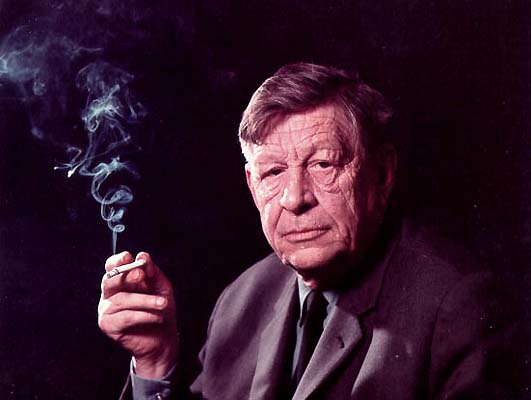
Shortly before his death, the poet W.H. Auden told talk-show host (and former politician) Richard Crossman, “Nothing I wrote prevented one Jew from being gassed or stalled the war for five seconds.” At first glance, this places the bar very high for the role of a writer in the affairs of the world, but it is simply a stark assessment of the reality that a writer has no say in the practical matters of life and death. He is not saying that words do not matter but is instead drawing the boundary between where they do matter and where they can not. Writers are makers and not doers, not “men of action,” Auden also liked to say.
One of his most famous poems is September 1, 1939, written to mourn the outbreak of World War II. The title is of course the date Germany invaded Poland. It was written quickly, not heavily edited, and published weeks later. Auden came to reject the poem and refused three times to include it in his Collected Poems. He told Crossman that the poem possessed rhetoric that was “too high-flown.”
In the second-to-last stanza he wrote,
All I have is a voice
To undo the folded lie,
The romantic lie in the brain
Of the sensual man-in-the-street
And the lie of Authority
Whose buildings grope the sky:
There is no such thing as the State
And no one exists alone;
Hunger allows no choice
To the citizen or the police;
We must love one another or die.
Auden said that he especially rejected that last line and wanted to correct it to, “We must love one another and die,” because “or die” is not real. There is nothing we can choose versus death. But it was lines like, “Those to whom evil is done / Do evil in return” and “There is no such thing as the State,” that he probably found too “high-flown.” They are too definitive, too short to allow for nuance, too inarguable—not because they are obvious, but because they are rhetorically rendered to disallow argument. (Was “evil” done to Germany? Heck, “evil” is a thick word, and if Germany is doing evil, Mr. Auden, why not explain what you mean by that? And if Germany is doing evil, what evil is any kind of response to any evil? Injustice is injustice is injustice.)
Auden rejected the poem for the wrong reasons. “All I have is a voice,” he wrote, and even if that, too, is factually incorrect—in many if not most countries, each of us has a voice and a vote and can campaign—it is correct in an essential way: the writer is “a maker, not a doer,” is a voice, and the writer has a right to be audaciously “high-flown,” audaciously non-nuanced, audaciously incorrect. He was rejecting his own right to be audaciously incorrect.
It is understandable why he rejected the poem from his own canon: he disagreed with some thoughts and found others expressed incorrectly, just as it is understandable that the poem has been embraced by people of very different political stripes for different reasons. (President Johnson intoned “We must love one another or die” in his awful “Daisy” television ad. And the poem was reprinted in many American newspapers right after September 11, 2001. He was angry about LBJ and probably would have been irritated by the latter embrace.) Very little in the poem is accurate, but poets have the right to be inaccurate, and “All I have is a voice” is his claim to that right. Very little in the poem is accurate, except for one thing: We must love one another. It should not feel like bravery to say this, but it does, today just as much as it did in September 1939. Bravery is a skill. We must continue to hone it.
Here is the complete poem:
September 1, 1939
I sit in one of the dives
On Fifty-second Street
Uncertain and afraid
As the clever hopes expire
Of a low dishonest decade:
Waves of anger and fear
Circulate over the bright
And darkened lands of the earth,
Obsessing our private lives;
The unmentionable odour of death
Offends the September night.
Accurate scholarship can
Unearth the whole offence
From Luther until now
That has driven a culture mad,
Find what occurred at Linz,
What huge imago made
A psychopathic god:
I and the public know
What all schoolchildren learn,
Those to whom evil is done
Do evil in return.
Exiled Thucydides knew
All that a speech can say
About Democracy,
And what dictators do,
The elderly rubbish they talk
To an apathetic grave;
Analysed all in his book,
The enlightenment driven away,
The habit-forming pain,
Mismanagement and grief:
We must suffer them all again.
Into this neutral air
Where blind skyscrapers use
Their full height to proclaim
The strength of Collective Man,
Each language pours its vain
Competitive excuse:
But who can live for long
In an euphoric dream;
Out of the mirror they stare,
Imperialism’s face
And the international wrong.
Faces along the bar
Cling to their average day:
The lights must never go out,
The music must always play,
All the conventions conspire
To make this fort assume
The furniture of home;
Lest we should see where we are,
Lost in a haunted wood,
Children afraid of the night
Who have never been happy or good.
The windiest militant trash
Important Persons shout
Is not so crude as our wish:
What mad Nijinsky wrote
About Diaghilev
Is true of the normal heart;
For the error bred in the bone
Of each woman and each man
Craves what it cannot have,
Not universal love
But to be loved alone.
From the conservative dark
Into the ethical life
The dense commuters come,
Repeating their morning vow;
“I will be true to the wife,
I’ll concentrate more on my work,”
And helpless governors wake
To resume their compulsory game:
Who can release them now,
Who can reach the deaf,
Who can speak for the dumb?
All I have is a voice
To undo the folded lie,
The romantic lie in the brain
Of the sensual man-in-the-street
And the lie of Authority
Whose buildings grope the sky:
There is no such thing as the State
And no one exists alone;
Hunger allows no choice
To the citizen or the police;
We must love one another or die.
Defenceless under the night
Our world in stupor lies;
Yet, dotted everywhere,
Ironic points of light
Flash out wherever the Just
Exchange their messages:
May I, composed like them
Of Eros and of dust,
Beleaguered by the same
Negation and despair,
Show an affirming flame.
____________________________________________
The WordPress Daily Prompt for January 8 asks, “If you could choose to be a master (or mistress) of any skill in the world, which skill would you pick?”
* * * *
Please subscribe to The Gad About Town on Facebook: http://www.facebook.com/thegadabouttown


 The Gad About Town