Today in History: August 30

Say ‘canal’ and there’s that final vowel
Towing silence with it, slowing time
To a walking pace, a path, a whitewashed gleam
Of dwellings at the skyline. World stands still.
The stunted concrete mocks the classical.
Water says, ‘My place here is in dream,
In quiet good standing. Like a sleeping stream,
Come rain or sullen shine I’m peaceable.’
Stretched to the horizon, placid ploughland,
The sky not truly bright or overcast:
I know that clay, the damp and dirt of it,
The coolth along the bank, the grassy zest
Of verges, the path not narrow but still straight
Where soul could mind itself or stray beyond.
—Seamus Heaney, “Banks of a Canal”

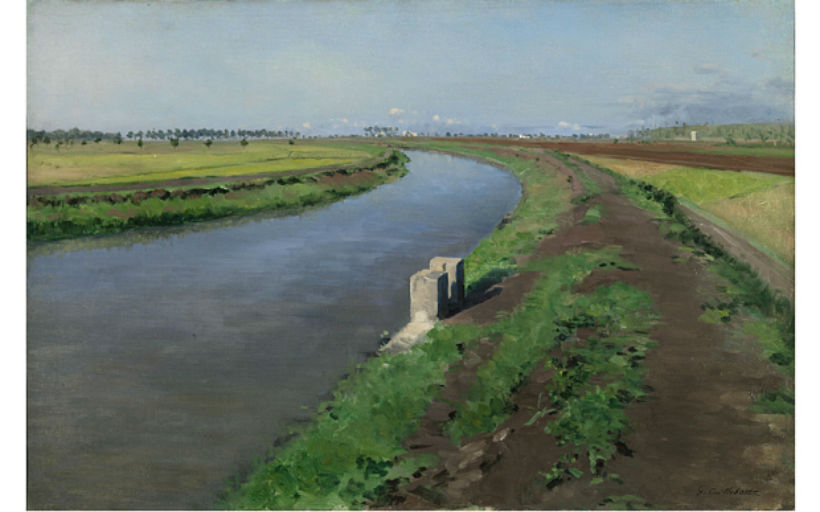
Seamus Heaney died on this date in 2013. Ten days before his death, he submitted the above poem, “Banks of a Canal” to the National Gallery of Ireland for inclusion in an anthology, Lines of Vision: Irish Writers on Art.

Each writer selected a work from the National Gallery and wrote a piece; Heaney chose Banks of a Canal near Naples (circa 1872) by the French artist Gustave Caillebotte, which is the painting at the top. Heaney was 74 at his death; his poetry retained its music and power: “the grassy zest / Of verges, the path not narrow but still straight / Where soul could mind itself or stray beyond.”
Read More

Today in History: The Beatles Say Goodbye

There was a big talk at Candlestick Park that this had got to end. At that San Francisco gig it seemed that this could possibly be the last time, but I never felt 100% certain till we got back to London. John wanted to give up more than the others. He said that he’d had enough—Ringo Starr, Anthology

After a couple hundred live shows over five years—lunchtime shows at The Cavern Club in Liverpool, long nights in Hamburg’s red light district, world tours, three annual tours of America—The Beatles took the stage at San Francisco’s Candlestick Park on this date 50 years ago. It was the nineteenth and last show of their latest American tour, and the four men on stage and a few others knew one other thing about it: it was going to be their final live performance as the Beatles.
Read More

Today in History: August 28

The two men, both of them adults, wanted the boy dead. They wanted him dead. The boy was 14 years old and a visitor from out of town, a city kid from Chicago.

On a visit to see family in the country, in Money, Mississippi, the boy from Chicago went to the local grocery store one day. He bought bubblegum.

He spoke to the woman behind the counter, who was not a lot older than he was, 21. Perhaps he thanked her, perhaps he said something else. Either way, she did not like the contact. She was white and the boy was black.

Her husband later said that the boy had “whistled” at his wife, so he and his half-brother wanted the boy dead. At 2:30 in the morning, with the young woman alongside to identify the boy, they went to the boy’s uncle’s home and found the boy.

What followed was not a lecture from two men to a boy about how a young man should speak with a woman. No. On this date in 1955, Roy Bryant and J. W. Milam took Emmett Till with them and the boy never returned. Days later, when the body was found in the Tallahatchie River, it was identifiable only by a ring the boy usually wore. The body was identifiable as human only in the minimal sense after what they had done before throwing Emmett Till in the water. They wanted him dead, you see.
Read More