January 23 in History

By October 1847, Elizabeth Blackwell (above) was 26 and had been studying medicine privately for a couple of years. She applied to medical schools and she was rejected by each one.

Hobart College (then called Geneva Medical College) in Geneva, New York, received her application and created its own standard to use in the decision to accept or deny her for matriculation: the administration put her cause up for a vote among the student body of 150 male students.

If even one student rejected her, against the votes of the 149 others, she would be rejected. The student body came through: the 150 voted unanimously to accept her as a fellow student, and on this date in 1849, Blackwell graduated with her class.

Blackwell was the first woman to earn a medical degree in the United States. She practiced medicine in America and in Europe in the 1850s and ’60s.
Read More

January 22 in History

Our Town, Thornton Wilder’s three-act drama of life in small-town America—and in the theater in which we are all seated—was performed for the first time on this date in 1938 at McCarter Theatre in Princeton, New Jersey. It won the Pulitzer Prize for Drama later that same year.
Read More

January 21 in History

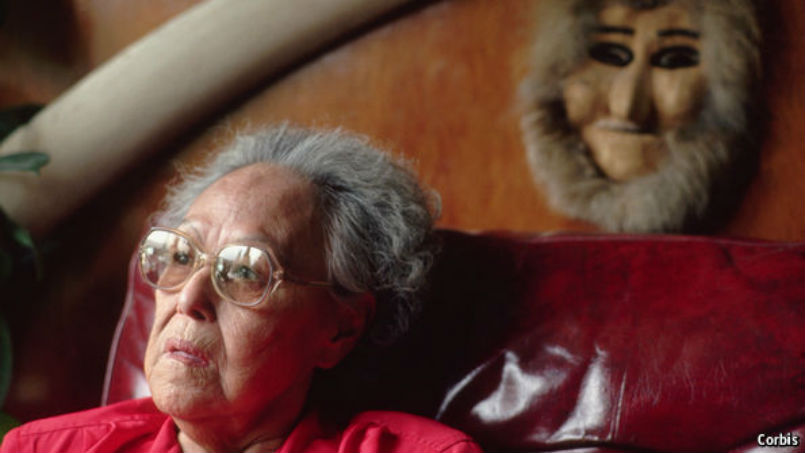
When Marie Smith Jones died on this date in 2008, the living history of a people and a language died, too. She was 89 and she was the last of the Eyak people, an indigenous group that lived along the Copper River in south-central Alaska.

Smith Jones (above) was also the last native speaker of Eyak, which was once the dominant language from Alaska down along the western coast of Canada, and the death of a language brought global attention to the fact that languages are disappearing at an increasingly rapid rate. Since the start of the century, about one language per year goes extinct with the death of its final native speaker. (There are about 7000 living languages spoken around the world right now, and ethnologists estimate that more than 90% will be extinct by 2050.)
Read More