Daily Prompt: The Curse of Concern

The WordPress Daily Prompt for August 5 asks us to play voyeur in our own lives: “We often capture strangers in photos we take in public. Open your photo library, and stop at the first picture that features a person you don’t know. Now tell the story of that person.”
___________________________________

I do not know the attractive couple entering the photo above from the left side of the frame, but that is okay, as I did not take the photo, and this is not about them. If I had a steadier hand with the photo editing Clone Stamp tool, they would be an oddly tall bush of purple flowers or a stack of blue Peroni umbrellas or two copies of that bicycle that they are walking towards. My hand is not that steady, so their brief moment together (are they still together?) was spared awkward editing. May the rest of their lives together or apart continue to be free of terrible editing decisions or deletion by a heavy-handed photo perfectionist.

But the photo above sets the scene:

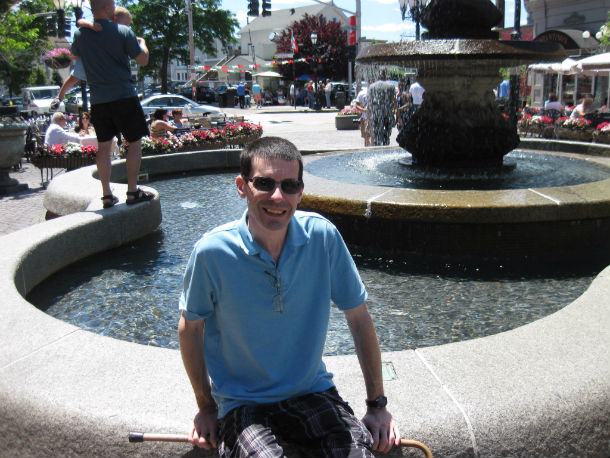
It is May. My beloved and I are eating brunch at the table under the Peroni umbrella that is all the way to the right in the photo above. We are at DePasquale Square on Federal Hill in Providence, Rhode Island, in an outdoors restaurant called Caffe Dolce Vita. After brunch, we walk to about where the above picture was taken, turn around, and she takes this photo of me:
providence riB

Two things: One, with spinal muscular atrophy type 3 or 4, which is what I have, sitting on a hard but rounded surface like the fountain I am sitting on instead feels for me like I am sitting on the edge of a plane sending troops into a war zone and the sarge is about to kick me out even though I do not yet have my parachute strapped on, so I am sitting on my cane for stability; two, that man behind me is strolling along the same fountain as if it is wider than a mere tightrope … with a child in his arms.

I knew I was going to hear a splash before it never happened. You can even almost make out the look of concerned anticipation on the face of the elderly woman sitting closer to the street. (Well, I can, now.) So a fall into the fountain by father and child was inevitable because it was already seen in the eyes of a worried old person, like a curse, the curse of concern. There is no worse curse than that, the curse of anonymous concern, because it is often followed by the worst four-word sequence in the English language: “You should not have … .”

“You should not have” shown your child the sun-dappled fountain up close as if the world was his and he can touch the sun itself in your safe arms.

Perhaps the curse of concern really is a curse only in the idea that you will hear from loved ones and strangers alike—loved ones as if they are strangers: “I didn’t think you could do it,” and strangers as if they are as close as loved ones: “I didn’t think you ought to have tried”—about their ability to foresee your future failure or your imperfect success.

I respect “I told you so” from people more, because, if it is spoken truthfully, perhaps the speaker had indeed offered advice that I had ignored or implemented poorly. “You should not have” is blaming me for your impotence at controlling the most recent past. I bring this up in order to confess that too often, I am that “concerned bystander” about to ex post facto say “Tsk” at someone about something they should not have done, but did do.

So I did not say anything, not anything at all, to the father and child behind me before I used my cane to grab his ankle and trip them into the fountain.

(I might have made up part of this story: I do know the couple in the photo at top.)

Daily Prompt: Stress Is a Six-Letter Word. So Is ‘Human’

The WordPress Daily Prompt for July 29 asks: “After an especially long and exhausting drive or flight, a grueling week at work, or a mind-numbing exam period—what’s the one thing you do to feel human again?”

Historically, I have been a great example of the mock dictum “Take my advice—I’m not using it.” I am someone who can introduce stress into the least stressful, innocuous, and even pleasant experiences in life, so sometimes the parts of life that others find stressful, I hunker down and find the effort inside myself to make them more stressful.

In one of my lesser achievements in the field of stress management, I gave myself a black eye while tying my shoes. These were boots with leather laces (I was not a cowboy) and such laces take effort to yank into position. While securing my “half-knot” on my right shoe, the length of lace in my left hand broke and I clocked myself in the right eye. I was 34-35 years old at the time, not eleven.

One of my co-workers asked, “I’m not sure I ought to say anything, but are you okay?”

“With what?”

“You look like you were in a fight or something.”

“Heh. Funny story, I did this this morning. Heh.” Embarrassed, I mumbled a series of words without connections between them to sound like a sentence or two: New laces. Need. Not leather. Store tonight. Because I lived alone and was ostensibly an adult, my friend did not call protective services on my behalf.

But I was perpetually stressed out by that job, a completely stress-less employment (technical writer in a factory) in a stressful environment (it was a job, and jobs are stressful). I was a contract employee who had been taught that, for contractors, “The last one hired is the first one fired,” and I was the last one hired in this office. Twice, a contractor was hired in my department (the “New Guy”), which afforded me the comfort of being the Not Last One Hired, but both times, the individual quit within days, which restored me to my place as Most Worried. Further, the head of the department who had gone on the hiring spree that had led to my employment was fired in front of us less than a year after I moved to the job. Under these circumstances, in which every week at work was “grueling,” you’d give yourself a black eye tying your boots, too.

It amazes me how much one can accomplish with no confidence in oneself. I held that job for four years, but it felt like twelve.

In those years, I believe I was addicted to being in perpetual (and slight) fear all the time, because I had a method for relieving stress that I trusted above all others, which presented a feeling of relief that sat on the pleasant side of the scale far more heavily than any stress sat on its side of the scale. The method is called vodka and it is no longer a part of my world. So what do I do now?

The question implies that during a stressful period one is not human and needs to be restored to a natural state of calm serenity and continuous need-meeting, but only when you have needs, mind you. When you have no needs, there is no need-meeting, which is perfection. All things in moderation, except moderation.

I have friends from the military, friends who have fought in hand-to-hand combat with enemies, and they report that when a person leaps from one serotonin-soaked event to another, one acquires an either/or outlook on life. They describe post-war life as one in which the soldier will either perceive everyone as an enemy, including the guy taking too long pouring himself coffee, or they return home to a world in which he loves everyone and sees every human being as a fellow traveler on this big blue marble of ours. He’s the vet who hands the half-and-half to you on line and then lets you step in front of him at the counter.

So I am a stress-filled person, certainly not a soldier returning from a war zone, except, perhaps, the one in myself, but life presents me with obstacles and challenges like work, life, relationships, life, long journeys, life, ongoing tests, life. And life. The only plane trips that have been successfully not stressful for me have been the ones in which I struck up a conversation with my seat mate. I am, as I am with much else in life, an uneasy flyer. I am the passenger across the aisle from you with white knuckles and clenched jaw. The trips that I remember most fondly are the ones in which I made a temporary best friend: A flight to Chicago in which my seat was switched on the plane from a seat surrounded by a family with three kids (making me the fourth) to a seat next to a woman who was also doing the crossword puzzle. A flight after 9/11 in which the entire plane got involved in a conversation about coming home to upstate New York and what we missed about living there. This approach to life works well on planes, in waiting rooms, on the coffee line.

When I remember I am a human being, I do not need to do anything to unwind or remind myself that I am human or to feel human. When I don’t, life is a grueling week of work spent on a plane flying me to a final exam that I have not studied for. It’s one broken shoelace after another.

(Daily Prompt) 45 and Me: A Love Story

The WordPress Daily Prompt for July 27 continues a recent preoccupation with age, aging, adulthood: “‘Age is just a number,’ says the well-worn adage. But is it a number you care about, or one you tend (or try) to ignore?”

One friend, upon hearing me describe a new ache or an old pain, used to reply, “You’ve never been (insert age here) before!” At first, I found this insulting, then, later, very insulting. But knowing the friend as I did, I eventually realized that he was not being dismissive when he said this, but was instead reminding me to do something I did not have a long history of doing: To pay attention to my body.

He was also saying that almost everything we experience is unique to us and not at all unique. That sentence is either wise in its simpleness, so simple and wise that “simpleness” is too complicated a word for it, or incredibly banal. I’ll go with banal. We are all growing older.

Age is a statistic and mine are these (feel free to play with the age calculator for your own numbers): As of July 27, 2014, I have been here for 16,687 days, which is also more than 400,000 hours and approximately 360,461,595 breaths, and 1,730,215,656 heart beats since I was born. Have I made each one of these days, breaths, and heartbeats count? Have I lived “each day as if it was my last?” Of course not. I spent at least 12,000 of these days either waiting for payday or avoiding late fees and deadlines. I also do not dance like no one is looking and rarely think before I speak.

I am 45 (and a half), which is somewhere in the middle of the middle. (I knew a woman in her 90s who used to tell people, “I am 93-and-a-half!”) Either I have already seen more sunrises than I have yet to see, or I have not even seen half of them. (I get up late, anyway, and have missed at least 16,000 sunrises.) I still possess a lot of my boyish lack of wisdom and am adding middle-aged foolishness to it. It’s a complicated age.

It is also an age that is not given much positive attention in art, music, or literature. Not just 45 specifically, but mid-40s. A character in his or her mid-40s is often tragic, a figure who is in need of change and perhaps pursues it but is incapable of changing, which is where the tragedy lies. Or he—and it is usually a he in this case—is in a mid-life crisis (in need of a change) and his pursuit of a solution is comic, impotent, or merely silly, and he learns his lesson and returns to his old ways. Karl Marx wrote, “History repeats itself, first as tragedy, second as farce.” In art, a 20-year-old character’s life is romantic, passionate; the life of a 45-year-old with the same emotions: farce.

It is the Age of Assessing Things, which would have sounded as boring and banal to my 25-year-old ears as it must to any 25-year-old’s ears.

(Not that there is not passion in my life; there is, and love now seems to count for more and feel more enduring than any love I have yet experienced. Life is amazing when one starts paying attention.)

Element 45 is rhodium, which is very rare—part of the platinum group of elements—and very expensive and yet we encounter it every day on our roads. It is used in catalytic converters, which of course are employed to convert the pollution our car engines create into less toxic pollution. My view of the age 45 is influenced by this coincidence of element and age. Forty-five, for me, is the age at which a lot of the life I have lived so far is being converted into something more breathable. That is not farce, but my life is not literature.

What have I learned so far in this life, and how many of these things do I really need for the rest of the journey? Which of these things are worth keeping? A lot of them, as it turns out, but not all. This particular lesson is not often the theme of art, as I wrote above, but around when he was 45, Elvis Costello wrote “45,” in which he sings:

Here is a song to sing to do the measuring
What did you lose?
What did you gain?
What did you win?

Enjoy.