Daily Prompt: Falling in Love with Falling in Love with a Place

The WordPress Daily Prompt for August 17 asks, “Take a look at your bookcase. If you had enough free time, which book would be the first one you’d like to reread? Why?”
__________________________________

On re-visiting Cape Cod this weekend, I remembered a favorite book, Henry Beston‘s “The Outermost House,” and decided to re-read it. I have not looked in its pages for 20 years and no longer own a copy. This sad situation was remedied with the money in my wallet being accepted at Yellow Umbrella Books. Since I was on vacation on Cape Cod, finding enough free time to re-read was not an issue.

Beston himself wrote perhaps the best physical description of Cape Cod in the book’s opening lines: “East and ahead of the coast of North America, some thirty miles and more from the inner shores of Massachusetts, there stands in the open Atlantic the last fragment of an ancient and vanished land. For twenty miles this last and outer earth faces the ever hostile ocean in the form of a great eroded cliff of earth and clay, the undulations and levels of whose rim now stand a hundred, now a hundred and fifty feet above the tides. Worn by the breakers and the rains, and disintegrated by the wind, it still stands bold.” He depicts a heroic shoreline, a land that declares its own terms of surrender against a hostile, battering sea. Given that Cape Cod resembles a single raised fist jutting in the air, a heroic, Byronesque, cliff face is only appropriate.

bretenmap1The house itself was a 20 x 16-foot cabin that Beston ordered built on the dunes near Eastham, Massachustts, along the Cape’s forearm, in 1925. It faced the ocean, and its many windows offered him a view of the water that made him feel like he was on a ship. Thus he called the house the “Fo’castle,” but it became known as the “outermost house” for an obvious reason: it sat at what seemed like the end of the earth. Beston never lived full-time in his shanty, but he spent enough time there to write his book which is subtitled, “A Year of Life on The Great Beach of Cape Cod.” Picking epic-seeming events from each of the seasons he experienced gives his “year” an intensity of action and feeling. The book was published in 1928 by Doubleday.

As a young man, I knew that I loved Cape Cod, for reasons of family and fun, but it was not until I devoured this short, 218-page, book, that I found the deeper reasons. It would be beautiful if every place on our planet could have a writer fall so utterly in love with it, as Cape Cod had Henry Beston. Beston’s brief meditation on the slow, usually imperceptible rhythms of nature—imperceptible because few bother to perceive them and communicate them—is written in a muscular language that makes the surf appear to have desires and dreams, the wind have language, the birds individual personalities.

It is not easy to take memorable landscape photos; the camera may capture every detail of a very detailed outdoors scene, but a photographer’s eye and hand is needed to direct our eyes to what he or she finds worth looking at. Otherwise, every beach snapshot is every other beach snapshot; they are alike in their uniqueness of sky and sand. The nature writer has even more difficulties: he could either be yelping on the page, “It was such a stupendous night sky full of stars! You should have seen it,” boring us with banal generalities, or, lurching in the other direction, boring us to tears with specifics. Beston finds the poetry in using the correctly applied terminology of whatever phenomena he describes. This was a revelation to my twenty-year-old self.
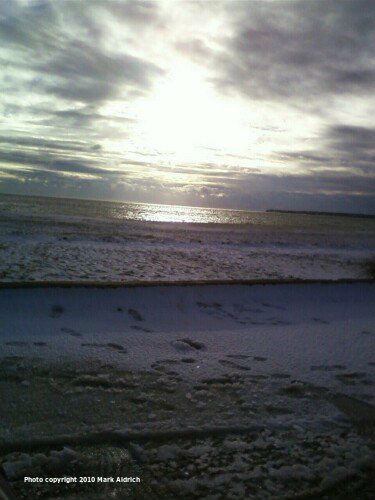
winter 2010 nantucket sound2

Cape Cod, winter 2010. Photo by The Gad About Town

Winter from atop the dunes is neither “frigid” nor “bitter,” two words that may frequent one’s letters home; rather it is “crystalline” and the snow is dancing and driving:

The snow skirred along the beach, the wind suffering it no rest; I saw little whirlpools of it driving down the sand into the onrush of the breakers, it gathered in the footprints of the coast guard patrols, building up on their leeward side and patterning them in white on an empty beach. The very snow in the air had a character of its own, for it was the snow of the outer Cape and the North Atlantic, snow icy and crystalline, and sweeping across the dunes and moors rather than down upon them.

When the National Park Service was evaluating the arguments for establishing the Cape Cod National Seashore, Beston’s book was cited frequently in the report’s pages. Beston died in 1968, and a sentence from “The Outermost House” is an epitaph: “Creation is still going on, the creative forces are as great and active today as they have ever been, and tomorrow’s morning will be as heroic as any of the world.” The cabin itself was swept away by the Blizzard of 1978, a nor’easter of heroic strength with historic effects; in other words, a storm that Henry Beston would have appreciated. The spot on the beach where the cabin stood, once atop the dunes, is now under the Atlantic Ocean, a portion of the Cape that the sea has claimed for itself.

No single development at any one location on the beach would have phased this wondering, passionate naturalist and writer, though:

And what of Nature itself, you say—that callous and cruel engine, red in tooth and fang? Well, it is not so much an engine as you think. As for “red in tooth and fang,” whenever I hear that phrase or its intellectual echoes I know that some passer-by has been getting life from books. It is true that there are grim arrangements. Beware of judging them by whatever human values are in style. As well expect Nature to answer to your human values as to come into your house and sit in a chair. The economy of nature, its checks and balances, its measurements of competing life—all this is its great marvel and has an ethic of its own. Live in Nature, and you will soon see that for all its non-human rhythm, it is no cave of pain.

* * * *
A documentary about Henry Beston and Outermost House is in production:

Henry Beston Documentary Trailer : Cape Cod from Mooncusser Films LLC on Vimeo.
Daily Prompt: The Li’l Guys

The WordPress Daily Prompt for August 14 asks, “Have you ever named an inanimate object? (Your car? Your laptop? The volleyball that kept you company while you were stranded in the ocean?) Share the story of at least one object with which you’re on a first-name basis.”
__________________________________

Each of the three cars I have owned … was it three? Let’s count. One exploded, caught fire, and melted into scrap before my eyes, one day after repairs to address its long-standing overheating issue. The next car was also prone to overheating—when one has owned a car that met its end via self-immolation, one develops a sensitivity to the matter—and I perpetually thought it was ten minutes from an explosion as well, but I saw it on the roads of my town for five years after I sold it. The last car was repossessed because I was not an adult back then, and banks like doing business with adults. So, yes, three.

Each of the three cars I have owned was always addressed as “she.” No proper names were given, though. As my disastrous history shows, it was best I not get too familiar with something I was going to mourn, sooner rather than later.

I have a superstitious nature, something that I am loathe to admit to. Place two identical pens before me, give me a day or two to use them, and I will declare one a favorite, and the other? I will have held it perhaps once, but I will have felt something about it frustrating or “wrong,” and left it alone. From then on, forever. I buy replacement pens even though I own many pens and have not been without a pen in decades. (The Zebra F-301 or G-301 model, for completeness’ sake. Black ink, 1.0 mm point size.)

blackwing

Pencil porn.

Pencils, too. I am probably the ideal Blackwing 602 customer, but I like money more. A 12-pack of the pencil—oh! Look at those gorgeous creations!—will set a customer back approximately $20 either online or in person at Barner Books in New Paltz. (Full disclosure: I have nothing to disclose and no business interests with Barner Books other than it is one of my favorite bookshops.) That is a lot of money for a dozen pencils, eight of which I might very well ignore for forever in my writing tool superstition. So even though I have held a Blackwing 602 only one time so far in my life and I drooled over its swift action on the page, I have not purchased a set and I tell myself that it is because these are knockoffs made by a company that bought the naming rights and not the classic pencils themselves. Those, the real original ones, pop up on eBay at prices like $60 for three pencils. Yes, unused.

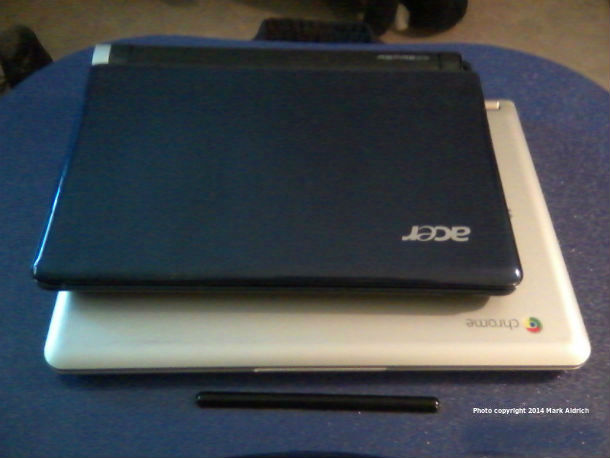
My writing implement superstition has reared its head in my life with computers, though, sad to say for my wallet. At this point, it would take me longer than you have available for me to recount the number of computers, laptops, and handhelds I have owned. (I loved the Treo 90 and owned a half-dozen over the years, some of which felt right and some of which did not.) Some computers I became attached to like a beloved typewriter, others were only employed to go online and make sure I was still alive when I discovered that typing on them just didn’t “feel right.” Four years ago I purchased a full-sized laptop on which I tried to write a book. Either the keyboard was built too sensitively or I typed on it like an orangutan, but it no longer produces the letter C. (One of the top 13 letters in our alphabet.) When the briefly popular Netbooks came out (the era lasted approximately six months in 2006), I bought the Acer seen at top. Upon learning that the full-size machine was resistant to writing, at least any words that needed the letter C, I returned to the Acer and discovered I was making more progress on that book project. It sat, happy to be employed, on top of the full-size laptop and became known as the “Little Guy.”

The silver Chromebook on which the Acer sits in the photo above is the computer on which I have been typing The Gad About Town since 2013. The “click” of its keyboard satisfies some ancient Smith-Corona itch I associate with writing, unlike most of the computers I have superstitiously ignored. (They all “click” when you type on them like I do.) It is also the “Little Guy,” and I am not looking forward to replacing him (cars are she and computers are he in my world, I suppose), as I have a real book contract for a real book now and need to get to work without any superstitions interfering.

Daily Prompt: George Takei Lost a Fan

The WordPress Daily Prompt for August 13 asks, “When was the last time a movie, a book, or a television show left you cold despite all your friends (and/or all the critics) raving about it? What was it that made you go against the critical consensus?”
__________________________________

De gustibus non est disputandum. Loosely translated this means, “There is no reason to argue about matters of taste.” There is no fighting over subjective personal likes or dislikes such as colors or sounds. You can not successfully argue me into liking certain smells. I can not punch you hard enough to like what strawberries taste like. Being ticklish or not being ticklish is not an example to offer in a friendly “nature v. nurture” debate.

Comedy does not fall under the “can’t argue (or explain) taste” category of conversations. It is not a subjective taste. At worst, comedy falls in the “agree to disagree” territory—when it fails to entertain or amuse or even offends. But “agree to disagree” is a phrase that at least implies an acceptance of the possibility that opinions can differ. At best, the discovery that you and a new acquaintance share a sense of humor can seal the deal on a friendship for life. I do not know if you find what follows funny, but if you do, consider us friends (if you do not, that is fine, too; it is simply that these 16 seconds might be the quickest way to determine if you and I are potential friends) (yes, I am exaggerating):

Comedy often offends. To a degree, all comedy is offensive, as it shakes up and toys with perceptions; if you do not find the “Fish-Slapping Dance” funny, it may be because you find the waste of intellectual effort offensive. Or perhaps fish jokes generally turn you right off. “How is this funny?” becomes the same question as “Why is this funny?” “Why is this on my screen?”

Usually, “How” and “Why” are not the same question, not even related. How a car functions (fuel, pistons, wheels, tires, go go go) is not the same question as why I am using it (to go buy more fuel to drive somewhere else … um, I may need to look into this vicious cycle). The “Fish-Slapping Dance” actually can be seen as a depiction of the “How is this funny?” conversation. Michael Palin, the “little fishes,” dances the question, and then John Cleese, the “big fish,” delivers the only possible retort. “It is or it is not.” Splash.

“Because it is” is sometimes the only reply, but someone who replies with this is merely saying “Because it is funny to me,” as if to say that one can not argue about taste. That is true, but funny is not a taste. (“Funny tastes” might be a future “Daily Prompt.”) One who says this is falling prey to the logical fallacy that if something is amusing to him or her, and he or she rhetorically concedes that while YOU may not find it amusing (thus covering both bases), you, the non-amused one, are wrong. Wrong. And then you may find them theorizing that you have something rigid intimately involved with your colon. “Agree to disagree!”

So whose perceptions ought to be offended? When can offense be something that even the offended party finds amusing? I do not know if there can be a “unified field theory of offensiveness.” Or comedy. Myself, I am not a fan of “cringe comedy,” television programs or films depicting socially awkward situations in which two parties are in conflict and one party resides in an obviously superior social strata, yet they are the aggrieved party, and we the audience are supposed to laugh at the supposed aggressor, who may simply be a character depicted “doing their job.”

When all the roles are depicted as equal, scenes of bullies getting their comeuppance or returning the comeuppance can be sublime:

Poor Edgar Kennedy! Poor Harpo! Poor Chico! And they are all bullies! All three take turns being the most creatively worst person. They kick each other and destroy hats for no reason other than that is what no one in these positions ever does. They are equals. The comedy lies in the dance of disaster that unfolds for no reason. This is not cringe comedy, as all three get some sympathy and a head shaking laugh. But cringe comedy would happily use this bit (and it goes on much longer through the film, the essential “Duck Soup,” from 1933) and not get what makes it funny. (Larry David would be Chico Marx and his bald Edgar Kennedy would be some anonymous barista.)

Comedy works for me when it presents someone punching up at someone else, at a bully, at someone or something in power. It never works, and it is more likely to offend me, when it is a matter of punching down at someone or something.

(But isn’t Chico Marx’s mock-Italian accent [he was French-Jewish, by way of Brooklyn] offensive? I could reply with the “you have to know the context” argument, that his act was a commonly seen one in the era, that really, Groucho was the only Marx brother with an act unlike any other seen in the era, but if you find the accent offensive in the here and now of 2014 because it is not 1933, I really have no reply. If it is offensive to you, then it is.)

We all are members of interest groups. I am white, half-Jewish, half-Baptist, tall and thin, an alcoholic in recovery, and have a disease that is disabling me. What is the difference between this:

And this:

The second image is from the “Fight Ataxia Project,” a website for those people diagnosed with one of the many forms of ataxia (I was diagnosed with Friedreich’s ataxia for a year) and for their loved ones and caregivers. It is one of several t-shirt logos that the group is selling. When one has a neuromuscular disease like ataxia or spinal muscular atrophy, one trips a lot and one falls down. The t-shirt is for people with such diseases. It exists to show that we can laugh at (at) ourselves. With ourselves.

The first image is a surprise. Not in itself; I have seen it before. It falls into the general territory of hard-hearted internet memes like, “every poor person is gaming the system and has a better cell phone than me,” or “look at these out-of-perfect-physical-shape shoppers at Walmart! They dress funny,” or “disabled people are faking it.” I can only speak for me, but I am poor and you probably have a nicer cell phone than I have, I shop at Walmart and hate it, and I am disabled and wish I was faking it. Why would I?

But I am my own interest group here, obviously. Of course, as a disabled person (not in a wheelchair, and I avoid the word “yet,” but … you know) that must be why I must be offended, right? Nope. Not that. My offense is from the combination of the “miracle meme” insult itself—but it’s not that insulting and I wouldn’t be posting this long post merely about this image—with the “you can’t argue about taste” attitude many took towards it when it was shared by George Takei on his Twitter account last week. (There is a must-read piece—after reading mine, of course—by Scott Jordan Harris in the August 13 issue of Slate.) Yes, that George Takei.

This George Takei:

The wonderful George Takei. The heroic George Takei whom everyone loves, including me. Who has in the past taken down internet memes from his vast social media network when he and his ghost writers have come under criticism for offending. He did not take this one down when disabled rights activists complained (obviously, as I was able to post it here), and wrote this response:

Fans get “offended” from time to time by my posts. There hardly is a day where something I put up doesn’t engender controversy. Concerned fans, worried the sky may fall, ask me to “take it down.”
So I’m also going to ask them also to take it down—a notch, please.

What? Because this internet meme is ironic (a handicapped person stands up to get a bottle of booze fro the top shelf), see, and I do not get the irony because I am too close to the issue. You can’t argue taste, after all.

But wait, George Takei’s argument seems to be that you can argue taste. Many of my posts court controversy, he says, and I receive complaints every day, some of which I respond to, but the complaints from the disabled and their advocates, well, those do not balance out the sheer comedy of the miraculous alcohol post. The complaints of the sensitive disabled (if anything, the disabled are pretty thick-skinned) fell on his deaf ears. Which is a handicap.

* * * *
Added at 8:07 a.m., August 14:
George Takei posted this on his Facebook page this morning:

I’ve just come back from an extended trip to England, and I came home to a large number of fan emails concerning a meme I shared more than a week ago. In that meme, a woman in a wheelchair was standing up to reach for a bottle of liquor in the store, and the caption said something about a miracle in the alcohol aisle. To this I added a quip about her being touched by the holy spirits.

I did not expect the level of offense this meme caused. I had naturally just thought of those movies where the evangelical preacher miraculously cures someone who was disabled. What I’d never really considered before so many fans wrote in is how that portrayal of disabled persons is filled with ignorance and prejudice—two things I never want to promote, even inadvertently.

Now, before all of you go and start defending my right to post what I want, I want first to thank the many fans who wrote in with the hopes of educating me on the question of “ableist” bias. While I did not ever mean to suggest by sharing the meme that all people in wheelchairs cannot walk, or that they don’t need them despite the fact that they can stand on their own from time to time, I have taken the fan mail and criticism to heart.

After I’d posted the meme, I noted in the comments an inordinate amount of very uncivil behavior on the part of many fans, including both those who demanded I take it down and those who said I should leave it up. I also received a good deal of email IN CAPITAL LETTERS asking me if I would feel the same way if someone called me FAG or a JAP. Now, I took down the meme from my timeline shortly after it went up, but I admit I was decidedly irked by the tenor of some of those criticizing me. In that moment, I posted a follow up telling fans that perhaps they should “take it down—a notch” which, in retrospect, was not the most sensitive response.

The fact that I was surprised by the response the wheelchair meme received indicates that I do indeed lack knowledge, and some sensitivity, over what is clearly a hot button issue, and that I and others can take this as an opportunity not to dig in, but rather to open up to the stories and experiences of those in the disabled community. I appreciate those who took the time to write in. I wish I’d had the chance to respond sooner, but until today I was not able to go through all the mail I’d received.

So to those who were hurt by my posts on this issue, I ask you please to accept this apology. To those who think I shouldn’t have to apologize, I want to remind you that I get to decide what I apologize for, so there’s no need to come to my defense.

Very well then, carry on, friends. Carry on.