Daily Prompt: Last Leaf

Today, September 21, is the last full day of summer in the Northern Hemisphere. According to the Old Farmer’s Almanac, the autumnal equinox will walk into our lives tomorrow at 10:29 p.m. EDT, precisely. In the Southern Hemisphere, today is the last full day of winter. It’s a big day for everyone. Pat the globe on the back. Good going, world!

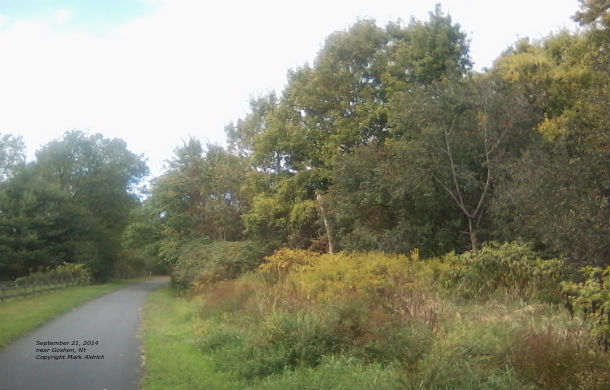
The photo above was taken at around 1:00 p.m. today in upstate New York, where the leaves are just beginning their annual color change. Starting with a deep green, they shift in color to a weak green, then yellow, then a red that I find beggars my attempts to describe it; it is a red I refer to as “fall foliage red,” because I do not run into it elsewhere.

This of course is a global phenomenon and most human beings do not need my poetical-ish endeavors at describing it, but we here in the Northeastern United States have fashioned something of a tourist trap out of this simple natural fact of life. “Come See Biology Happen!” I do not know if other countries with similar climates as ours, usually found at the 42nd parallel north (a line I am just south of), have the “leaf peeper” phenomenon, but around here and in hilly areas north of here (Vermont, especially) by October 1 we will start to see weekend visitors leave their cities and their sidewalk trees or their plowed-over suburban tracts of land with five carefully placed trees per yard that are still only four inches in diameter to come stare at ours and re-remember what hillsides look like. We sell them calendars crammed full of 12 beautiful and glossy photos of the green and red hillsides that they have been looking at and hillsides they have not yet been to, photos they will look at in their cubicles next summer, when they will make plans to visit us again in the fall, so they can buy another calendar.

The circle of life is seen vividly in the changing colors of the leaves and in the annual calendar purchases of the leaf peepers.

People living in every region of the world must take advantage of something natural to attract visitors—the ocean and beaches, a mountain, or a major, powerful river—in the northeast we attract outsiders with something ephemeral, short-lived, yet constant: A season’s change, which takes mere weeks to complete, but it will be here again same time next year. You can plan your trip here with help from The Weather Channel: New York Fall Foliage. (That takes care of today’s public service aspect to the website.)

The red leaves then turn to orange and brown but by then most of them are on the ground, after rain and wind has knocked them off the trees. The leaf peepers do not stay behind and help us rake them up and dispose of them, thus denying themselves the complete autumnal equinox experience. Sad, really. But they must return to their homes and find spots for their 2015 Fall in Vermont calendars.

But we upstate New Yorkers, who live in a region that lacks a colorful nickname despite our colorful autumn—are we Hudson Valley-ites? Hudson Valleyers? Upstaters? Upstites? Catskillers? Upper Delawarians? Mohawk Valleyans? Mohawk Valets?—we remain. Someone is needed to take the photos and craft the calendars and grow the fake pumpkins for the real pumpkin spice lattes. (I held out till last year, when I finally had my first PSL, then I had my second, and on.) Every year, we are the last leaf on the tree.

I’m the last leaf on the tree
The autumn took the rest but they won’t take me
I’m the last leaf on the tree

I fight off the snow
I fight off the hail
Nothing makes me go
I’m like some vestigial tail
I’ll be here through eternity
If you want to know how long
If they cut down this tree
I’ll show up in a song.

__________________________________
The WordPress Daily Prompt for September 21 asks, “Changing colors, dropping temperatures, pumpkin spice lattes: do these mainstays of Fall fill your heart with warmth—or with dread?”

To Be Brief … No Such Thing in Some Books

Most copies of “Tristram Shandy” by Laurence Sterne are about 600 pages long. The book is a fictional autobiography in which Tristram, the not-quite hero of a story that is not quite his own, attempts to tell us about his life from birth onward. However, he does not even begin to begin telling us about his birth and his first day on earth until the fourth volume because, like his own conception on page 1, his story is much interrupted.

(On page one, at the very moment Tristram is to be conceived, his mother asks his father if he remembered to wind the clock, an ill-timed interruption that, according to Tristram, produced an author who is incapable of telling a story straight to its end without breaks, questions, and digressions.)

The full title of Sterne’s masterpiece is “The Life and Opinions of Tristram Shandy, Gentleman,” and it was published over almost eight years from 1759 to 1767. It made the Irish writer world-famous and wealthy.

At the end, one more character brings in one more story and Tristram’s mother asks, “L–d, what is all this story about?” It is the second-to-last sentence in the book and it is also the question most readers ask as they conclude reading Sterne’s great comic novel. “Tristram Shandy” is one of the most entertaining novels in English because it never gets to its point.

Christopher Ricks once described Sterne’s novel as “the greatest shaggy-dog story in the language.” By the end of all these pages Tristram has only brought us all the way into his own toddlerhood, leaving with us the thought that, should he continue the attempt to tell his life-story, he will never catch up to himself.

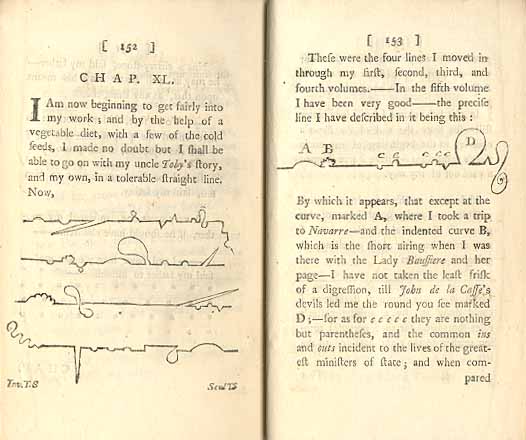
Thus, not much of Tristram Shandy’s life nor many of his opinions appear in the book, but many other characters—and their opinions—do. The title is the novel’s first joke. Tristram Shandy is not a character in his own story. He often criticizes himself for his many digressions and his way of not getting to the meat of his story very quickly, but he always steps away from criticizing himself, and he even sets out in one chapter to finally tell his own story in a “tolerable straight line,” but not before drawing his narrative schemes for the volumes we have just read in a series of diagrams:

tristram

He opens a chapter in which he promises a straight story with an interruption about how hard it is to do that. He identifies for us which interrupting anecdote corresponds to which bend away from the “tolerable straight line” and defends the sections that he labeled with “ c c c c c ” as “nothing but parentheses, and the common ins and outs” of life. Several paragraphs later, Tristram lays out an estimate for us: If he writes two volumes a year for the next 40 years, he will be all caught up … to where he is now, 40 years before that imagined future, at which time he would have written thousands of pages yet have decades of life yet to tell us about.

Tristram recognizes that his own storytelling method has created a paradox for himself: If it took him one year to bring himself in his own story to one full day old, yet he lived 364 additional days in that writing process, that means that 364 days have been added to his job, 364 days that he did not write about because he had not yet gotten to them in the process of getting to be one day old in the narrative. “… [A]t this rate I should just live 364 times faster than I should write”—just?! that implies he might slow down!—”It must follow, an’ please your worships, that the more I write, the more I shall have to write—and consequently, the more your worships read, the more your worships will have to read.”

Sterne’s Shandy is self-entrapped in an ever-present present which interferes in real time with his recounting of the past. And Sterne loved finding every conceivable method to interrupt his character’s storytelling. Shandy wants desperately to be brief, but how brief should he be? How brief can he be? If an experience takes X amount of time to live through, and if a story about that experience takes more than X amount of time to tell—because listeners need the context and background—then every story in a life takes longer to tell than however much time it took to live it. Every writer will live forever by that logic.

Tristram’s mother asks at the end, “What is all this story about?” At the moment, Obadiah has been complaining about a cow that will not give birth, perhaps because the Shandy bull was not successful in impregnating it. He thinks he is owed a calf. Tristram’s mother asks her question and the answer is about both Obadiah’s story and the book we are have been reading: “‘L–d! said my mother, what is all this story about?—’ ‘A Cock and a Bull, said Yorick—And one of the best of its kind, I ever heard.'”

Cue the rimshot. A “cock and bull story” is a derogatory term for a fanciful tale; Obadiah’s complaint was literally an accusation having to do with that phrase. It also describes the book in the reader’s hands. Sterne’s punchlines are brief, as they always should be, but there are many of them in Tristram Shandy, as he builds joke after joke, scene after scene, chapter upon chapter.

__________________________________
The WordPress Daily Prompt for September 20 asks, “‘I would have written a shorter letter, but I did not have the time.’—Blaise Pascal. Where do you fall on the brevity/verbosity spectrum?”
There is an expression, “Brevity is the soul of wit.” And another: “The more the merrier.” As in “Tristram Shandy,” the punchlines and wit should be quick and brief, but plentiful.

Daily Prompt: Reading People

The woman next to me on the plane was in acute distress. She did not tell me this herself, but she appeared to me to be bearing a weight of grief and/or worry. I did not know what the source of upset was. She checked and re-checked her watch, and kept shifting her weight in her seat but kept herself leaning forward like an intense talk show host. She picked up the Airfone (this was in 2000) and considered doing something with it but returned it to its cradle. She picked it up again. She put the mandatory flight nuts in her handbag and did not accept a soda or water.

I am a dunderhead when it comes to feelings. With some experience in public speaking, I find that I can read a room more accurately than I can read an individual. Furthermore, I can tell when someone is ticked off at me far more capably than I can tell if a person is happy about something I have done or said or even if they are happy I am in their life. I need a lot of positive reinforcement.

On the plane, I knew that my ego wanted me to be this woman’s white knight and to be an attractive shoulder for her to lean against, but because I knew that this was what my ego wanted (or believed it wanted—what if she had leaned against me and actually wanted to talk and cry?), I knew I should simply keep reading my magazine. I did.

Anyone in a relationship knows their partner well enough that they can tell from a “Hello” text message with no other words or punctuation whether their partner is happy, upset, or confused by something. Or all of the above at the same time. Usually, not always, but usually, my girlfriend and I avoid the confusion that texting or other quick modes of communication can bring, and, when one of us detects something is off, we turn it into a phone call. We keep matters open and clear. I am grateful that we have not had many fights, but our worst fights have come when one of us did not phone and the communications got snarled and then so did we.

Was the woman beside me trying to get my attention with all her huffing and not-quiet sobbing? Anyone’s attention? Was she with the people across the aisle? They appeared to be a couple. Was she with them? No. Definitely no. There are ways to have a private moment in public spaces and then there are ways to have private moments in ways that may earn, well, the legitimate sympathy—and even empathy—of strangers. I do not profess to know that I can identify the difference between these two types of moment, in the moment. This fellow passenger on a flight from Cincinnati, Ohio, to Newburgh, New York, was proving to be a test of my ability to read a human being.

If I do not know my own emotions very well, which is something I started to write about recently (“For Crying Out Loud!“), I am not going to be able to correctly interpret another complicated human being’s complicated emotional displays. And I did not know my emotional inner life very well back in 2000; I did not know how complex the palette of emotions on display can be.

It may be that the woman beside me on the plane had brief moments of wanting to pour her heart out to me separated by moments of unapproachable grief or whatever she was suffering, but my default facial expression resides somewhere between poker-faced and perturbed by a distant sound that only I hear. (Look at my portrait accompanying this web site.) I probably looked as unwelcoming as possible, and then confused things when I would attempt to look welcoming, “just in case” she wanted to talk. I asked, “Are you okay?” and her shoulders replied with a surprised shudder and nothing else, no look in my direction, no words.

The landing was suspenseful, which is to say that technically it was uneventful but each sound from outside the plane, each bump of turbulence as our plane dropped into the thicker air, was audibly registered by the passenger beside me. Perhaps she was merely a nervous flyer? No. On the ground she took or placed (I do not remember which) a call on her cell phone to get a hospital address. She rushed to the front of the plane with no words to me or anyone, without waiting for the go-ahead from the air stewards.

__________________________________
The WordPress Daily Prompt for September 17 asks, “Are you a good judge of other people’s happiness? Tell us about a time you were spot on despite external hints to the contrary (or, alternatively, about a time you were dead wrong).”

There will be no column from The Gad About Town tomorrow, September 18, as I will be attending a television show taping in NYC. Yay, me.