Daily Prompt: Between the Devil and the Deep Blue Me

“You will meet some people who find themselves unreasonably perfect. Unforgivably, unbelievably golden. Stay away from them.”

No one said this to me as I ventured into life as we know it. I do not know why; if I am blessed enough to be referred to by someone as their father someday, it might be one of the first things I tell the little one. In the hospital. Well, not the first. It might be a part of some advice I give as he or she heads off to college. Perhaps. Or maybe he or she will need to learn it on their own.

“They will tell you that they are their own worst critic themselves, but they will fight you bitterly if you ever criticize them or offer suggestions.”

* * * *
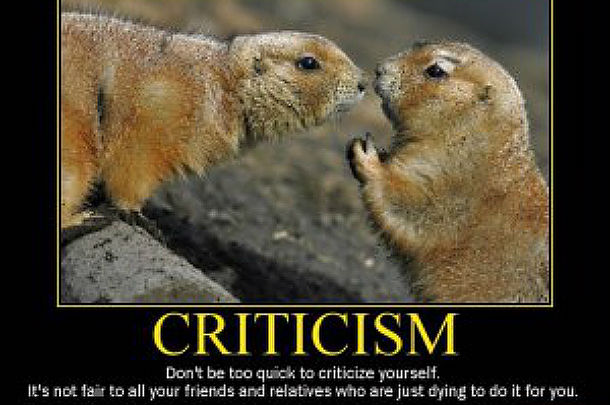
“I am my own worst critic.” I have heard this sentence many times and I have even heard me say it about myself. I probably said it about myself a few days ago. It is bunk. Most (not all) of the people who declare this (including me) are asking you to verbally pat them on the shoulder, tell them they need to go easier on themselves, congratulate them for their high standards. (Some people truly are too hard on themselves, but they tend to not declare this.)

A critic’s job is to attempt to figure out how something works, usually a work of art, and point out the spots where it is not working or not seeming to work well enough. Where it is failing to communicate. Ironically or not, it is not a job for someone who likes tearing things down. That’s what a reviewer does, and not a good one. (Someone should produce an annual book, “A Guide to Reviewers.” Very few reviewers are critics in the strict sense, because doing real criticism is grueling and gets into the nuts and bolts of a thing. It is a job in which one writes 25 pages on a two-page long, 48-line, poem. [It was “Skunk Hour,” by Robert Lowell.] On the other hand, there are a lot of writers who call themselves reviewers, but really they are critics who figure things out and explain it all to us, and I love reading them.)

I was the type of kid who liked taking things apart and putting them back together, enjoyed the search for the one necessary part that appeared to make the thing run when it was in place. The one part in whose absence the thing did not function. Now, I know that one could call this “slow-motion breaking things,” as very few gadgets that I played with were ever restored to a state one might call “functional,” but it is the outlook of a critic. I also loved doing magic tricks. How does a magic trick work? It isn’t by magic.

I enjoyed diagramming sentences, which is a similar thing. (My sentences do not vary in structure, much, I know, I know.)

If I had been truly my own worst or harshest critic, well, my life might have headed somewhere else. (I might not be writing.) No, I was my “worst” critic in that I did not see things clearly, how things worked and did not work. I was my “harshest” in that I liked, perversely liked, tearing myself down. And then I would feel angry at myself for my failure to: Get published, or finish a degree, or father a family, or something else. (Hey, you! Yeah, you. You want to know how to get published? Shhhh. Come over here. I’ll tell ya. Closer. Ready? FIRST, WRITE SOMETHING!) I never began anything so how could I legitimately moan at the absence of the sweet rewards of success? That is a terrible critic; really, it is just a bully. I was my own worst bully. (I am not that anymore.)

I was perpetually caught between my devil and the deep blue me.

The above is an honest assessment, briefly sketched. Honesty is a rare social commodity. One ought to attempt, at least attempt, to be rigorously honest. Not brutally honest. That particular word pair, “brutally honest,” has become a common phrase of late, and while I do not know its origin I do know that it is empty. A completely empty phrase. Any honest communication, from “I love you” to criticism, is not brutal if it is honest.

“Let me be brutally honest,” she said. “I like that cologne.”

We can be brutal, and it can be honest, but “brutal” trumps anything the word is modifying. When I was young, I learned the art of telling complete truths, honest truths, about TMI matters just to deflect questioners about things I really did not want to talk about. That is brutal honesty, I suppose.

Criticism, or anything, offered as brutal honesty is neither honesty nor is it criticism. It’s just brutal.

__________________________________
The WordPress Daily Prompt for September 24 asks, “How are you at receiving criticism? Do you prefer that others treat you with kid gloves, or go for brutal honesty?“Because the question was titled, “Handle With Care,” well, here:
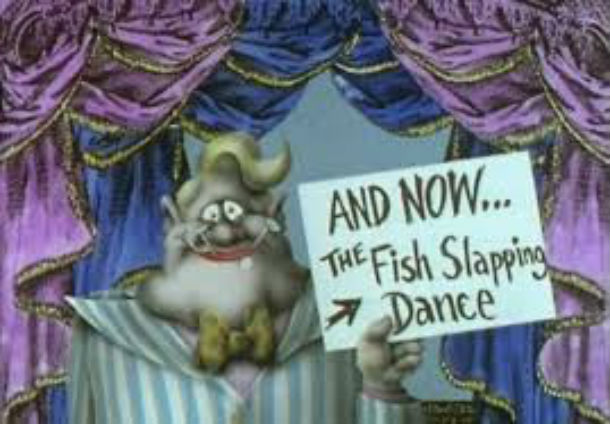
The Fish-Slapping Dance

“If you had to come up with one question, the answer to which would determine whether or not you could be friends with a person you’ve just met, what would it be? What would the right answer be?”

“That’s a great question. Oddly comprehensive, yet a little intrusive at the same time.”

“I agree, but my usual ice breaker question is to ask people that I have just met what their ice breaker question is. So, what is it?”

“Did you want more coffee?”

“That’s your question?”

“No. Your cup is empty. Free refills, hon’.”

* * * *
The speed with which one can determine the depth or length of a friendship—somewhere between forever and not at all—is inequal to the facts of a friendship. How many reminiscence-conversations have you had with friends in which you have learned that either your memory of meeting a friend is faulty or that the friend did not like you on first encounter? I have had both types.

I hinted in a recent column, okay, I explicitly stated in a recent column that if you find the “Fish-Slapping Dance” funny, you and I will more than likely be friends for life.

It may be the Monty Python troupe’s quickest route to the biggest laugh. I wrote, “If you do not find the ‘Fish-Slapping Dance’ funny, it may be because you find the waste of intellectual effort offensive. Or perhaps fish jokes generally turn you right off. ‘How is this funny?’ becomes the same question as ‘Why is this funny?’ ‘Why is T H I S on my screen?’ The ‘Fish-Slapping Dance’ actually can be seen as a depiction of the ‘How is this funny?’ conversation. Michael Palin, the ‘little fishes,’ dances the question, and then John Cleese, the ‘big fish,’ delivers the only possible retort: ‘It is or it is not.’ Splash.”

I can over-intellectualize and explain how the bit does not work, but every attempt I make falters the moment Michael Palin hits the water, when I laugh, sometimes quietly and sometimes out loud, every time.

I knew approximately two things when I wrote this a couple of months ago: that my girlfriend, the closest friend I have, probably does not know much if any Monty Python material and that I do not know if we share a sense of humor, even though she and I laugh a lot at many of the same things and same comics. For instance, her response after listening to some recordings of my radio show was to say that it was nice hearing my voice and that I sounded like I was enjoying myself. It is a comedy show.

Thus, I was rather nervous when I posted the Monty Python video above, several weeks ago, as she might very well read what I wrote, view the classic bit of comedy, and then instant message a break-up with me. I did not know what I did not know, but I was going to learn sooner or later. Are we companions for life, based on one sixteen-second joke?

“I’ve been sitting in my office, laughing at that.” she wrote me that night. Thus, my belief that the Monty Python “Fish-Slapping Dance” is the litmus test of comedy, a proof of companionability, was sustained.

Kindergartners may have the most effective conversations for establishing a friendship: favorite color, up versus down, best food. Matters of eternal importance like those. I try to remember this and always keep track of what is important to me, just in case someone wants to know on the spot: Green, the number 4, the letter N, the word Yes.

__________________________________
The WordPress Daily Prompt for September 23 asks, “If you had to come up with one question, the answer to which would determine whether or not you could be friends with a person you’ve just met, what would it be? What would the right answer be?

Daily Prompt: Four Minutes and 24 Years

The benches in front of 1 Penn Plaza, along West 34th Street, are lively at lunchtime and look like they remain so long after lunch, as deliverymen pick up and drop off all day long and limo drivers waiting for their VIPs kibitz with one another and with passersby who want to know how famous the person about to become their next brush with fame is and whether he or she is worth pausing for on their way to their next New York City attraction.

There was no reason for me to be in front of the famous skyscraper to make this observation last Thursday afternoon. Five minutes before passing the limo drivers and their VIPs and the lunchtime crowd, I was finishing up being lost in Penn Station, the renowned train- and bus- and everything else station (flying saucers will someday land there because it is shaped like one). Ten minutes before that, frustrated that I could not find a sign directing me to exactly where I was going, many many blocks away, I reasoned that any door with sunlight coming through it and people’s shadows walking past must lead to the outside and a street, any street, and the possibility that, once there, I would be able to figure out where I am. In New York City, on the streets, I am (usually) okay, since it is one of the easiest cities to negotiate on foot. It’s a grid. (Mostly.)

That hunch led me up one staircase to plate glass doors that entered into Madison Square Garden. I headed back down that staircase.

Out on the street, I made my way back around MSG to the front of Penn Station and then onward, north along 8th Ave. to have coffee with a college classmate and then meet up with other friends to attend a taping of “The Colbert Report.”

The college classmate and I had not seen each other in almost 24 years, when I had thrown a post-graduation party he attended; thoughts and memories of this party were on my mind while I strolled up 8th. Cars were blocking the crosswalk, so instead of waiting to cross, I turned right and started over to 7th, where I would continue my northward stroll.

This is how small a moment any moment can truly be. Had the crossing been available, I would have continued on 8th. But sitting on a bench on 34th Street at that moment was another college classmate, in fact the co-host of that post-graduation party, someone I have not seen or spoken with in three years and who did not know I was in New York City. He has an office in 1 Penn Plaza and was on his lunch break, people-watching.

Had I walked past ten minutes earlier, I would have missed him, but I had just spent those ten minutes escaping from Penn Station.

“Is that … Kevin? Really?” I thought to myself. Can’t be. I was not going to say anything; I was going to walk past the person who I assumed was a merely a stranger with a familiar face, since how could it be that I would bump into a long-ago friend in this giant city; a hunch had just now almost gotten me lost in Madison Square Garden. I had better leave the hunching business to others, I thought.

“Mark?” That settled it; it was my old friend. With one friend waiting for me in a restaurant in midtown and about 20 more blocks to walk, I had about four minutes to bring my graduate school housemate up to date. He had the same four minutes to bring me up to date. What was I doing in the city. What was he doing on that bench. Our relationship statusi, our work situations, my physical condition. How long it had been since. How utterly baffling the fact of what we were experiencing right then was. Why I was not taking the subway instead of walking 20-plus blocks. We finally, after all these years, exchanged phone numbers.

“How long has it been?” That was my other friend’s first question as I walked in the restaurant, a few minutes later. I reminded him: 24 years. And an extra 10 minutes because I had run into someone. He, too, was on his lunch break, so we had limited time in which to reacquaint each other with each other. Relationships, work, life.

How much time does it really take to tell someone what you’ve done and seen? Maybe it only takes about four minutes to (re)establish who you are and the rest is elaboration with anecdotes.

Who am I? Someone who takes 10 minutes to get out of a wide-open train station but is happy at the social accident that was thus made possible.

* * * *

colbert ticket2

My thumb.

__________________________________
The WordPress Daily Prompt for September 22 asks, “You’re about to enter a room full of strangers, where you will have exactly four minutes to tell a story that would convey who you really are. What’s your story?”