Throw Back Your T’back Thursday

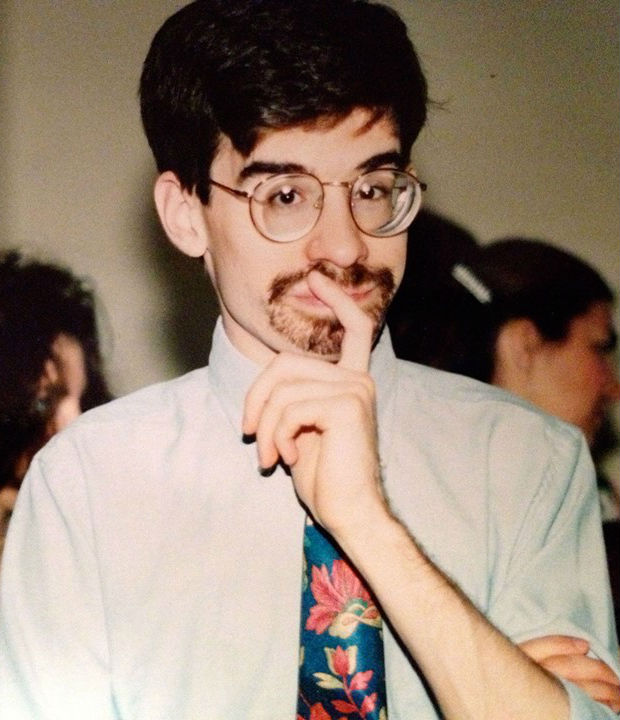
The photo below was shared with me about a year ago by a longtime friend. He informed me that he took it in June 1994. I do not remember the occasion but I do remember the hair, and that alone tells me it was from 1994.

The photo was taken at a party in his and his girlfriend’s apartment. I lived in the same complex as them at the time but I was soon moving “uptown” in New Paltz. (Three blocks away.) I believe that at the moment he was snapping this, I was asking him to be a future roommate with me the next school year, as no one had yet agreed to join me. (I was not an easy roommate to endure and two decades later, I got mine. In spades.) We were in graduate school, literature students, and my memory of our parties is unreasonably romanticized.
1994b

I loved that floral necktie more than it loved me, as it never held a knot that suited my fidgety liking. I have been the frayed death for many ties. And I certainly needed a haircut. The unruly hair—look at that thing on my head! It’s getting caught in my right eyebrow!—contradicted the intent of the tightly trimmed goatee, or vice versa, but I presented the world a lot of mixed messages about me in more ways than my grooming back then. I am 25 in this photo. An interesting life is ahead.

This is me in 2014. My girlfriend took this photo.
2014


* * * *
About a week ago, Michele at Steps Times Two awarded The Gad About Town a “Lovely Blog” award and I have not taken the time to thank her. Thank you. The reason she gave, on her blog, was, “Although he’s already been nominated, I have to add him to my list.” I love that. Thank you.

It is the seventh award this blog has received since joining WordPress in January.

In the blogging world, there are some rules of etiquette in the form of paying forward the awards attention. Here are the rules:

1. Thank the person who nominated you for the award.
2. Display the award on your blog—by including it in your post and/or displaying it using a “widget.”
3. Share 7 facts or things about yourself.

In no order: A. Upon doing something new, I complain every time. B. Strawberries are my favorite food and I wish they had protein so they could be a complete meal for carnivorous me. C. Being in recovery makes every day feel like an awards ceremony. D. My love of the number 4. E. When it is fall I think that spring is the best season, and in spring I think that fall is. F. When asked to name a favorite book or movie, I usually blurt out like a nervous tic an answer that may have been true two decades ago, when I looked like the above photo, but without thinking. So I re-watched “The Maltese Falcon” after naming it last week, once again, as a favorite movie. It is still good. G. I whine.

4. Nominate bloggers you admire.

I am going to repeat something I wrote earlier this week. I have been participating for the last three months in responding to our WordPress service’s Daily Prompt, which has helped spur my most prolific period of writing since graduate school. (This prolific-ness is a good thing, too, because I am working on a terrific project, due out soon, with another blogger.) Most of the writers with whom I have been communicating regularly, several of whom ask me questions and give me applause every single day, I met via that service. My subscribers have doubled and so has the number of blogs that I subscribe to. Go to the Daily Prompt any day and you will see the several dozen blogs that I read and often like every day. Steps Times Two is really good. Michele is a teacher and a poet and a good, honest writer. I have also been reading Curl Up and Dye, written by Amy, who is exploring love and art in various manifestations, and very deeply.

* * * *
This was going to be the first sentence for today’s free-write post, but then I changed my mind: “I want to learn how to meditate.”

____________________________________________
The WordPress Daily Prompt for October 23 asks, “Our ten-minute free-write is back! Have no mercy on your keyboard as you give us your most unfiltered self (feel free to edit later, or just publish as-is).

* * * *
Please subscribe to The Gad About Town on Facebook: http://www.facebook.com/thegadabouttown

Message in a Bottle

Everyone who writes has an imaginary friend.

There is an ideal reader in my imagination, a figure who finds even my shopping lists and notes in the margins of books interesting. I have not yet actually met anyone who fits this description, but I keep writing, just in case.

Rarely have I written something while in the presence of the person I was writing to. The only exceptions to this would be times I have sent a note or a text to the person sitting next to me, but these were done for one of two reasons: 1. We needed to be silent, or 2. I wanted to elicit an ironic smirk when we needed to be silent.

So everyone who writes has a figure, real or imagined, who is supposed to be the reader of the message. For me, this person has changed over time, and even changes from piece to piece.

In the 1990s, when I wrote for a weekly newspaper, I rarely learned which articles or columns were actually read.

I covered school sports, which has a couple of rules: Cram in the names of every participant on the field and even every benchsitter, without mentioning the bench. (Unless the bench was locally made and recently delivered, in which case it was a good idea to include the names of the lumberyard and the furniture maker along with a quote about its bench-y comfort from someone sitting on it.) When both schools are local, simultaneously downplay and up-play the final score. Describe good performances from both sides. Cram in a few more names: the coaches, the refs, some of those in attendance.

A compliment from a reader of one of those articles was a thank you from a parent purchasing an extra copy to send to the grandparents–if I ran into them at the grocery store while they were purchasing that extra copy.

I also had a humor column (guess its name) and I once wrote something controversial in it. Now, this was done out of an idiotic frustration that I felt from my perceived lack of feedback. “How do I know what people think?” I said to no one out loud, and so I put on my explorer costume and ventured forth without leaving my desk to find out. If I had said it out loud, my editor probably would have dissuaded me.

My column was on page 4, and on page 3 was a column written by an elderly man who had spent a lifetime in newspapers, local newspapers; his entire four-decade-long career had been spent in the same county we were covering. It is possible that he had written something about every single building in the county and more than a few open fields. Not one piece of mail had come into the newspaper office about my column, even when I had requested feedback from readers, but there was a letter every single week about the old man’s column. “He should retire already” or “May he never quit” were the only two themes, but one of these arrived every week!

(He passed away about 15 years ago and the newspaper, which I had by then left, continued to run his columns as a weekly “Best of …” tribute; I am certain the paper still received the “He should retire” and “May he never quit” letters every week.)

But I was the target of no such letters and I envied the old man his passionate readership. The one time that I wrote something controversial, controversy followed: Our music columnist used his weekly space to rebut my column and publicly declare that not only had he not ever read me but he was going to continue to not read me, which seemed a neat trick. He did not send a letter to the editor; instead he wasted his own column inches to disagree with me. I told him, in person, in my job as assistant editor, that we still needed his music review that week and we would run the complaint in the letters section, which needed a letter as we had received not even one that week. He insisted on using his space to not review music in that issue, though.

Times are different now, says everyone who has lived long enough to learn to talk, and this blog, which is almost a year old now, has readers who are also writers and who like to give feedback. “The Gad About Town” has a small readership, so far, but a feedback-y sort of readership, for which I am grateful. I do not need to generate controversy just to do so. I also do not need to cram in the names of a lumberyard and furniture store.

Everything we write is a message in a bottle, and I no longer attempt to steer the currents to shore for my messages.

____________________________________________
The WordPress Daily Prompt for October 22 asks, “Many of us had imaginary friends as young children. If your imaginary friend grew up alongside you, what would his/her/its life be like today? (Didn’t have one? write about a non-imaginary friend you haven’t seen since childhood.)”

* * * *
Please subscribe to The Gad About Town on Facebook: http://www.facebook.com/thegadabouttown

The Legend of Pop Hinks: A Legend

“Metaphors was as rare for me as things I can’t find anywhere.”—Pop Hinks.

Pop was describing a time when he was stretching, reaching, striving for an easy analogy, yet it eluded his thinking brain like a bird that had flown away from his grasp. It was a moment and a bird and Pop. Just those three things and they were themselves complete and entirely themselves.

The bird alighted and then flew away just past his gripping fingers, but it was still close enough for him to catch a thought about a moment in which he could envision, or so he said, a time when he caught that bird. A starling, he said it was.

Metaphors, analogies, similes could be similarly elusive but in a literal sense. “Slippy eels,” Pop Hinks took to calling them.

He was a blues player, one of the greatest slide guitarists on the north side of Kansas City, but the Kansas side, where there were no blues players. It was long a source of frustration for him that he regularly was ranked the third-greatest slide player even though he was the only one. He did not play with a slide, which may have presented most of his trouble.

Pop Hinks also played professional baseball in that far-long-ago era of the 1930s. He starred in a semipro league that was an imitation of the Negro Leagues, but one that starred white players only.

His baseball days were filled with long nights of transcendent sadness spent daydreaming on the bench about playing baseball, and sometimes his daydreams coincided with the game he was watching and not participating in. His blues nights were spent waiting in the backrooms of the seedless bars he did not play in, waiting eagerly to hear the one name he most wanted to hear called to the stage: his own. He never heard it and it was even more rarely called.

He could never find, not till his dying day, which has not yet come, he could never find the analogy that would match his baseball love with his blues love. One song, “A Grand-Slam,” he never played. Another, “The Walk Off,” was never requested. Yet another, “The One-Four-Five,” describing a little-seen play in which a pitcher fields a hit and inexplicably throws to an out-of-position second baseman who throws to third to catch a confused runner off base, was never written, although we debut it below.

It is difficult, Pop Hinks would say, to find a metaphor that covers all analogies, communicates something about real-life situations like love and baseball and the blues to fit most listeners. There are few walk-off homers in life or art or the blues. But if you asked him about those long-ago nights in Kansas City, he would shake his head and say, “I can take you there. But I’ll have to charge.”

* * * *
The Magnificent Glass Pelican (MGP) is a live half-hour radio comedy show that my friends and I have written, produced, and acted in for over two decades. Lately, it has been an improvised half-hour, produced by us and scripted live on-air. The current season is our 23rd consecutive or so.

Each Wednesday night at 7:30 p.m. (tomorrow), the MGP half-hour is broadcast on 88.7 FM WFNP (“The Edge”) in the Rosendale-New Paltz, New York, area or is streaming live here: The MGP on WFNP. This is at 7:30 p.m. Eastern, and the broadcasts are not archived, so if you can check us out live tomorrow, thank you.

“Pop Hinks” was a monologue I wrote 15-20 years or so ago, when I had not yet started thinking. Sean Marrinan plays Pop Hinks, and that is Sean with the impressive beard on his face. John Burdick plays the guitar. I wrote the words.

“The One Four Five,” written by John Burdick:

* * * *
[Historical note: Before the Brooklyn Dodgers brought Jackie Robinson to the major leagues, white team owners maintained a ban on playing black baseball players, so the black community built a professional baseball league for itself. It was called the Negro Leagues and it existed from the late 1800s till the 1950s, when Major League baseball started integrating. I hate explaining jokes, but there might be readers who may not know this, who might think something called the Negro Leagues was a weird joke. In reality, it was not a joke, which is a sad fact for America. In the joke, which I have now killed utterly dead, I am picturing a world in which white America, upon seeing the success of the Negro Leagues, would create a baseball league to steal black America’s thunder, even while professional baseball was in fact all-white.]

____________________________________________
The WordPress Daily Prompt for October 21 asks, “The World Series starts tonight! In your own life, what would be the equivalent of a walk-off home run? (For the baseball-averse, that’s a last-minute, back-against-the-wall play that guarantees a dramatic victory.)”

* * * *
Please subscribe to The Gad About Town on Facebook: http://www.facebook.com/thegadabouttown