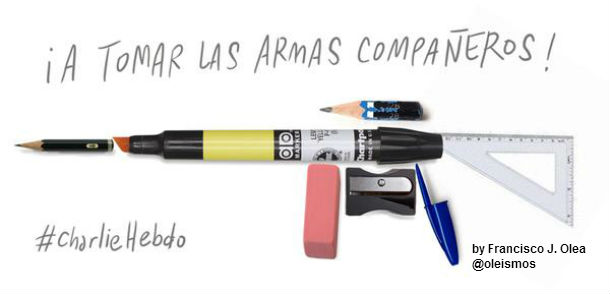
‘A tomar las armas compañeros’

I do not often write until I am certain—or self-deluded into thinking—that what will come out will present my thoughts clearly. When I gush, I feel embarrassed that I am using anyone’s time with an indulgence of self when others deserve a reader’s time more. I don’t deserve a reader’s time just because I’m here on a soapbox. Feel free to move on …

Sometimes I am confused. Are there are too many soapboxes in this world and not enough people reaching out to help people up and expand understanding, or are there too few soapboxes from which to proclaim love, describe help, and attempt to expand understanding?

You already know what took place today in Paris. The fact of a soapbox was addressed with state-less mass murder. It was a terrorist attack on the right to write, to publish, to think, to feel, to love. The right to be jerks, which the cartoonists who were killed today declared for themselves. Each of us, if we wish to claim it for ourselves, has a soapbox from which we can expand understanding, even by expressing shock, revulsion, confusion.

Today is not a day for pretty sentences and confidence in metaphors; it is a day for assuring one another in plain terms that there is a right to write, a right to love, a right to be shocked and confused. A right to hate hate.

The idea that an idea, a clever cartoon, a spoken sentence, is to be met with bloody murder is one that can only be addressed with more ideas and sentences, because the attack is bizarre proof of power of the written word. Murderers are murderers, but murder is not an idea. It is not a political statement. It is not criticism. It empty and totalitarian. Anyone who believes that their God demands blood to defend him/her/it does not understand their own God, and any God that truly can not defend itself from a mere human’s verbal insult isn’t much of a God.

The universe is indifferent and entropy is a reality, but alongside entropy, the universe possesses—or was given—creativity. There is no indifference in creativity. Totalitarianism, of whatever stripe, pretends to be political, but it is a political declaration of being pro-entropy, which is an untenable stance.

We live in an increasingly neurotic era, globally. America, my home, has spent more than a decade (some would insist the number is more like six decades) attempting to strong-arm the world into agreeing with our own self-regard. No one will be taking me and my cane from my desk for typing that sentence and hitting publish.

Murder is murder. It is not an idea. It is a vacuum, and vacuums are totalitarian in their lack of purpose. History teaches us that ideas fill the vacuum, the murderous vacuum. More ideas, please. Love is stronger than hate. That’s one.

The photo-cartoon above is by a Chilean cartoonist named Francisco J. Olea. I cried when I saw it. The caption, “A tomar las armas compañeros,” can be translated to, “Grab your weapons, friends.” More ideas, please. Write them and draw them and hit publish. More ideas, please.

The Spanish poet Federico García Lorca was murdered during the Spanish Civil War by soldiers on the nationalist side, the Francoists. In “Fable and Round of the Three Friends,” he foresaw, in his surrealist fashion, his own end:

When the pure forms sank
under the cri cri of daisies
I understood they had murdered me.
They searched the cafés and the graveyards and churches,
they opened the wine casks and wardrobes,
they destroyed three skeletons to pull out their gold teeth.
Still they couldn’t find me.
They couldn’t?
No. They couldn’t.
But they learned the sixth moon fled against the torrent,
and the sea remembered, suddenly,
the names of all her drowned.

More Lorca for a sad day:

City That Does Not Sleep
In the sky there is nobody asleep. Nobody, nobody.
Nobody is asleep.
The creatures of the moon sniff and prowl about their cabins.
The living iguanas will come and bite the men who do not dream,
and the man who rushes out with his spirit broken will meet on the
street corner
the unbelievable alligator quiet beneath the tender protest of the
stars.

 
Nobody is asleep on earth. Nobody, nobody.
Nobody is asleep.
In a graveyard far off there is a corpse
who has moaned for three years
because of a dry countryside on his knee;
and that boy they buried this morning cried so much
it was necessary to call out the dogs to keep him quiet.

 
Life is not a dream. Careful! Careful! Careful!
We fall down the stairs in order to eat the moist earth
or we climb to the knife edge of the snow with the voices of the dead
dahlias.
But forgetfulness does not exist, dreams do not exist;
flesh exists. Kisses tie our mouths
in a thicket of new veins,
and whoever his pain pains will feel that pain forever
and whoever is afraid of death will carry it on his shoulders.

 
One day
the horses will live in the saloons
and the enraged ants
will throw themselves on the yellow skies that take refuge in the
eyes of cows.

 
Another day
we will watch the preserved butterflies rise from the dead
and still walking through a country of gray sponges and silent boats
we will watch our ring flash and roses spring from our tongue.
Careful! Be careful! Be careful!
The men who still have marks of the claw and the thunderstorm,
and that boy who cries because he has never heard of the invention
of the bridge,
or that dead man who possesses now only his head and a shoe,
we must carry them to the wall where the iguanas and the snakes
are waiting,
where the bear’s teeth are waiting,
where the mummified hand of the boy is waiting,
and the hair of the camel stands on end with a violent blue shudder.

 
Nobody is sleeping in the sky. Nobody, nobody.
Nobody is sleeping.
If someone does close his eyes,
a whip, boys, a whip!
Let there be a landscape of open eyes
and bitter wounds on fire.
No one is sleeping in this world. No one, no one.
I have said it before.

 
No one is sleeping.
But if someone grows too much moss on his temples during the
night,
open the stage trapdoors so he can see in the moonlight
the lying goblets, and the poison, and the skull of the theaters.
—translated by Robert Bly

____________________________________________
The WordPress Daily Prompt for January 7 asks, “A sanctuary is a place you can escape to, to catch your breath and remember who you are. Write about the place you go to when everything is a bit too much.”

* * * *
Please subscribe to The Gad About Town on Facebook: http://www.facebook.com/thegadabouttown


Glass Houses

There is a wonderful show business saying that if a performer is a great enough talent, “you could put him or her behind a brick wall and they will still find a way to entertain.” While I believe this to be true in idealistic theory, I also think that not putting him or her behind a brick wall would be profoundly helpful to their cause. If a website is going to be worth a visit, publicity is going to help get that visit.

I have gone viral approximately not once, so I have some expertise in the field of not being at all famous.

Some of you may not remember that last March I was almost on the verge of getting on line for the waiting room to visit the Land of the Almost Known. My “About.me” page was featured on that website’s “popular” list, and my page, which usually receives about 150 views per day, was seen by 3051 other About.me users, 2000 within the first hour of being listed. Another 1300 visited the next day.

Three thousand. I know, I know. I have lived in at least one building that had a larger population.

What does fame feel like? Living in Philip Johnson’s “Glass House.”

The Glass House. Located in New Canaan, CT, it was built in 1949.

The Glass House. Located in New Canaan, CT, it was built in 1949.


This post will be number 192, I think, on this website. There are a handful of columns that I am proud of having written and published, and they are these:
1. The several pieces I have published about my life with adult spinal muscular atrophy. I even explain the duck on my website. Here, I will group them together in one package: Spinal muscular atrophy.
2. A Conspiracy Theory of Conspiracy Theories
3. Guilty of White
4. Requiem for a Sponsor
5. Two appreciations of the Bonzo Dog Doo-dah Band and its leader, Vivian Stanshall
6. A column about the Baseball Hall of Fame
7. An appreciation of one of my favorite places, Opus 40
8. Comedy: The ‘Fish-Slapping Dance’
9. A column about W.H. Auden’s character: “Auden’s Decency”

As a self-publicist, I am not certain I would hire me, but I was the only person to apply for the job. On Twitter, there are a handful of people who profess to like what appears here and even share selected pieces. That amazes me, and I am speechless.

There are also people on that service who use unpleasant names (I was called the B word recently, which was a surprise) or offer strange advice (when I shared a recording of T.S. Eliot the other day, the fiftieth anniversary of his death, one person took the time to explain what drugs I ought to get a prescription for, and that he could help). In the name of publicity, I should never block anyone, but I did in both of those cases.

No glass house for me.

* * * *
Please visit some or all of the above columns, follow me on Twitter, and please subscribe to The Gad About Town on Facebook: http://www.facebook.com/thegadabouttown. Thanks.

____________________________________________
The WordPress Daily Prompt for January 6 asks, “Your blog just became a viral sensation. What’s the one post you’d like new readers to see and remember you by? Write that post.”

Humble-Bragging, Part 2

The word “humblebrag” has been around long enough that even I have heard of it. (Is that a humblebrag?) A collection of examples has been collected in a book that I have not yet read, entitled, “Humblebrag.” The word is common enough that it is even in the Oxford Dictionary, at least in the online edition.

For some reason, I only recently learned the term and, egomaniac that I am, I thought that I had come up with the concept years ago. I certainly had not.

That is probably a humblebrag.

The word describes the craft of hiding a brag about oneself inside a seemingly self-deprecating statement. For instance, if and when I name-drop a famous person and simultaneously mention how nice they were to li’l ol’ me, which is something that I certainly have done, that is a pretty standard humblebrag. A humblebragger gets two social rewards for the price of one: a congratulations for the achievement that they are proud of—and perhaps ought to be proud of, even without the name-drop—and a verbal pat on the shoulder in recognition of their semi-sincere humbleness. “I met Oprah Winfrey once,” is a minor brag that is almost no brag at all, unless the conversation is not “famous people we have met,” but instead it was your reply to, “Have you decided what you’re getting yet? I’m starving.”

“I was hanging out with Oprah Winfrey the other day,” is a big brag if you merely saw her private plane near your gate at O’Hare Airport. We have been taught that people do not like braggarts and that humbleness is a positive attribute to be celebrated.

“I bet Oprah Winfrey tells just about every li’l ol’ barista (like moi) that they make the best (insert name of coffee concoction here).” That is a humblebrag. It rhymes with “Shut up.”

(In full disclosure, I am not a barista, and I have not met or otherwise encountered Oprah Winfrey. I have been in O’Hare Airport a few times and may have bought a coffee there.)

Most of the above was written a few months ago (“Humble-Bragging and Secret-Keeping”) on the subject of keeping secrets. My thesis then was that if one is asked whether one is good at keeping secrets, there really is no good response to that question. It is a social logic double-bind: If one is good at keeping secrets, there is only one way to prove it—by keeping a secret—and any new acquaintance who might test one’s skill in this realm by sharing a secret is either sharing something not worth keeping secret (“Can you keep a secret? I’ve been wearing blue all week!” “Yeah, um, you’ve worn the same sweater three days in a row.”) or is worth avoiding at the next Anonymity Anonymous meeting. (Friendships offer enough challenging—and rewarding—situations without the addition of tests.)

In a similar vein, one can ask about another person’s bravery; my sad life experience has been that those who tell you spectacular stories about their personal experiences with their own honest-to-goodness bravery sometimes do not show up when needed. (Sometimes they do.) I have been friends with people who have had to dig deep in themselves for physical and emotional bravery—people in the military, a member of the NYPD who was buried in rubble on 9/11, one of the first female firefighters in New York City—and none of them volunteered stories. Each of them would volunteer a story about a time he or she had screwed something up far more readily than speak about rescues they had authored.

I am no hero. I hope I have helped out some people, but since I do not know, I assume I have not. So I keep myself available.

* * * *
I chose a new layout. I was using “The Columnist” all 2014, was happy with it, but thought I would change things for the new year. I am still using the free layouts but might invest money in this website. Any suggestions? Advice? Does this layout make my ideas look good? And thank you to those who have responded so far.

____________________________________________
The WordPress Daily Prompt for January 5 asks, “Tell us about the time you rescued someone else (person or animal) from a dangerous situation. What happened? How did you prevail?”

* * * *
Please subscribe to The Gad About Town on Facebook: http://www.facebook.com/thegadabouttown