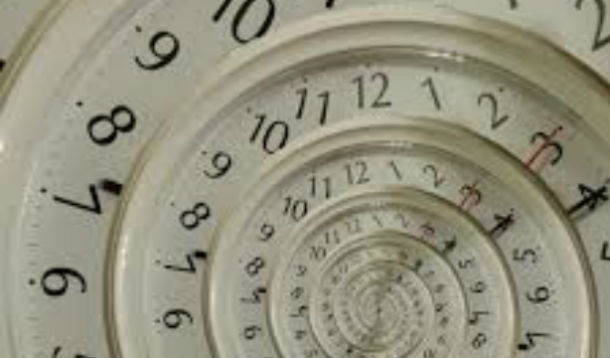
Some Time Travels

In his “Confessions,” St. Augustine writes, “What then is time? If no one asks me, I know; if I wish to explain it to one that asks, I know not.” He decides that time is an idea, unique to humans, and also unique in that we can simultaneously grasp the past in memory, the present by attention, and the future by expectation. In our minds, but only there, we are not locked to one perception of one reality.

Yesterday, I deleted everything that I had written up to that point by dragging my unbuttoned shirtsleeve across my laptop’s touchpad while reaching for my coffee. (No, I can not replicate the results in an experiment; yes, like an idiot, I have attempted to replicate these results in an experiment.) In a feat of memory, I retyped all that I had written to that point; simultaneously I remembered what I had written, was super-present and typed it attentively, and expected a future in which I regularly saved my work, a lesson I first learned, oh, 20 years ago. I was in three specific time-experiences at once, and all of them sucked.

* * * *
For decades, it has been known that subatomic particles can be in two places at the same time. In yet more recent (2014) experiments, physicists have “simulated” time travel. Science reporters tell us that time travel is in the “near future,” or, more prosaically, “just around the corner.” If this is so, no one from the future has yet visited us, because if it truly is something that we will invent or discover in the future (near or not-so) we would know all about it already. This is because, oh, you get it.

Many therapy techniques suggest remembering oneself in a childhood moment and reaching out to that younger self; the thought is that we carry every self we have yet been forward into our psychological present and can communicate something of a healing nature to those past selves. Whenever I have attempted anything of this sort, I have cried. I have received no reports from the younger self about what he made of the unexplained appearance of an older man leaning on a cane.

* * * *

How the false truths of the years of youth have passed!
Have passed at full speed like trains which never stopped
There where I stood and waited, hardly aware,
How little I knew, or which of them was the one
To mount and ride to hope or where true hope arrives.
— “I Am A Book I Neither Wrote Nor Read,” Delmore Schwartz

* * * *
The thought experiment of time travel has a long history in popular culture. Fantasists invent tools (a jet-pack in every garage) in novels and movies, tools which actually only address the needs of the present moment and do not attempt to imagine the future needs that will be answered by the future tools. In almost every science fiction work that uses the device of time travel, the several paradoxes of “a visitor from the future would influence current history and thus change their present” or “if I go back in time and change a mistake, erase an error, will I not change who I am now?” are addressed.

Many of the heroes decide or discover that the path that brought them to where they are and to the person they are now was always worth taking, errors and all. As long as one is breathing, lessons can be applied. (Ebenezer Scrooge, for example.)

It is a seductive thought experiment, though. Offer a person a time machine to return to a specific moment in the past and take up residence there, from that moment onward, and relive one’s life so one can fix whichever errors and enhance whichever successes that followed, well, it is seductive. Offer a person life from a future moment from which they can see it all unfold, … well.

* * * *
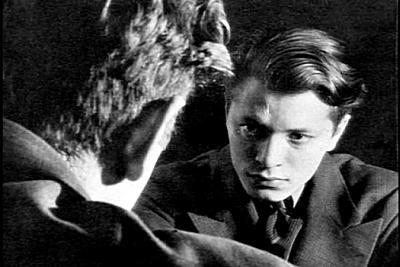
delmoreschwartz

Delmore Schwartz

Delmore Schwartz’s heart-rending short story, “In Dreams Begin Responsibilities,” opens with the narrator in a movie theater as he realizes the feature is his parents on their first date; he becomes frantic and yells at the screen, “Don’t do it!” and gives a list of reasons. (Oh, to have been Delmore’s mother. He was 21 when the story was published.) The audience hisses him down, as he is ruining the movie for them, but he knows how it ends.

My father tells my mother how much money he has made in the week just past, exaggerating an amount which need not have been exaggerated. But my father has always felt that actualities somehow fall short, no matter how fine they are. Suddenly I begin to weep. The determined old lady who sits next to me in the theatre is annoyed and looks at me with an angry face, and being intimidated, I stop. I drag out my handkerchief and dry my face, licking the drop which has fallen near my lips. Meanwhile I have missed something, for here are my father and mother alighting from the street-car at the last stop, Coney Island.

At the end, the narrator is thrown out of the movie theater while on screen his father is refusing to have his fortune told by a Coney Island fortune teller. And then he awakens to “the bleak winter morning” of his 21st birthday. It was all a dream.

* * * *
As Augustine saw, way back in the 4th century, we always live in the three time zones of our experience and psyche simultaneously: past, present, and future. Always.

I no more wrote than read that book which is
The self I am, half-hidden as it is
From one and all who see within a kiss
The lounging formless blackness of an abyss.

How could I think the brief years were enough
To prove the reality of endless love?
— “I Am A Book I Neither Wrote Nor Read,” Delmore Schwartz

* * * *
Neat Thing of the Day: Lou Reed reading “In Dreams Begin Responsibilities” (Reed had been a student-mentee of Schwartz’s at Syracuse University): In Dreams Begin Responsibilities.

____________________________________________
The WordPress Daily Prompt for October 7 asks, “Congrats! You’re the owner of a new time machine. The catch? It comes in two models, each traveling one way only: the past OR the future. Which do you choose, and why?”
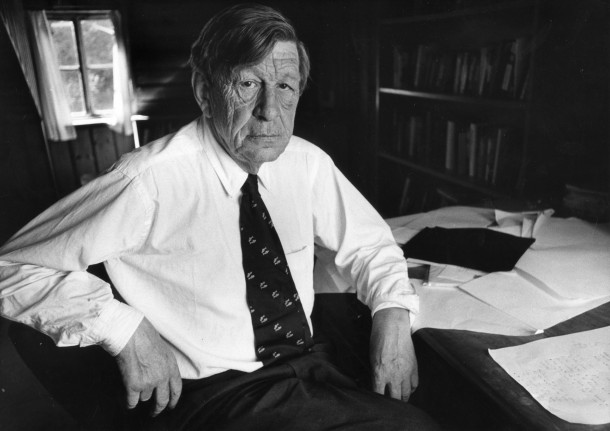
Auden’s Decency

In the documentary, “Tell Me the Truth About Love,” W.H. Auden’s friend Thekla Clark recounts the story of one of Auden’s lovers complaining to him that he thought Auden would be more “romantic,” being a poet, after all. “But you aren’t romantic,” Clark quotes the lover telling the poet. “You aren’t romantic at all.”

“If you want romance,” Clark quotes Auden replying, “screw a journalist.” (Except she does not say “screw.”)

Auden was not one for ruining a good line—or a good night—by spending it explaining the difference between romance and sentimentality.

Auden’s poetry, often about love, derived from an almost clinical study of his own personal history and emotions. A professional poetic detachment yielded a poetry that was undisturbed by sentimentality. Yet Auden is also the least cynical and one of the most humane of the great poets.

One can not declare oneself humble. Humility and decency do not allow for advertising. The moment one discusses one’s virtues, one yields them. In the same documentary, “Tell Me the Truth About Love,” Auden tells the talk-show host Michael Parkinson that “a writer is a maker, not a man of action” so everything he writes is an autobiography, is his history of his experience transformed in his senses, and that, no, he would not be writing his memoirs. The autobiography of a man of action—a politician or general or activist—may be necessary to understand them.

(The clip starts around minute three. The documentary, which first aired on the BBC in 2000, is full of interviews with Auden and his circle. Once upon a time, talk shows featured literary figures; Michael Parkinson was the Johnny Carson or Dick Cavett of Britain, minus the jokes. Actually, Dick Cavett was the Parkinson of America.)

Auden learned the difference between a man of action and a maker early on, and he learned how tempting it could be to confuse the two. In the 1930s, while a young writer, he was made into a hero of the British left, and moved to America to reacquire his privacy. Edward Mendelson quotes Auden in “The Secret Auden,” in the current issue of the New York Review of Books: “I suddenly found I could really do it, that I could make a fighting demagogic speech and have the audience roaring … . It is so exciting but so absolutely degrading; I felt just covered with dirt afterwards.”

By the 1960s, both his politics (left) and his religion (he returned to the Anglican Church of his youth in 1940) were publicly known, but he was no longer a speech maker and never was a proselytizer. From Mendelson’s article:

When he felt obliged to stand on principle on some literary or moral issue, he did so without calling attention to himself, and he was impatient with writers like Robert Lowell whose political protests seemed to him more egocentric than effective. When he won the National Medal for Literature in 1967, he was unwilling either to accept it in Lyndon Johnson’s White House during the Vietnam War or “to make a Cal Lowell gesture by a public refusal,” so he arranged for the ceremony to be held at the Smithsonian, where he gave an acceptance speech about the corruption of language by politics and propaganda.”—The Secret Auden,”

To accept an award from one’s adopted country and relocate the ceremony from the heart of power to the nation’s museum, and then to turn the ceremony into a lecture about corruption is, when available, a different sort of bravery than an attempt to make one’s absence into a loud presence.

Edward Mendelson is Auden’s literary executor, and in the New York Review article, he reveals that he is still learning of some of Auden’s acts of decency, 40 years after the poet’s death. Charities he quietly funded, a manuscript donated for a sale to pay for a friend’s surgery, a prisoner who wrote him once and began a lifelong correspondence course in literature. Even the story of a woman from his congregation in Manhattan who “was suffering night terrors, so he took a blanket and slept in the hallway outside her apartment until she felt safe again.”

There is even this story, revealed last year in a letter to the Times of London:

Sixty years ago my English teacher brought me to London from my provincial grammar school for a literary conference. Understandably, she abandoned me for her friends when we arrived, and I was left to flounder. I was gauche and inept and had no idea what to do with myself. Auden must have sensed this because he approached me and said, “Everyone here is just as nervous as you are, but they are bluffing, and you must learn to bluff too.”

Auden knew, Mendelson writes, that good and evil exist, but that human beings fall on a spectrum between the two. Most are not evil people attempting to be saintly but good people striving to become better. There “are those who, like Auden, sense the furies hidden in themselves, evils they hope never to unleash, but which, they sometimes perceive, add force to their ordinary angers and resentments, especially those angers they prefer to think are righteous. On the other side are those who can say of themselves without irony, ‘I am a good person,’ who perceive great evils only in other, evil people whose motives and actions are entirely different from their own. This view has dangerous consequences when a party or nation, having assured itself of its inherent goodness, assumes its actions are therefore justified, even when, in the eyes of everyone else, they seem murderous and oppressive.” When one’s nation declares itself a force for good in the world, maybe one should make sure the passport is up-to-date. Auden once wrote, “Many a sore bottom finds/A sorer one to kick.”

We do not practice what we thoroughly possess. We say we “practice” kindness because we do not possess it, not to the degree that makes us kind. We practice love because we are not loving but can always be more so. The humble acts of decency and kindness may not change the universe, but they may change an individual’s universe. In the often misquoted line from his amused and amusing 1957 poem, “The More Loving One,” Auden says, “If equal affection cannot be,/Let the more loving one be me.”

* * * *
Mendelson mentions Thekla Clark in his New York Review article, in one more anecdote about Auden’s quiet defense of doing the right thing, and adds that he learned of this “in a documentary film, ‘Wystan: The Life, Love and Death of a Poet,’ by Michael Buergermeister, which had its premiere in Oxford last year.” It is the only mention I have found of this documentary. On Buergermeister’s own website, only this trailer for the film appears:

It is tantalizing.