‘For the Time Being,’ Part 3

The concluding sections of W.H. Auden’s Christmas oratorio continue his blend of the contemporary and everyday with the mysterious and eternal. All of modern philosophy is briefly made to vanish in a blur of the mundane world:

But, for the time being, here we all are,
Back in the moderate Aristotelian city
Of darning and the Eight-Fifteen, where Euclid’s geometry
And Newton’s mechanics would account for our experience,
And the kitchen table exists because I scrub it.
It seems to have shrunk during the holidays.

The fact of faith—not what one has faith in, but that faith exists, is a reality itself—that is the miracle of the day, is what Christmas is about:

Follow Him through the Land of Unlikeness;
You will see rare beasts, and have unique adventures.

“For the Time Being” was published in 1944. It is found in Auden’s Collected Poems. Section III is perhaps the most often reprinted part of the poem:

III
NARRATOR:

Well, so that is that. Now we must dismantle the tree,
Putting the decorations back into their cardboard boxes—
Some have got broken—and carrying them up to the attic.
The holly and the mistletoe must be taken down and burnt,
And the children got ready for school. There are enough
Left-overs to do, warmed-up, for the rest of the week—
Not that we have much appetite, having drunk such a lot,
Stayed up so late, attempted—quite unsuccessfully—
To love all of our relatives, and in general
Grossly overestimated our powers. Once again
As in previous years we have seen the actual Vision and failed
To do more than entertain it as an agreeable
Possibility, once again we have sent Him away,
Begging though to remain His disobedient servant,
The promising child who cannot keep His word for long.
The Christmas Feast is already a fading memory,
And already the mind begins to be vaguely aware
Of an unpleasant whiff of apprehension at the thought
Of Lent and Good Friday which cannot, after all, now
Be very far off. But, for the time being, here we all are,
Back in the moderate Aristotelian city
Of darning and the Eight-Fifteen, where Euclid’s geometry
And Newton’s mechanics would account for our experience,
And the kitchen table exists because I scrub it.
It seems to have shrunk during the holidays. The streets
Are much narrower than we remembered; we had forgotten
The office was as depressing as this. To those who have seen
The Child, however dimly, however incredulously,
The Time Being is, in a sense, the most trying time of all.
For the innocent children who whispered so excitedly
Outside the locked door where they knew the presents to be
Grew up when it opened. Now, recollecting that moment
We can repress the joy, but the guilt remains conscious;
Remembering the stable where for once in our lives
Everything became a You and nothing was an It.
And craving the sensation but ignoring the cause,
We look round for something, no matter what, to inhibit
Our self-reflection, and the obvious thing for that purpose
Would be some great suffering. So, once we have met the Son,
We are tempted ever after to pray to the Father;
“Lead us into temptation and evil for our sake.”
They will come, all right, don’t worry; probably in a form
That we do not expect, and certainly with a force
More dreadful than we can imagine. In the meantime
There are bills to be paid, machines to keep in repair,
Irregular verbs to learn, the Time Being to redeem
From insignificance. The happy morning is over,
The night of agony still to come; the time is noon:
When the Spirit must practice his scales of rejoicing
Without even a hostile audience, and the Soul endure
A silence that is neither for nor against her faith
That God’s Will will be done, that, in spite of her prayers,
God will cheat no one, not even the world of its triumph.

IV
CHORUS:

He is the Way.
Follow Him through the Land of Unlikeness;
You will see rare beasts, and have unique adventures.

He is the Truth.
Seek Him in the Kingdom of Anxiety;
You will come to a great city that has expected your return for years.

He is the Life.
Love Him in the World of the Flesh;
And at your marriage all its occasions shall dance for joy.

____________________________________________
The WordPress Daily Prompt for December 26 asks, “Have you ever managed to paint yourself into the proverbial corner because of your words? What did you do while waiting for them ‘to dry’?”

* * * *
Please subscribe to The Gad About Town on Facebook: http://www.facebook.com/thegadabouttown

‘For the Time Being,’ Part 2

During World War II, the poet W.H. Auden wrote a book-length poem entitled “For the Time Being.” It is subtitled, “A Christmas Oratorio,” and it is a retelling of the Christmas story, but with a 20th Century sensibility. His Herod, for instance, is a technology-loving king who loves that he lives in an Age of Reason and is ever-perplexed by faith and irked that he must hunt down and exterminate the baby Jesus.

An oratorio is a type of composition that was popular in the Baroque period and in churches and has not had many comebacks as a poetic or theatrical form because it never had a period of dominance. It never went away but it was never the first choice of writing mode for many writers. (Paul McCartney produced a quite famous one, “A Liverpool Oratorio,” two decades ago.) Auden was a poet of structures and forms, though, and he produced an attempt at almost every style and poetic structure in his body of work (about 400 poems and several full-length verse plays).

Oratorios are not often staged because the form resides somewhere between performance and recitation. The piece will have characters, but the characters only address the audience and rarely each other. Music is not necessary but can supply punctuation and help telegraph and amplify the intended moods of the work. There is only one full-length recording of Auden’s Christmas oratorio online, from a performance in 2007 by the St. Peter’s Cultivators in Chicago:

By 1940, Auden’s personal spiritual journey saw him rejoin the Anglican Church of his youth in the form of the Episcopal Church. It was also around this time that he had emigrated from England to America. As Edward Mendelson, Auden’s literary executor, describes it, “Auden returned to the Anglican Communion in 1940 after seven years of thought about the moral content of Christianity, about what it means to love—or not to love—one’s neighbor as oneself.” (New York Review of Books, December 6, 2007.) More Mendelson:

Auden took seriously his membership in the Anglican Church and derived many of his moral and aesthetic ideas from Christian doctrines developed over two millennia, but he valued his church and its doctrines only to the degree that they helped to make it possible to love one’s neighbor as oneself. To the extent that they became ends in themselves, or made it easier for a believer to isolate or elevate himself, they became—in the word Auden used about most aspects of Christendom—unchristian. Church doctrines, like all human creations, were subject to judgment. […] Auden referred to himself as a “would-be Christian,” because, he said, even to call oneself a Christian would be an unchristian act of pride. “Christianity is a way, not a state, and a Christian is never something one is, only something one can pray to become.” [Emphasis mine.]

After a decade in which he personally witnessed the Spanish Civil War and watched Europe move into two philosophies—fascism and democracy—and gird itself for a war over them, Auden removed himself to New York City and developed for himself a personal faith that to some might sound a-religious and to others like he had become born again. It is in that mode that he wrote “For the Time Being,” a work that uses both verse and prose and toys vertiginously with setting (it is simultaneously urban and contemporary, 1940, and the Roman Empire in its Judean outposts).

For Christmas Day 2014, here are two sections, a verse by the Star of the Nativity and part of a long monologue by Herod on the subject of Faith versus Reason and how Reason must triumph (but won’t). The full poem is found in Auden’s Collected Poems.

The Summons
STAR OF THE NATIVITY:

I am that star most dreaded by the wise,
For they are drawn against their will to me,
Yet read in my procession through the skies
The doom of orthodox sophrosyne:
I shall discard their major preservation,
All that they know so long as no one asks;
I shall deprive them of their minor tasks
In free and legal households of sensation,
Of money, picnics, beer, and sanitation.

Beware. All those who follow me are led
Onto that Glassy Mountain where are no
Footholds for logic, to that Bridge of Dread
Where knowledge but increases vertigo:
Those who pursue me take a twisting lane
To find themselves immediately alone
With savage water or unfeeling stone,
In labyrinths where they must entertain
Confusion, cripples, tigers, thunder, pain.

If you will recall, the Three Wise Men visit King Herod to ask if he knows the location of the newborn king of the Jews that they have heard about. In response, Herod requests that the Wise Men find the baby Jesus and report back to him, ostensibly so he can travel and worship the baby but in truth to eliminate the child who might usurp his crown. In Auden’s oratorio, Herod is given a four-and-a-half page prose speech, because a man of reason would not be represented in verse. And Herod is above all a man of reason, a technocratic king with building projects throughout the land and an ongoing war against what he calls witchcraft and idolatry. He is also a bit of a fusspot:

The Massacre of the Innocents
Herod:

[…]To-day, apparently, judging by the trio who came to see me this morning with an ecstatic grin on their scholarly faces, the job has been done. “God has been born,” they cried, “we have seen him ourselves. The World is saved. Nothing else matters.”
One needn’t be much of a psychologist to realise that if this rumour is not stamped out now, in few years it is capable of diseasing the whole Empire, and one doesn’t have to be a prophet to predict the consequences if it should.
Reason will be replaced by Revelation. Instead of Rational Law, objective truths perceptible to any who will undergo the necessary intellectual discipline, and the same for all, Knowledge will degenerate into a riot of subjective visions—feelings in the solar plexus induced by undernourishment, angelic images generated by fevers or drugs, dream warnings inspired by the sound of falling water. Whole cosmogonies will be created out of some forgotten personal resentment, complete epics written in private languages, the daubs of schoolchildren ranked above the greatest masterpieces.
Idealism will be replaced by Materialism. Priapus will only have to move to a good address and call himself Eros to become the darling of middle-aged women. Life after death will be an eternal dinner party where all the guests are twenty years old. Diverted from its normal and wholesome outlet in patriotism and civic or family pride, the need of the materialistic Masses for some visible Idol to worship will be driven into totally unsocial channels where no education can reach it. Divine honours will be paid to silver tea-pots, shallow depressions in the earth, names on maps, domestic pets, ruined windmills, even in extreme cases, which will become increasingly common, to headaches, or malignant tumours, or four o’clock in the afternoon.
Justice will be replaced by Pity as the cardinal human virtue, and all fear of retribution will vanish. Every corner-boy will congratulate himself: “I’m such a sinner that God had to come down in person to save me. I must be a devil of a fellow.” Every crook will argue, “I like committing crimes. God likes forgiving them. Really the world is admirably arranged. And the ambition of every young cop will be to secure a death-bed repentance.
[…]
Naturally this cannot be allowed to happen. Civilisation must be saved even if this means sending for the military, as I suppose it does. How dreary. […] Why couldn’t this wretched infant be born somewhere else? Why can’t people be sensible? I don’t want to be horrid. Why can’t they see that the notion of a finite God is absurd? Because it is. And suppose, just for the sake of argument, that it isn’t, that this story is true, that this child is in some inexplicable manner both God and Man, that he grows up, lives, and dies, without committing a single sin? Would that make life any better?

A conclusion tomorrow. Thank you for indulging me. Merry Christmas, everyone.

____________________________________________
The WordPress Daily Prompt for December 25 asks, “You wake up one morning to find a beautifully wrapped package next to your bed. Attached to it is a note: “Open me, if you dare.” What’s inside the mystery box? Do you open it?”

* * * *
Please subscribe to The Gad About Town on Facebook: http://www.facebook.com/thegadabouttown
Words and Things

The only message worth devoting much time and effort to communicating is love. Today, a sad news day, is a good day to remember that.

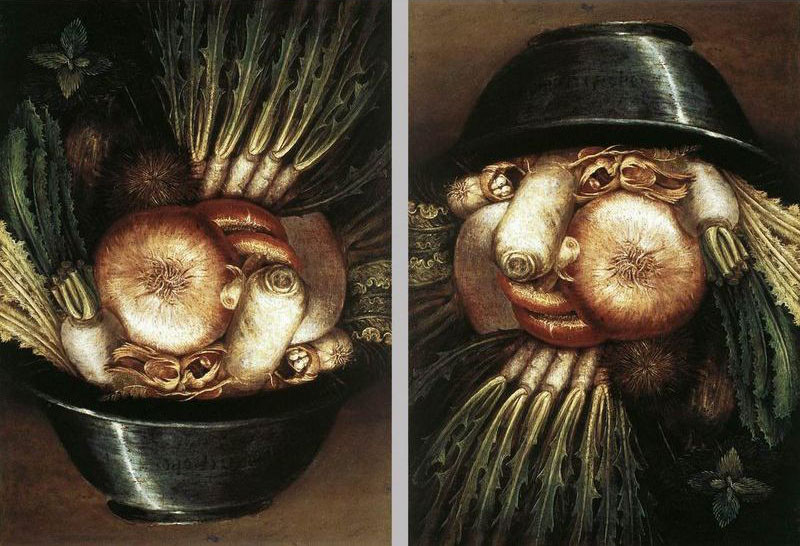
A few months ago I wrote about two artists who played with the question of whether what they are depicting is anything more or less than words on a page or paint on a surface. Both George Herbert and Arcimboldo (and Andy Warhol, in his own way) make art of the question, What is art? Is it what it depicts, an idea about what it depicts, both at the same time (which makes it a third option), or something less than? Is art, by definition, always a misfire, in that a depiction of a thing is not the thing and never can be?

Arcimboldo painted portraits of character types rather than individuals; for instance, a librarian composed entirely of books or a gardener made of vegetables in a bowl. That latter painting depends on the viewer to decide to see the bowl filled with veggies or a human “face.”

When is a face a face and when is it a bowl of root vegetables? When is a painting a painting and something greater than a collection of chemicals on canvas?

Vegetables In A Bowl, Or, The Gardener

George Herbert wrote poems about the only idea that he deemed to be worth considering: The eternal love of his Christian God and man’s time-and-space-and-language-constrained attempt to return that love. Two of his poems are written in the shape of what they are about. Like Arcimboldo painting a root vegetable for a nose, Herbert uses words to build an item; in one, “The Altar,” each word is a “stone” making up the altar that the poem is conceived as being:

A broken ALTAR, Lord, thy servant rears,
Made of a heart and cemented with tears;
Whose parts are as thy hand did frame;
No workman’s tool hath touch’d the same.
A HEART alone
Is such a stone,
As nothing but
Thy pow’r doth cut.
Wherefore each part
Of my hard heart
Meets in this frame
To praise thy name.
That if I chance to hold my peace,
These stones to praise thee may not cease.
Oh, let thy blessed SACRIFICE be mine,
And sanctify this ALTAR to be thine.

One word, a single syllable, too many or one word mislaid or deleted, and there is no altar there. It is an altar made of words but no less central to the life of a church than an altar made of stone. The poem appears in the only book of poems that he compiled himself, a book titled “The Temple,” which walks the reader, a “dejected poor soul,” through a church. Thus, his altar, “The Altar,” is central in the book. (At Herbert’s request, the book was published posthumously, with his stated desire that it might bring “consolation of [to] any dejected poor soul.”)

It is probably an untranslatable poem, in fact if not sentiment. (Indeed, an admittedly brief survey has not yielded one.) The shape of the poem is dictated by the number of syllables in his choice of words; it is a translation of an object, a real thing, into words anyway, and as such is forever a failure. It is a “broken altar.” The human heart is the only perfect, unbroken, stone for worship, is the only true altar. All that his mind can make is something out of these pieces of meaning, words, and if he can get out of his own way (“if I chance to hold my peace”), these words as assembled here only exist to worship and love. They are what they are, words, and the words each on their own are not an altar, and a spoken version of this poem is not an altar, either. When is an altar an altar? At what point is a poem something other than, more than, words on a page?

However well-constructed it may be—it looks like an altar, for crying out loud—it does not matter. It is no altar. Not even a photorealistic painting of an altar would be an altar. Further, no altar is truly an ALTAR, as no earthly object is made of the only stone of faith that exists: the human heart “cut” by God.

Herbert’s faith was that of a man for whom questions about faith were a part of it. His worship and his poetry exist in a space of failure, where a poem of an altar is not an altar but is a sort of altar, an attempt at one. His poetry depicts a figure who is struggling in every way to comprehend and return eternal love and who is met every time by a figure who replies that it is all a bit easier than he is making it. But all I have is language, Herbert’s speakers proclaim: “We say amiss / This or that is: / Thy word is all, if we could spell.”—”The Flower.”

Herbert often describes the moment when the perceiving of love comes easily, and it is always sensuous, often reads as if it is written to a new love:

Who would have thought my shriveled heart
Could have recovered greenness? It was gone
Quite underground; as flowers depart
To see their mother-root, when they have blown
—”The Flower”

But Herbert’s worshipper is always doubting himself, his faith, whether his faith is correct or not. In “Love (iii),” Herbert’s speaker is an unworthy guest in God’s (Love’s) home, but his host is gently persistent:

Love bade me welcome: yet my soul drew back.
Guiltie of dust and sinne.
But quick-ey’d Love, observing me grow slack
From my first entrance in,
Drew nearer to me, sweetly questioning
If I lack’d anything.

A guest, I answer’d, worthy to be here:
Love said, You shall be he.
I the unkinde, ungrateful? Ah, my deare,
I cannot look on thee.
Love took my hand, and smiling did reply,
Who made the eyes but I?

Truth Lord, but I have marr’d them: let my shame
Go where it doth deserve.
And know you not, sayes Love, who bore the blame?
My deare, then I will serve.
You must sit down, sayes Love, and taste my meat:
So I did sit and eat.

So if poetry is always at best an approximation of True Love, why not try to sing this struggle, as well? The “cheerfully agnostic” (which pretty much describes me, as well) English composer Ralph Vaughan Williams created five songs out of four Herbert poems a little over a century ago. The suite is called “Five Mystical Songs,” and one, “Love Bade Me Welcome,” is a setting of “Love (iii).” Some churches use the last song, “Antiphon,” as a hymn sung by the congregation.

Here is Sir Thomas Allen performing the set (in two sections) with the BBC Symphony Orchestra:

____________________________________________
The WordPress Daily Prompt for December 16 asks, “You have to write a message to someone dear to you, telling that person how much he/she means to you. However—instead of words, you can only use 5-10 objects to convey your emotions. Which objects do you choose, and what do they mean?”

* * * *
Please subscribe to The Gad About Town on Facebook: http://www.facebook.com/thegadabouttown