A Reading for Ashraf Fayadh

At his retrial in November 2015, the court not only found him guilty a second time but decided to change his sentence from flogging to death by beheading. The poet Ashraf Fayadh, a stateless Palestinian born in Saudi Arabia, was arrested in January 2014 and charged with apostasy, with renouncing his religion. His poetry was put on trial. His life is at risk.

When a court appoints itself as a literary critic, both the judicial system it is a part of and literature are diminished.

Today, writers around the world are focusing attention on Ashraf Fayadh’s story: according to The Guardian, 122 events in 44 countries are being held in which Fayadh’s work will be read. It is being organized by the “International literature festival Berlin.”

Consider this column, with my recording down below, one more event.
Read More

A Moonless Night

At once sarcastic and tender, W.H. Auden’s “The More Loving One” asks us to imagine a night sky empty of stars:

Looking up at the stars, I know quite well
That, for all they care, I can go to hell,
But on earth indifference is the least
We have to dread from man or beast.

 
How should we like it were stars to burn
With a passion for us we could not return?
If equal affection cannot be,
Let the more loving one be me.

 
Admirer as I think I am
Of stars that do not give a damn,
I cannot, now I see them, say
I missed one terribly all day.

 
Were all stars to disappear or die,
I should learn to look at an empty sky
And feel its total dark sublime,
Though this might take me a little time.
— “The More Loving One,” W.H. Auden, 1957

I might very well like a starless sky and call it sublime or subtle in its black-on-black nuance, the poet declares, and not mourn the sight of a supernova, which is after all the explosive death of a star, and I may not notice the absence of one should it simply blink out, but in all matters, “If equal affection cannot be,/Let the more loving one be me.”

In all matters attracting my human attention, be it the night sky or my beloved’s face, let the more loving one be me.
Read More

Do I Dare?

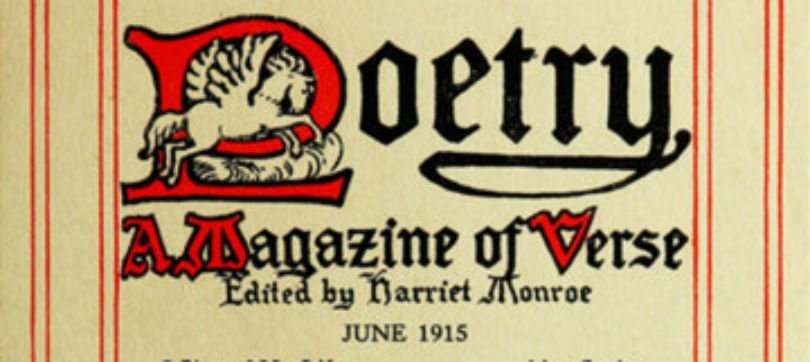
If you were a subscriber to Harriet Monroe’s monthly magazine Poetry in 1915, you received your June edition this week 100 years ago. It was an issue with 16 poems, one of which was “The Love Song of J. Alfred Prufrock” by T.S. Eliot. Eliot was 26, about to marry, wrote the poem in 1910, and put it in a desk drawer. He devoted himself to his graduate studies and then moved to England, where he met his fellow American, Ezra Pound.

Eliot showed Pound some of his poems, including “Prufrock.” Pound, whose skills at publicity sometimes outmatched his poetry (if he were alive today, he would be on Twitter ’round the clock, which is not necessarily something I write out of admiration), talked about a new young poet he had found at every opportunity.

Prufrock and “Prufrock” are 100 this week. The response to the poem in the 1910s was visceral; in the ongoing critical conversations “Where is literature now?” and “Where is literature headed?,” “Prufrock” revealed that 1915 was a moment in which both questions were the same for once. A critic in the Times Literary Supplement wrote a year later, “The fact that these things occurred to the mind of Mr Eliot is surely of the smallest importance to any one—even to himself. They certainly have no relation to ‘poetry.'” That is not a vote in favor. Pound’s positive reaction was no less effusive: “Prufrock” is “the best poem I have yet had or seen from an American.”
Read More