‘Today, I am two separate gorillas’
The Bonzo Dog Doo-Dah Band has received a great deal of attention in recent years. Even its Wikipedia entry has grown from a stub to a forty-paragraph historical disquisition in a few short years, which surely must be a sign of something, with fourteen footnotes, two sources, and five “for further readings.” (Thank you very much, Mr. and/or Mrs. Whoever Did That.)
If you are a fan of the Bonzos, nothing I may write here will do more than remind you of something you also like. If you are not (yet), nothing that I write may convince you that you have a bright future ahead of you discovering the works of these music-comic dolt-geniuses, so here is an intro anyway (“Adolf Hitler on vibes”):
For a group that was somewhat pop, mostly tongue-in-cheek, unforgettable on stage, and almost-not-quite-but-why-couldn’t-just-one-more-person-have-bought-our-record a one-hit wonder, forty paragraphs is a lot. So perhaps I am not alone in my fandom. One of the pleasant surprises in writing this website has been the number of hits that a post I wrote about Bonzo founder Vivian Stanshall has received (in triple digits since March).
The Bonzos served as a bridge, a missing link (if you were looking for one) between The Beatles and the Monty Python group. In late 1967, the Bonzos appeared in both “Magical Mystery Tour” (partially entertaining the Beatles—John Lennon heckles them—with a performance of their song “Death Cab for Cutie”) and in the pre-Python but mostly Python-staffed afternoon television show, “Do Not Adjust Your Set.”
Here, from “Do Not Adjust Your Set,” a pre-Python Michael Palin introduces the Bonzos and Stanshall does his best worst Elvis in “Death Cab for Cutie.”
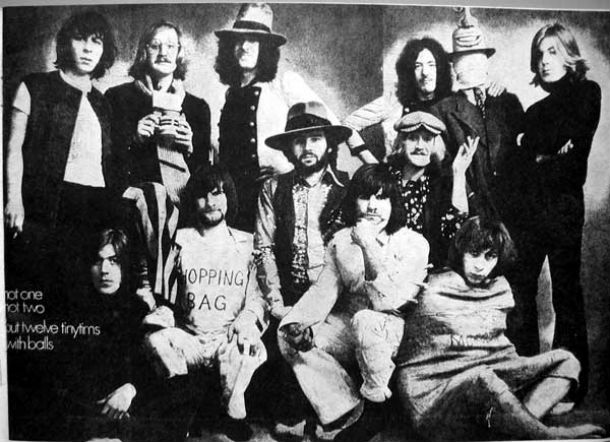
In most of their performances, Stanshall was the lead singer, focus of attention, easily distracted emcee, and camera hog whenever one was present. The basic Bonzo line-up was Neil Innes, Rodney Slater, Sam Spoons, Roger Ruskin Spear, Vernon Dudley Bohay-Nowell, “Legs” Larry Smith, and Bob Kerr. At times, the group was down to three members (when an album was required to meet a contractual obligation) and at others, more than a dozen musicians and affiliated acts might be occupying the stage.
As head song composers, Stanshall was paired up with Neil Innes, but according to Innes, “Death Cab for Cutie” was the only true collaboration between the two heads of the head-less Bonzos, because it was the only time he and Stanshall were actually in the same room while writing. Stanshall wrote wordplay-heavy songs with lines that were saturated in nonsense, and Innes was (and is) a songwriter whose Beatles-esque tunes led not only to to the Bonzos being produced by Paul McCartney (the minor hit “I’m the Urban Spaceman,” which qualified the group as an almost one-hit wonder) but also to a Beatles lawsuit in the 1970s when music he wrote for his parody group, the Rutles, was found to be too reminiscent for comfort. Several Innes songs for the Rutles now list Lennon-McCartney as co-composers. Further cementing the Beatles-Python link occupied by the Bonzos, “The Rutles” was an Eric Idle project with Innes.
Their collaboration “Mr. Apollo” combines an almost-too-catchy Innes tune with Stanshall’s absurd and long fake sales pitch for an exercise gimmick: “Five years ago, I was a four-stone apology. Today, I am two separate gorillas. No tiresome exercises. No tricks. No unpleasant bending.” The song also features a fuzzy heavy metal guitar solo, even though it dates from the era about six months before anyone had heard heavy metal guitar solos.
And here is the also too-catchy “I’m the Urban Spaceman,” which Paul McCartney produced under the pseudonym, Apollo C. Vermouth, because he was simply having too good a month in November 1968 to take credit for everything:
It is completely an Innes song, so Stanshall is relegated to court jester in performance; also, you can see how much the group dis-enjoyed lip-singing.
The Bonzos got their start in a pub in the early 1960s, when several similarly aged young men (20-somethings) hanging out there found they had similar interests, especially in kitschy old 1930s records, and started to informally perform together. Slater recounts Stanshall bringing in one such record and declaring, “Look at this! I bought it for a penny but it’s worth twice that!”
Their early performances were live and faithful renditions of the pop not-so standards that they heard on the records. But other acts were also performing live and faithful renditions of obscure 1930s records, too, so the Bonzos, many of them art students entranced by Dada, started to create their own Dadaist sound and look. The group was an act without a point that loved being an act and having no point except being an act.
By 1970, the job of jester in the court of pop music or musician in the court of comedy no longer needed to be filled. The Bonzos disbanded, sort of. Reunion line-ups performed through the 1970s and still come together. The group’s set lineup varied in name and number so whimsically anyway that it could be said that its members simply wandered away. Innes went on, as written above, to a long and varied career continuing to bridge a gap between comedy and pop music. Most of the surviving members are jazz musicians who will always be remembered as Bonzos.
The group celebrated its fortieth anniversary in 2006 with a live show that featured special guests like Stephen Fry. What it was the fortieth anniversary of was up for discussion, but 1966 was the year the group came to the attention of the larger British public, as it landed its first major label record deal and appeared on television for the first time.
And Vivian Stanshall. He died almost twenty years ago, in March 1995, because he used to smoke cigarettes and drink brandy in bed and those two things do not mix well with nodding off. He is one of those artists about whom one marvels at his inventiveness, at the waterfall of words most of his work produced, and still feels that his career was somehow smaller than it was meant to be. I certainly disagree. (I am sure his non-ghost is not thanking me, anywhere.) He left the world wanting more of him, which is what performers are always told to do.
Here is a BBC documentary about Vivian Stanshall from 2004, “The Canyons of His Mind“:
____________________________________________
The WordPress Daily Prompt for December 15 asks, “We all have our semi-secret, less-known personal favorites—a great B-side, an early work by an artist that later became famous, an obscure (but delicious) family recipe. Share one of your unsung heroes with us—how did you discover it? Why has it stayed off everyone’s radar?”
* * * *
Please subscribe to The Gad About Town on Facebook: http://www.facebook.com/thegadabouttown
 The Gad About Town