‘Two of One Kind’


This is the story that moved me the most today. Clara Gantt of Los Angeles, 94 years old, accepted the remains of her husband on Friday at Los Angeles International Airport, a short time after learning that he had in fact died in 1951 as a prisoner of war in North Korea. That country has slowly, so slowly, begun to release information about and even the mortal remains of battlefield dead and dead POWs to its sworn enemy, the United States.

Mrs. Gantt’s final contact from her husband was a Christmastime letter sent from the front at the end of 1950. Shortly after, historians now know, he was taken prisoner on the battlefield and died in Korean custody. They had only been married for two years, or 65, depending on whether one asks Mrs. Gantt.

Her dedication to the memory of her late husband was such that she refused to consider him her late husband until this year, when she learned that the government had received remains from North Korea and positively identified them as Sgt. Joseph Gantt. She told reporters that even when she was able to purchase a house for herself in the 1960s, she also hired a gardener to tend it, since she knew he did not like yard work and she wanted him feel free to do whatever he liked when he returned home from the war.

From the Los Angeles Times story: “During the last 63 years, no one else caught Clara Gantt’s fancy as she waited for news of her husband. She told the base officials assigned to check wives’ homes for other men to come by anytime, (as) they’d never catch her with anyone.

“‘I am very, very proud of him. He was a wonderful husband, an understanding man,’ she told reporters at the airport. ‘I always did love my husband, we was two of one kind, we loved each other. And that made our marriage complete.'”

Widow, 94, Receives Remains of Fallen Husband

I learned about that kind of enduring love from my grandparents. Eighteen years ago this month, William Aldrich died, aged 91. Bill and Edith (Pearson) Aldrich were married for 64 years. I asked my grandmother if she could recall how they met. “How did we meet? I don’t think I remember,” she said and looked at her sister-in-law, my great-aunt June, and repeated my question.”What did we do?” she asked. June brightened, “We danced.”

“I guess we danced,” my grandmother nodded and looked at me. The two of them held hands and repeated, “We danced.”

Edith Aldrich had a gift that the widow in Los Angeles did not receive: She saw her husband every day for 64 years. But both love stories are priceless.

As they grew old and then older, my grandparent’s life became that “complete” marriage. In their small Vermont hill town, the mail was delivered twice a day to the country store. My grandfather would march down the hill, cross highway 100 and the bridge over the West River, collect the mail and return. Her eyes would follow him every step.

By age 85, he was living with Alzheimer’s and her watchful care included hiding the car keys and having my uncle (and once, me) conceal the lawnmower behind the barn, lest he act on his foggy desire to fix something, anything, and hurt himself. (When I last saw him, age 89, he was still able to bend at the waist and pluck his hated dandelions out of the ground from a standing position, so he remained physically strong till the end.)

My grandmother outlived her beloved Bill by almost 14 years, dying in June 2009 at age 98. One day, years into her widowhood, she and I went for a walk on her road, the same road as the family cemetery, and she mentioned him.

“I miss your grandfather every day,” she told me, as if this was something she had been thinking about. “I’m not interested in joining him just yet, but I know he’s waiting for me.” 


Shooting Stars

Every 33 years, Comet 55P/Tempel-Tuttle makes its closest approach to the sun; it is one of a handful of comets that can be seen more than once in a person’s life. Tempel-Tuttle’s most recent visit to the inner solar system was in March 1998.

As each comet approaches the sun, the energy from our star burns off material from the comet, creating the famous bright appearance and cosmically long tail that we see with every comet (these phenomena are on display this week with the approach of Comet ISON). This material, mostly particles the size of grains of sand, is left behind in space. Every time Comet Tempel-Tuttle starts its disintegration, the process happens at around the distance of earth’s orbit, so a cloud of dust is left behind for us to crash through every year. This is the Leonid meteor shower. Every November 18 or so, we cross through a cloud of what had been the comet’s tail in some previous visit.

From ‘earthsky.org’

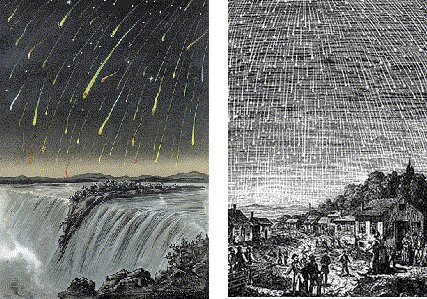
Even better, every third visit or so, Comet Tempel-Tuttle intersects our orbit so closely to where the earth actually is at the time that the cloud of debris is thick enough to make the Leonid meteor shower particularly spectacular. The woodcuts at right depict the 1833 Leonid meteor “storm,” which contemporaries reported produced 100,000 meteors per hour. The comet’s last visit, in 1998, was not one of those close-by visits, and we are now just about midway till our next encounter, so this year’s Leonids will produce maybe 10 to 15 shooting stars per hour, which is still 10 to 15 more per hour than one sees most nights.

This year, this weekend, there are other bright nighttime visitors–a full moon and the aforementioned Comet ISON, which is now bright enough to be seen without aid–but the Leonids are always my meteor shower. This is because November 18 is my birthday. If you see a shooting star this weekend, thanks for noticing something that is coming in third on most lists of things to look for in the night sky–my personal shooting stars.

* * * *

We did not own a telescope when I was a child and I do not remember if either my sister or I ever expressed an interest in possessing one, but my parents considered each occasional celestial phenomena the cause of a family outing. I remember this with great fondness now, which I think was something our mother would tell my sister and me when we were swaddled in the back of our station wagon, wondering why we were outside at this horrible hour just to look at the sky.

“You will remember nights like this,” Mom would say with a smile. “You won’t remember whether you got a full night’s sleep tonight years from now, but you’ll remember seeing” the Perseids or the Leonids or a lunar eclipse, sometimes partial, sometimes total. I think I remember the lunar eclipses particularly well because they are action-packed compared to patiently awaiting a shooting star, and because they end. There is no natural point of departing during a meteor shower, other than when the hot chocolate gets cold. (And then we would return home and I would discover while lying in bed that I already missed being outside in the cold, staring at the sky.)

Our parents did not send us to bed expecting to be awakened a few hours later to drive into the country, so each night-sky outing was its own event and seemed to be sprung on us as a new thing. They are not scientifically-inclined, either, so what we were looking at and for was always mysterious, beautiful, an unexpected gift.

My dad would drive the station wagon to whatever local high point away from the lights that he could find (hard to do in suburban Poughkeepsie). One of our local schools had a parking lot that sufficed, especially for the eclipses.

It was in adulthood that I discovered the appeal of wandering out into a field with a beloved and staring at the deep Ulster County country sky and keeping warm together while the hot chocolate went cold. Especially in November, “for my birthday.”

Last night, my current beloved–who I think will be my current beloved for a very long time–and I walked the Walkway Across the Hudson, which is open at night for every full moon. We looked at the sky, kept each other warm, and because I am not scientifically-inclined, everything was mysterious, beautiful, an unexpected gift.