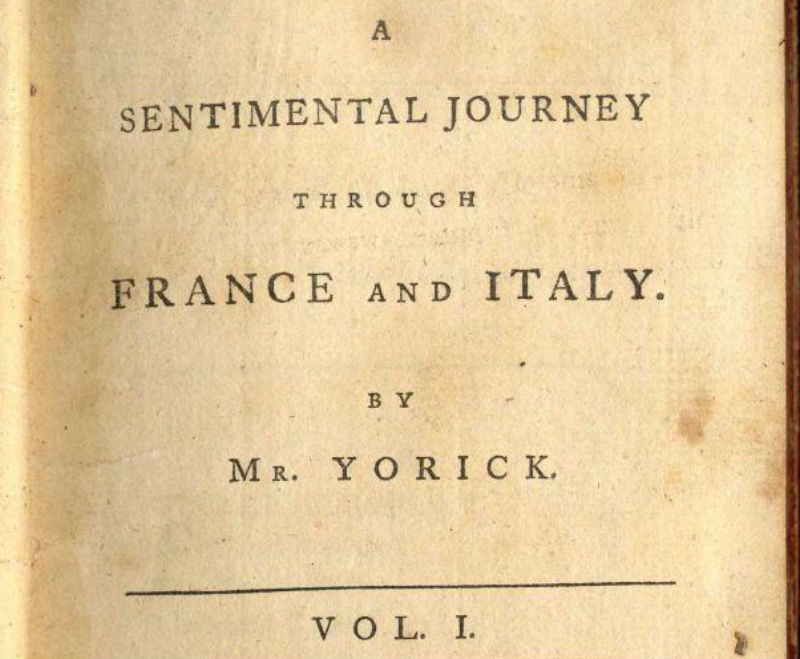
A Sentimental Journey Through …

Laurence Sterne was dying of consumption, the polite yet dramatic term that people used to employ for pulmonary diseases, especially tuberculosis. He had contracted it by 1740, when he was still in his 20s, and he fought for his every breath for his remaining three decades of life.

In 1765, he left England in search of better breathing, and he traveled abroad to France and Italy. He was a surprise best-selling author by this point, a clergyman who had decided on a whim to start telling the life story of a character but by not telling it in a straightforward manner, to comically digress his way through “The Life and Opinions of Tristram Shandy, Gentleman.” One of the earliest novels in English or any language, “Shandy” was an instant success when its first two volumes started appearing in 1759.

The genre we call “travel writing” was not as common in the 1760s as it is now, and most works in that genre at that time were quite unsentimental: verbal pictures of natural phenomena and wonders of the man-made world and warnings-slash-complaints about the foreignness of foreigners on their strange home turf. In his 1765 journey, Sterne encountered fellow novelist Tobias Smollett, and the stern, dry Smollett left such an impression on the always amused Sterne that in his book, “A Sentimental Journey Through France and Italy,” he based a character named “Smelfungus” on Smollett. Nice revenge.
Read More

The Story with a Twist, or, I’m a Frayed Knot

Every alcoholic in recovery has a collection of anecdotes that can be simultaneously heartbreaking, outrageous, and hilarious. Perhaps they are hilarious only to fellow alcoholics; perhaps they can not even be listened to by outsiders. For an outsider, most alcoholic anecdotes may as well conclude with the same punchline, an interchangeable rubber-stamped ending: “And then I got away with it again.” Or, “I didn’t die that time, either.” And then comes the next hair-raising—or eyebrow-raising—tale.

Every alcoholic in recovery is living a story with a twist ending, if they remain in recovery. It is that two-word pair there, “in recovery,” that provides the surprise, the twist, a period of life as surprising to behold as some of the antics, the many bizarre actions and activities and inactions and inactivities that were surprising for outsiders to watch unfold in the previous life.
Read More

Henry Beston’s Cape Cod in Winter

The photo above was taken at Nauset Beach on Cape Cod on a December afternoon in 2010; the white glaze covering the footprints is ice and snow, and the Atlantic has ice in it—some of the white caps were frozen, and the waves merely swelled them, shifted them.

Henry Beston wrote perhaps the best physical description of Cape Cod in the opening lines to his classic book “The Outermost House“: “East and ahead of the coast of North America, some thirty miles and more from the inner shores of Massachusetts, there stands in the open Atlantic the last fragment of an ancient and vanished land. For twenty miles this last and outer earth faces the ever hostile ocean in the form of a great eroded cliff of earth and clay, the undulations and levels of whose rim now stand a hundred, now a hundred and fifty feet above the tides. Worn by the breakers and the rains, and disintegrated by the wind, it still stands bold.” He depicts a heroic shoreline, a land that declares its own terms of surrender against a hostile, battering sea. Given that from the air Cape Cod resembles a single raised fist jutting into the sea, a heroic, Byronesque, cliff face is only appropriate.
Read More