Just (Don’t Over)do It

One of Oscar Wilde’s pithiest quips (or one of his quippier piths) is, “Everything in moderation, including moderation.” Lampooning his prudish-seeming Victorian contemporaries, he was suggesting we should show some restraint in the not enjoying of this sensual world. We should refrain from overdoing our lack of enjoying pleasure.

Some time ago, I wrote to Wilde, but he did not reply as he died 68 years before my birth. I wrote, “Everything in moderation, except moderation.” His ongoing silence about this speaks volumes.

What about those who do not take too much pleasure in the world? What of the underrepresented excessively self-repressed? Aside from the fact that they probably do not want too much—or any!—attention and thus representation given to them, what can we do for the successfully overly moderate among us?

Those who magnificently overdo their lack of excesses are the non-heroes we can lovingly ignore, um, adore, for our current era of superheroes and superstars.

Every fifth movie or television show seems to be about an average human being discovering quite by accident that they possess previously unknown super powers, whether strength, speed, invisibility, divisibility. They find they have super senses, which they employ to solve crimes (if they had super senses all along, how did they not detect that they had super senses?), which seem to be committed by others who have also discovered that they have super abilities but want to rule the world as a result. (None of these works of fiction seem to depict anyone discovering previously unknown super-capacities for human compassion, but most Christians would say that there was only one such figure, and He was sufficient.)

The cultural desire for superheroes reflects a cultural infantilism, a desire for super-parents in a world that we tell each other—in the news and other movies—is a darn scary place. Many of our original fictional superheroes were created in a similarly scary world, during the Second World War. We felt that we needed rescuing, we desired a rescuer, so we created a spectacular hero in our comic books, novels, movies. The hero represents what we discover we had inside us all along: strength to face any foe, bear any burden. (But “pay any price,” to finish JFK’s quote? Not so much. Maybe a few bucks for a ticket and some popcorn.)

We live in a similarly scary world, so we are seeing a lot of superheroes in our cultural fantasy life once again.

However, not a one is super-moderate in his lack of vices. “Super Moderate Man.” Our movie makers could depict him displaying restraint of tongue and pen and keyboard when confronting things with which he disagrees. He is no teetotaler, but knows his limitations and thus never consumes. (Myself, I am a teetotaler, because I do not know my limitations.) If he stays up late fighting villainy one night, they could show him getting to bed early the next night. He rarely swears, so when he does it makes a point. He “stops and smells the roses,” but not every darn time, because sometimes he has places to go. The movie makers could write a dramatic scene in which he heroically fills out product warranty cards … and pays his taxes. He never lectures or wags his finger and he takes the time to show others how to make a fine pot of coffee. Some complain that the coffee is too strong, and some say it is too weak.

“Super Moderate Man” does not wear a cape, because really, who wears a cape? There is not one rack of capes to be found in any mall anywhere. (He shops in malls.) If he possesses a cloak of invisibility, it is only there to mask any evidence of a sense of style.

Super Moderate Man: A hero some of the time for most people, but it is okay if he is not.

____________________________________________
The WordPress Daily Prompt for September 27 asks, “‘Perhaps too much of everything is as bad as too little.’—Edna Ferber. Do you agree with this statement on excess?”

Daily Prompt: Unasked Questions

“AMA” no longer stands for the “American Medical Association” or “Ameliorating My Attitude.” (Never heard of that one? Neither have I. It doesn’t exist.) In our Twitterverse and Redditworld, AMA is now the acronym for “Ask Me Anything.”

And we can. Even Pope Francis (yes, THAT pope) has a Twitter account, @Pontifex, as does the Dalai Lama, other religious figures, and every politician. Or at least their offices have Twitter accounts. Here is a recent papal Tweet:

The sentiment may be true enough, but what stands out is that the pope gets a lot more retweets than I do. This is irking, as I have been on Twitter (@MarkSAldrich) for far longer.

For the last few years, public figures from the president to famous actors have scheduled AMA sessions on Reddit, on Facebook, and on Twitter, the start of which is usually announced with a photo of the famous person holding a handwritten sign stating “Ask Me Anything” and the day’s date. The “holding a sign” part often makes the famous person look a bit like a hostage. Like poor Bill Gates (well, those three words do not often appear in that particular sequence!) here:

reddit-600x303

In the old days of any time before now, if one wanted to ask a famous person a question, one had two available methods: A. Study and work very hard and become famous oneself and learn to befriend other famous people, one of whom is the person you always wanted to ask something, anything. Sidle up to that famous person and say something like, “You know, I have always wanted to ask you something. In fact, I worked and studied very hard to become famous myself and I became famous and I became friends with you just so I could ask you something. And now I do not remember what it was. What an amazing short story this would make! More caviar?” B. Write them a letter, purchase a stamp, place the letter in an envelope and the stamp outside the envelope, mail it and hope to receive a reply.

Somewhere, my mother has a scrapbook filled with autographed photos of Hollywood celebrities of the 1950s; in some rare cases the movie star hand-wrote a note of thanks. I do not believe she “asked them anything” personal, so she did not receive any news making replies. (Luckily, she did not have this mailman working in her neighborhood: “Brooklyn Postal Worker Arrested for Not Delivering a Decade’s Worth of Mail.“)

Part of the appeal to the contemporary social media “ask me anything” sessions, and to the fact that many famous actors and writers and some famous politicians personally work on their Twitter/Facebook accounts and reply to us everyday sorts, is to be impertinent to them. Call it the “BaBaBooey Effect.” This is the opposite to the “Access Is Everything” attitude which we sometimes see in the press, the “‘Meet the Press’ Effect,” in which reporters whose employment depends on continued access to important people do not ask difficult, impertinent, questions, questions that might make the important person cut off future access. People who are not reporters might shout a verbal graffito (“Bababooey”) and make some noise, become a part of the story. They are easily ignored, but so are the Sunday morning talk shows, on which news is rarely found or broken.

Instead, news is more often broken when a reporter who knows that he or she will lose access to a famous news maker if they in fact ask them anything, goes ahead and asks that one question. Or when, as with shows like “60 Minutes,” the show reports on some shady business whose practices are worth exposing by sending a national reporter who will not face backballing in his or her own neighborhood because he or she exposed a neighbor’s shady business practices, like a local reporter would.

Early in my brief local newspaper reporting career, I actually heard this from the sidewalk below my second-floor apartment: “We can’t talk here. I see the light on in that hack’s room.” That felt like a huge compliment coming as it did from someone I was publicly writing about. “I’m a hack! I’ve made it.” Then I thought, “How does he know where I live?”

It was a criminal matter I was writing about, after all. But given one question to ask one person, I might go back in time to that night and yell out my window, “How do you know where I live?”

____________________________________________
The WordPress Daily Prompt for September 26 tells us, “You’ve been given the opportunity to send one message to one person you wouldn’t normally have access to (for example: the President. Kim Kardashian. A coffee grower in Ethiopia). Who’s the person you choose, and what’s the message?”

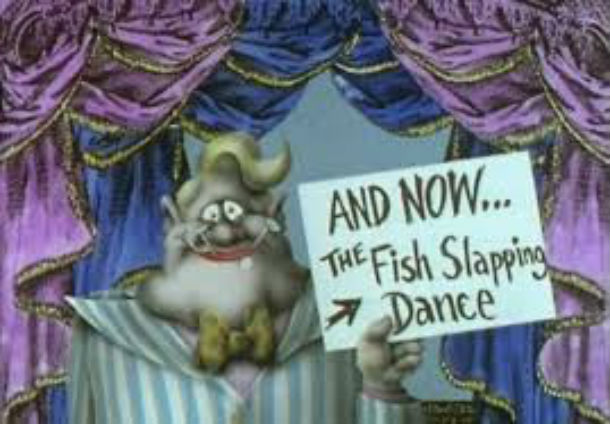
The Fish-Slapping Dance

“If you had to come up with one question, the answer to which would determine whether or not you could be friends with a person you’ve just met, what would it be? What would the right answer be?”

“That’s a great question. Oddly comprehensive, yet a little intrusive at the same time.”

“I agree, but my usual ice breaker question is to ask people that I have just met what their ice breaker question is. So, what is it?”

“Did you want more coffee?”

“That’s your question?”

“No. Your cup is empty. Free refills, hon’.”

* * * *
The speed with which one can determine the depth or length of a friendship—somewhere between forever and not at all—is inequal to the facts of a friendship. How many reminiscence-conversations have you had with friends in which you have learned that either your memory of meeting a friend is faulty or that the friend did not like you on first encounter? I have had both types.

I hinted in a recent column, okay, I explicitly stated in a recent column that if you find the “Fish-Slapping Dance” funny, you and I will more than likely be friends for life.

It may be the Monty Python troupe’s quickest route to the biggest laugh. I wrote, “If you do not find the ‘Fish-Slapping Dance’ funny, it may be because you find the waste of intellectual effort offensive. Or perhaps fish jokes generally turn you right off. ‘How is this funny?’ becomes the same question as ‘Why is this funny?’ ‘Why is T H I S on my screen?’ The ‘Fish-Slapping Dance’ actually can be seen as a depiction of the ‘How is this funny?’ conversation. Michael Palin, the ‘little fishes,’ dances the question, and then John Cleese, the ‘big fish,’ delivers the only possible retort: ‘It is or it is not.’ Splash.”

I can over-intellectualize and explain how the bit does not work, but every attempt I make falters the moment Michael Palin hits the water, when I laugh, sometimes quietly and sometimes out loud, every time.

I knew approximately two things when I wrote this a couple of months ago: that my girlfriend, the closest friend I have, probably does not know much if any Monty Python material and that I do not know if we share a sense of humor, even though she and I laugh a lot at many of the same things and same comics. For instance, her response after listening to some recordings of my radio show was to say that it was nice hearing my voice and that I sounded like I was enjoying myself. It is a comedy show.

Thus, I was rather nervous when I posted the Monty Python video above, several weeks ago, as she might very well read what I wrote, view the classic bit of comedy, and then instant message a break-up with me. I did not know what I did not know, but I was going to learn sooner or later. Are we companions for life, based on one sixteen-second joke?

“I’ve been sitting in my office, laughing at that.” she wrote me that night. Thus, my belief that the Monty Python “Fish-Slapping Dance” is the litmus test of comedy, a proof of companionability, was sustained.

Kindergartners may have the most effective conversations for establishing a friendship: favorite color, up versus down, best food. Matters of eternal importance like those. I try to remember this and always keep track of what is important to me, just in case someone wants to know on the spot: Green, the number 4, the letter N, the word Yes.

__________________________________
The WordPress Daily Prompt for September 23 asks, “If you had to come up with one question, the answer to which would determine whether or not you could be friends with a person you’ve just met, what would it be? What would the right answer be?