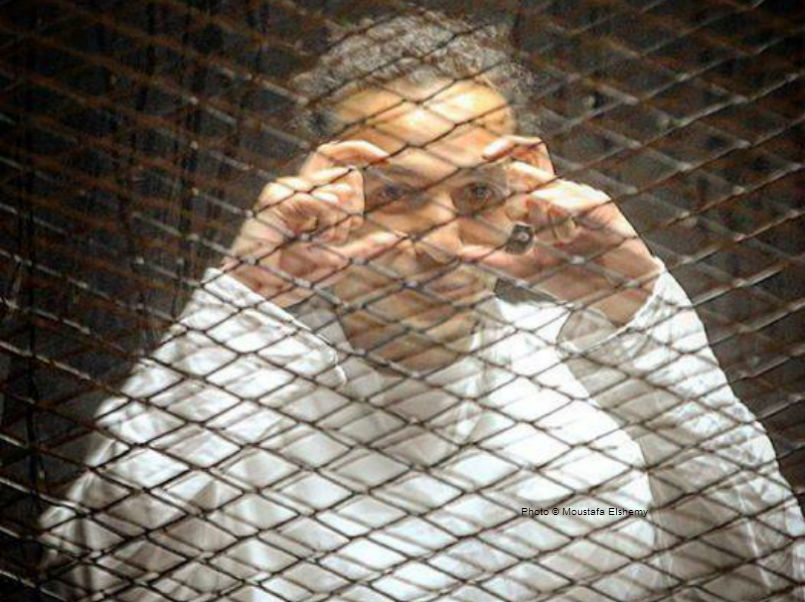
Shawkan’s Journey Through Injustice

The delays are growing shorter. The latest delay in photographer Mahmoud Abu Zeid’s journey through Egypt’s justice system was announced today: four days. The start of his trial has once again been re-scheduled, this time from today to May 21. This is the sixth delay since the end of 2015.

Egypt has been much in the news lately, so a delay in one case of injustice may not attract the attention it deserves. It was confirmed today that U.S. Secretary of State John Kerry will be in Cairo tomorrow for talks with Egypt’s president, Abdel Fattah el-Sisi. It also comes after two courts sentenced 152 people to between two and five years in prison on Sunday for participating in peaceful protests last month. They were not convicted of vague charges like “inciting violence,” though that was in the mix; they were all found guilty of protesting, something that has been illegal in Egypt since 2013.

That news has taken much of the attention away from the story of one photographer, Mahmoud Abu Zeid, known professionally as Shawkan. But it may predict some possible outcomes for Shawkan, none of them happy. President al-Sisi’s government is willing to find people guilty of peaceful protest, and it now has the apparatus in place to handle large numbers of defendants, which is what a government confronts its justice system with when it makes mass arrests at protests a standard practice, a policy. Both circumstances will come to bear on Shawkan’s story and it may be why this latest delay is for only four days.

Shawkan was arrested more than 1000 days ago while covering a protest that was not peaceful, that was a part of the vast demonstrations that one could say were a part of the ongoing Arab Spring movement. He is one of more than 700 co-defendants awaiting the start of his trial.
Read More

‘Secularism is the Solution’: My articles about Raif Badawi

This is an up-to-date list of the articles and columns I have written concerning Raif Badawi. Each one was first published here, in The Gad About Town website; several were subsequently linked to and quoted in other media outlets, including the Raif Badawi Foundation’s website itself. (I am not an impartial reporter, so it was an honor to see my work there.)

The ongoing diplomatic silence regarding Raif Badawi is perplexing in the face of the global outcry. Last November, Yves Rossier, Switzerland’s Secretary of Foreign Affairs, told a Swiss newspaper, La Liberté, that Raif Badawi’s sentence has been suspended.
Read More

Not Abandoned: #FreeShawkan

August 14, 2013, was 994 days ago. On that date, Mahmoud Abu Zeid was arrested in Egypt. He is a photojournalist who was arrested while being a photographer. Four times since December of last year, his first court hearing has been postponed; the next attempt at a hearing will come on May 10.

Under Egyptian law, there is a two-year cap on pre-trial detention; 994 days is longer than two years.

You may very well have seen some of his work in recent years, as his photographs have appeared in Time magazine, in periodicals throughout Europe, and they have been distributed by Corbis, a major syndicate. (One photo is reprinted below the fold.) Mahmoud, who publishes under the name “Shawkan,” photographed everyday life in Egypt as well as breaking news stories like the protests in Tahrir Square and the trial of former president Hosni Mubarak.

Today is World Press Freedom Day, an annual commemoration established by the United Nations in December 1993. It celebrates the vital importance of a free press around the world, of the importance of the freedom of expression. What I write here is not important, but the fact that I can hit the “Publish” button in a few moments and send this into the world, that fact is.
Read More