July 28: Speak Out for Ashraf Fayadh

In February, a court in Abha, Saudi Arabia, announced that it had retracted its November 2015 death sentence for the poet Ashraf Fayadh and exchanged it for a sentence of eight years in prison and 800 lashes with a cane. He must also make a public statement of repentance.

This new sentence switched his conviction from one of apostasy, or renouncing his religion, to one of blasphemy, insulting that religion and its leaders.

On Thursday, July 28, artists and activists around the world will speak out on behalf of Ashraf Fayadh by creating art, writing essays, joining a Tweetstorm, recording podcasts, and many other ways of showing support in a “Day of Creativity.” The website “Arabic Literature (in English)” published a list of ten suggestions in a recent post: “Make Noise & Beauty on July 28, a Day of Creativity for Ashraf Fayadh.” If you participate, please use the hashtag #FreeAshraf. Everything that follows below is my small contribution.

The Operating System, a small press, will be publishing a volume of Fayadh’s poems entitled Instructions Within, translated by Mona Kareem.
Read More
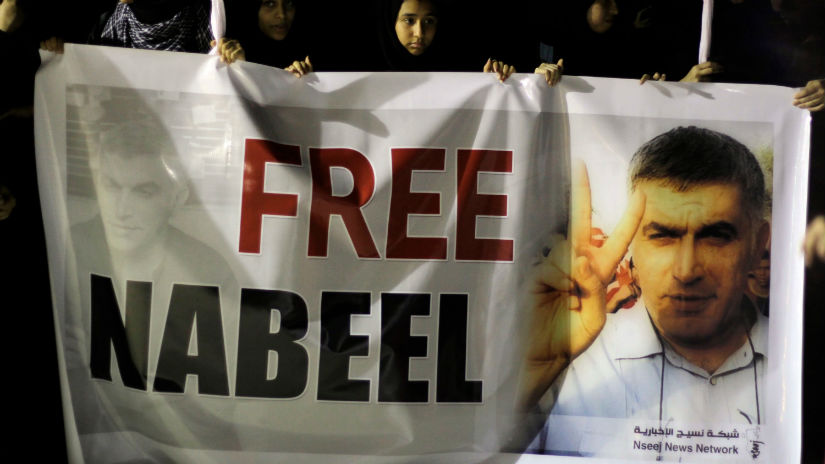
On Trial for Tweets: Rajab’s Trial Postponed

Since he was arrested on June 13, Nabeel Rajab, the president of the Bahrain Center for Human Rights, has been kept in solitary detention in conditions so squalid that outside observers have verified the “toilet and shower are unclean, unhygienic, and filled with potentially disease-carrying sludge.” His trial for comments he posted online was scheduled to start today, July 12, but at the hearing the judge postponed the start until August 2.

A request from his lawyers to release him pending the start of the trial was rejected. Rajab remains in pretrial custody.

After two weeks in these conditions, Rajab was brought to a hospital in Bahrain with an irregular heartbeat. Blood tests proved that he also has a urinary tract infection and “low mononucleosis,” but he is not receiving medicine for these ailments.

Although he is being kept in solitary confinement, his right to privacy is regularly trampled: any visits from family or his lawyers are attended by Rajab, his family members or lawyers, and two police officers, who sit with Rajab and his visitors.
Read More

Brave in the Face of Indifference

Bravery is a skill. I do not know if I have cultivated it in myself. Bravery is, of course, not what one does in the absence of fear but what one can do—what one actually does—when fear is present.

[A comment: Today is December 21, 2016. I wrote the first draft of this column almost a year ago. Sadly, the only update to offer today is this one: All the parties described below are, simply, even more brave than they were several months ago. Ali remains in prison. His father posts updates each week and sometimes more frequently on social media. We learned this summer that he earned a university degree while in prison. Dawood al-Marhoon and Abed allahhassan al-Zaher also remain in prison. Raif Badawi remains in prison. He is starting to learn of the global movement that has grown around the fight to free him. Back to the column from October 2015:]
Read More